

problems of cultivating these soils are cracking and difficulty
in serving (Ben Mahmoud 2013). Table 4.15 shows its Great
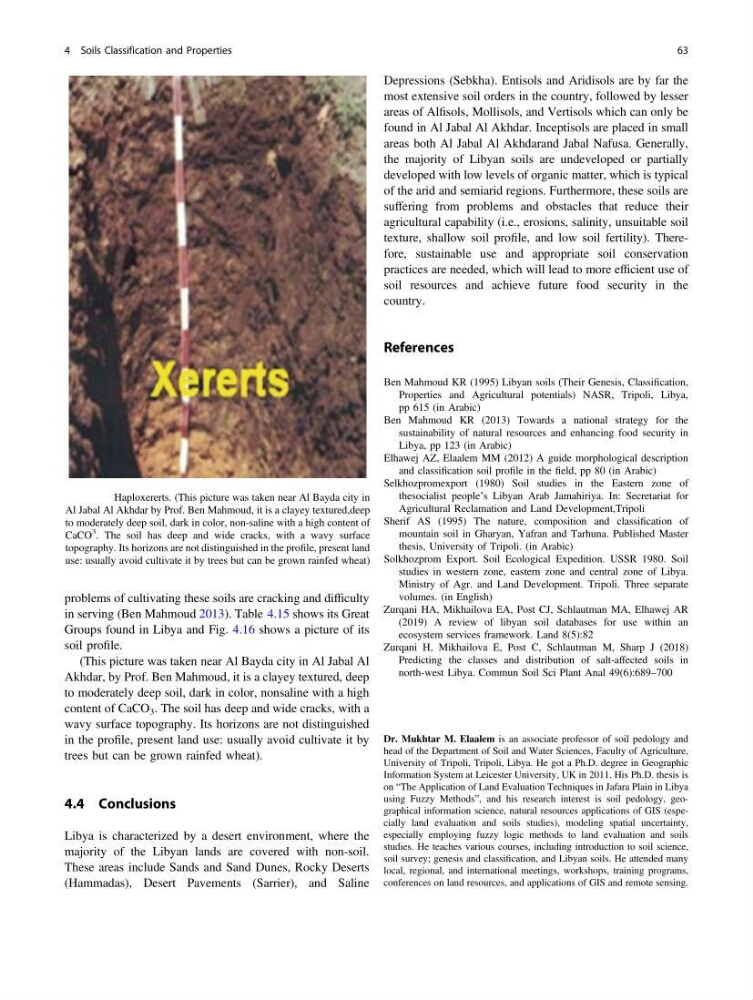
Groups found in Libya and Fig. 4.16 shows a picture of its
soil profile.
(This picture was taken near Al Bayda city in Al Jabal Al
Akhdar, by Prof. Ben Mahmoud, it is a clayey textured, deep
to moderately deep soil, dark in color, nonsaline with a high
content of CaCO 3 . The soil has deep and wide cracks, with a
wavy surface topography. Its horizons are not distinguished
in the profile, present land use: usually avoid cultivate it by
trees but can be grown rainfed wheat).
4.4 Conclusions
Libya is characterized by a desert environment, where the
majority of the Libyan lands are covered with non-soil.
These areas include Sands and Sand Dunes, Rocky Deserts
(Hammadas), Desert Pavements (Sarrier), and Saline
Depressions (Sebkha). Entisols and Aridisols are by far the
most extensive soil orders in the country, followed by lesser
areas of Alfisols, Mollisols, and Vertisols which can only be
found in Al Jabal Al Akhdar. Inceptisols are placed in small
areas both Al Jabal Al Akhdarand Jabal Nafusa. Generally,
the majority of Libyan soils are undeveloped or partially
developed with low levels of organic matter, which is typical
of the arid and semiarid regions. Furthermore, these soils are
suffering from problems and obstacles that reduce their
agricultural capability (i.e., erosions, salinity, unsuitable soil
texture, shallow soil profile, and low soil fertility). Therefore, sustainable use and appropriate soil conservation
practices are needed, which will lead to more efficient use of
soil resources and achieve future food security in the
country.
References
Ben Mahmoud KR (1995) Libyan soils (Their Genesis, Classification,
Properties and Agricultural potentials) NASR, Tripoli, Libya,
pp 615 (in Arabic)
Ben Mahmoud KR (2013) Towards a national strategy for the
sustainability of natural resources and enhancing food security in
Libya, pp 123 (in Arabic)
Elhawej AZ, Elaalem MM (2012) A guide morphological description
and classification soil profile in the field, pp 80 (in Arabic)
Selkhozpromexport (1980) Soil studies in the Eastern zone of
thesocialist people’s Libyan Arab Jamahiriya. In: Secretariat for
Agricultural Reclamation and Land Development,Tripoli
Sherif AS (1995) The nature, composition and classification of
mountain soil in Gharyan, Yafran and Tarhuna. Published Master
thesis, University of Tripoli. (in Arabic)
Solkhozprom Export. Soil Ecological Expedition. USSR 1980. Soil
studies in western zone, eastern zone and central zone of Libya.
Ministry of Agr. and Land Development. Tripoli. Three separate
volumes. (in English)
Zurqani HA, Mikhailova EA, Post CJ, Schlautman MA, Elhawej AR
(2019) A review of libyan soil databases for use within an
ecosystem services framework. Land 8(5):82
Zurqani H, Mikhailova E, Post C, Schlautman M, Sharp J (2018)
Predicting the classes and distribution of salt-affected soils in
north-west Libya. Commun Soil Sci Plant Anal 49(6):689–700
Dr. Mukhtar M. Elaalem is an associate professor of soil pedology and
head of the Department of Soil and Water Sciences, Faculty of Agriculture,
University of Tripoli, Tripoli, Libya. He got a Ph.D. degree in Geographic
Information System at Leicester University, UK in 2011. His Ph.D. thesis is
on “The Application of Land Evaluation Techniques in Jafara Plain in Libya
using Fuzzy Methods”, and his research interest is soil pedology, geographical information science, natural resources applications of GIS (especially land evaluation and soils studies), modeling spatial uncertainty,
especially employing fuzzy logic methods to land evaluation and soils
studies. He teaches various courses, including introduction to soil science,
soil survey; genesis and classification, and Libyan soils. He attended many
local, regional, and international meetings, workshops, training programs,
conferences on land resources, and applications of GIS and remote sensing.
Fig. 4.16 Haploxererts. (This picture was taken near Al Bayda city in
Al Jabal Al Akhdar by Prof. Ben Mahmoud, it is a clayey textured,deep
to moderately deep soil, dark in color, non-saline with a high content of
CaCO
3
. The soil has deep and wide cracks, with a wavy surface
topography. Its horizons are not distinguished in the profile, present land
use: usually avoid cultivate it by trees but can be grown rainfed wheat)
4 Soils Classification and Properties
63
in serving (Ben Mahmoud 2013). Table 4.15 shows its Great
Groups found in Libya and Fig. 4.16 shows a picture of its
soil profile.
(This picture was taken near Al Bayda city in Al Jabal Al
Akhdar, by Prof. Ben Mahmoud, it is a clayey textured, deep
to moderately deep soil, dark in color, nonsaline with a high
content of CaCO 3 . The soil has deep and wide cracks, with a
wavy surface topography. Its horizons are not distinguished
in the profile, present land use: usually avoid cultivate it by
trees but can be grown rainfed wheat).
4.4 Conclusions
Libya is characterized by a desert environment, where the
majority of the Libyan lands are covered with non-soil.
These areas include Sands and Sand Dunes, Rocky Deserts
(Hammadas), Desert Pavements (Sarrier), and Saline
Depressions (Sebkha). Entisols and Aridisols are by far the
most extensive soil orders in the country, followed by lesser
areas of Alfisols, Mollisols, and Vertisols which can only be
found in Al Jabal Al Akhdar. Inceptisols are placed in small
areas both Al Jabal Al Akhdarand Jabal Nafusa. Generally,
the majority of Libyan soils are undeveloped or partially
developed with low levels of organic matter, which is typical
of the arid and semiarid regions. Furthermore, these soils are
suffering from problems and obstacles that reduce their
agricultural capability (i.e., erosions, salinity, unsuitable soil
texture, shallow soil profile, and low soil fertility). Therefore, sustainable use and appropriate soil conservation
practices are needed, which will lead to more efficient use of
soil resources and achieve future food security in the
country.
References
Ben Mahmoud KR (1995) Libyan soils (Their Genesis, Classification,
Properties and Agricultural potentials) NASR, Tripoli, Libya,
pp 615 (in Arabic)
Ben Mahmoud KR (2013) Towards a national strategy for the
sustainability of natural resources and enhancing food security in
Libya, pp 123 (in Arabic)
Elhawej AZ, Elaalem MM (2012) A guide morphological description
and classification soil profile in the field, pp 80 (in Arabic)
Selkhozpromexport (1980) Soil studies in the Eastern zone of
thesocialist people’s Libyan Arab Jamahiriya. In: Secretariat for
Agricultural Reclamation and Land Development,Tripoli
Sherif AS (1995) The nature, composition and classification of
mountain soil in Gharyan, Yafran and Tarhuna. Published Master
thesis, University of Tripoli. (in Arabic)
Solkhozprom Export. Soil Ecological Expedition. USSR 1980. Soil
studies in western zone, eastern zone and central zone of Libya.
Ministry of Agr. and Land Development. Tripoli. Three separate
volumes. (in English)
Zurqani HA, Mikhailova EA, Post CJ, Schlautman MA, Elhawej AR
(2019) A review of libyan soil databases for use within an
ecosystem services framework. Land 8(5):82
Zurqani H, Mikhailova E, Post C, Schlautman M, Sharp J (2018)
Predicting the classes and distribution of salt-affected soils in
north-west Libya. Commun Soil Sci Plant Anal 49(6):689–700
Dr. Mukhtar M. Elaalem is an associate professor of soil pedology and
head of the Department of Soil and Water Sciences, Faculty of Agriculture,
University of Tripoli, Tripoli, Libya. He got a Ph.D. degree in Geographic
Information System at Leicester University, UK in 2011. His Ph.D. thesis is
on “The Application of Land Evaluation Techniques in Jafara Plain in Libya
using Fuzzy Methods”, and his research interest is soil pedology, geographical information science, natural resources applications of GIS (especially land evaluation and soils studies), modeling spatial uncertainty,
especially employing fuzzy logic methods to land evaluation and soils
studies. He teaches various courses, including introduction to soil science,
soil survey; genesis and classification, and Libyan soils. He attended many
local, regional, and international meetings, workshops, training programs,
conferences on land resources, and applications of GIS and remote sensing.
Fig. 4.16 Haploxererts. (This picture was taken near Al Bayda city in
Al Jabal Al Akhdar by Prof. Ben Mahmoud, it is a clayey textured,deep
to moderately deep soil, dark in color, non-saline with a high content of
CaCO
3
. The soil has deep and wide cracks, with a wavy surface
topography. Its horizons are not distinguished in the profile, present land
use: usually avoid cultivate it by trees but can be grown rainfed wheat)
4 Soils Classification and Properties
63