

which they contain calcium carbonate. Some of which are
completely free of calcium carbonate, while others contain
high levels of it, sometimes reaching 20% or more. They
are poor in organic matter and nutrients such as nitrogen,
phosphorus, and trace elements, but rich in basic nutrients
such as potassium, calcium, and magnesium. In Libya,
these soils are covered by approximately 356,000 hectares
and are classified under the great group level as shown in
Table 4.12 and Fig. 4.13 (Ben Mahmoud 2013).
(This picture was taken from Al Marj in the Al Jabal Al
Akhdar, by prof. Ben Mahmoud, it is a clayey textured, very
deep soil, Red in color, nonsaline with low to moderate
content of CaCO 3 . It has the Ochric and Argillic horizon,
present land use: cultivated by wheat).
4.3.4 Mollisols
These soils can be found only in the Al Jabal Al Akhdar and
they are classified under a single suborder level in Libya
(Ben Mahmoud 1995).
• (Rendolls): These soils are known in the old classification systems as “Rendzina”. They are present in flat low
regions of the Al Jabal Al Akhdar, where the water
gathers on the surface. Accordingly, a dense vegetation
cover of grass and natural plants is growing on these soils
for long periods during the year. These conditions result
in a noticeable accumulation of the organic materials
which consequently cause the formation of the organic
mineral horizon (Mollic Epipedon). In many instances,
the profile of these soils contains limestones that are close
to the surface or hard calcic layers since these soils
originally formed from limestone. These soils are characterized by a shallow soil profile, as their depth does not
exceed 60 cm. There are two types of these soils: the first
is reddish and the second is dark gray. It was observed
that the color of the formed soil depends on the original
material, as pure hard limestone forms red soil, while soft
limestone containing impurities gives dark gray soils
(Ben Mahmoud 1995).
These soils are characterized by a high percentage of
calcium carbonate and a relatively high percentage of
organic matter compared to the rest of Libyan soils, being
comprised of about 2% organic materials. The texture of
these soils ranges from loamy to clay loam, and the degree of
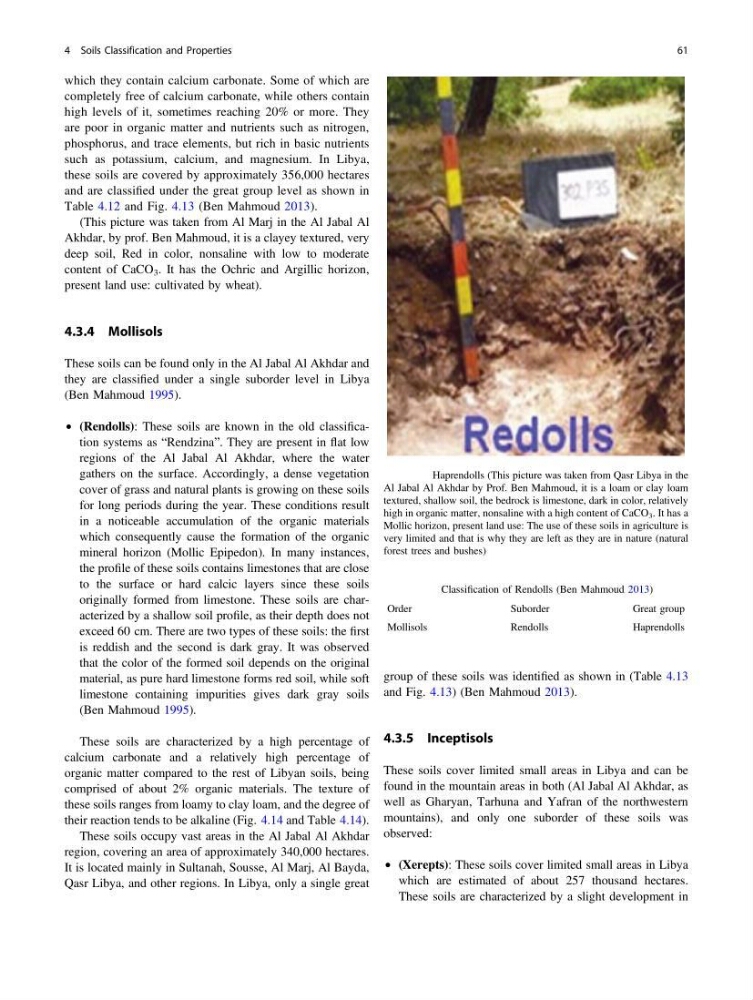
their reaction tends to be alkaline (Fig. 4.14 and Table 4.14).
These soils occupy vast areas in the Al Jabal Al Akhdar
region, covering an area of approximately 340,000 hectares.
It is located mainly in Sultanah, Sousse, Al Marj, Al Bayda,
Qasr Libya, and other regions. In Libya, only a single great
group of these soils was identified as shown in (Table 4.13
and Fig. 4.13) (Ben Mahmoud 2013).
4.3.5 Inceptisols
These soils cover limited small areas in Libya and can be
found in the mountain areas in both (Al Jabal Al Akhdar, as
well as Gharyan, Tarhuna and Yafran of the northwestern
mountains), and only one suborder of these soils was
observed:
• (Xerepts): These soils cover limited small areas in Libya
which are estimated of about 257 thousand hectares.
These soils are characterized by a slight development in
Table 4.13 Classification of Rendolls (Ben Mahmoud 2013)
Order
Suborder
Great group
Mollisols
Rendolls
Haprendolls
Fig. 4.14 Haprendolls (This picture was taken from Qasr Libya in the
Al Jabal Al Akhdar by Prof. Ben Mahmoud, it is a loam or clay loam
textured, shallow soil, the bedrock is limestone, dark in color, relatively
high in organic matter, nonsaline with a high content of CaCO 3 . It has a
Mollic horizon, present land use: The use of these soils in agriculture is
very limited and that is why they are left as they are in nature (natural
forest trees and bushes)
4 Soils Classification and Properties
61
completely free of calcium carbonate, while others contain
high levels of it, sometimes reaching 20% or more. They
are poor in organic matter and nutrients such as nitrogen,
phosphorus, and trace elements, but rich in basic nutrients
such as potassium, calcium, and magnesium. In Libya,
these soils are covered by approximately 356,000 hectares
and are classified under the great group level as shown in
Table 4.12 and Fig. 4.13 (Ben Mahmoud 2013).
(This picture was taken from Al Marj in the Al Jabal Al
Akhdar, by prof. Ben Mahmoud, it is a clayey textured, very
deep soil, Red in color, nonsaline with low to moderate
content of CaCO 3 . It has the Ochric and Argillic horizon,
present land use: cultivated by wheat).
4.3.4 Mollisols
These soils can be found only in the Al Jabal Al Akhdar and
they are classified under a single suborder level in Libya
(Ben Mahmoud 1995).
• (Rendolls): These soils are known in the old classification systems as “Rendzina”. They are present in flat low
regions of the Al Jabal Al Akhdar, where the water
gathers on the surface. Accordingly, a dense vegetation
cover of grass and natural plants is growing on these soils
for long periods during the year. These conditions result
in a noticeable accumulation of the organic materials
which consequently cause the formation of the organic
mineral horizon (Mollic Epipedon). In many instances,
the profile of these soils contains limestones that are close
to the surface or hard calcic layers since these soils
originally formed from limestone. These soils are characterized by a shallow soil profile, as their depth does not
exceed 60 cm. There are two types of these soils: the first
is reddish and the second is dark gray. It was observed
that the color of the formed soil depends on the original
material, as pure hard limestone forms red soil, while soft
limestone containing impurities gives dark gray soils
(Ben Mahmoud 1995).
These soils are characterized by a high percentage of
calcium carbonate and a relatively high percentage of
organic matter compared to the rest of Libyan soils, being
comprised of about 2% organic materials. The texture of
these soils ranges from loamy to clay loam, and the degree of
their reaction tends to be alkaline (Fig. 4.14 and Table 4.14).
These soils occupy vast areas in the Al Jabal Al Akhdar
region, covering an area of approximately 340,000 hectares.
It is located mainly in Sultanah, Sousse, Al Marj, Al Bayda,
Qasr Libya, and other regions. In Libya, only a single great
group of these soils was identified as shown in (Table 4.13
and Fig. 4.13) (Ben Mahmoud 2013).
4.3.5 Inceptisols
These soils cover limited small areas in Libya and can be
found in the mountain areas in both (Al Jabal Al Akhdar, as
well as Gharyan, Tarhuna and Yafran of the northwestern
mountains), and only one suborder of these soils was
observed:
• (Xerepts): These soils cover limited small areas in Libya
which are estimated of about 257 thousand hectares.
These soils are characterized by a slight development in
Table 4.13 Classification of Rendolls (Ben Mahmoud 2013)
Order
Suborder
Great group
Mollisols
Rendolls
Haprendolls
Fig. 4.14 Haprendolls (This picture was taken from Qasr Libya in the
Al Jabal Al Akhdar by Prof. Ben Mahmoud, it is a loam or clay loam
textured, shallow soil, the bedrock is limestone, dark in color, relatively
high in organic matter, nonsaline with a high content of CaCO 3 . It has a
Mollic horizon, present land use: The use of these soils in agriculture is
very limited and that is why they are left as they are in nature (natural
forest trees and bushes)
4 Soils Classification and Properties
61