

– Al Jabal Al Akhdar region: This mountain area
extends from the Al Rajma region in the west to the
Derna region in the east, with a length of about
400 km and a width of about 30 km. This region
covers the remains of natural forests that consist of
evergreen Cupressus sempervirens, Quercus coccifera,
Pinus halepensis, and Juniperus phoenicea.
– The south region of Al Jabal Al Akhdar: This area
is located along the south of Al Jabal Al Akhdar. It is a
a rangeland in which various shrubs and grasses grow,
such as Artemisia herba-alba and Atriplex mollis, in
addition to other annual and perennial plants.
– The eastern coastal plain region: This area includes
the Benghazi and Derna plain, which are agricultural
and rangeland areas.
• The central region: This region extends from Misrata in
the west to Benghazi in the east. It is a coastal plain
region with abundant saline wetlands (i.e., Sebkha),
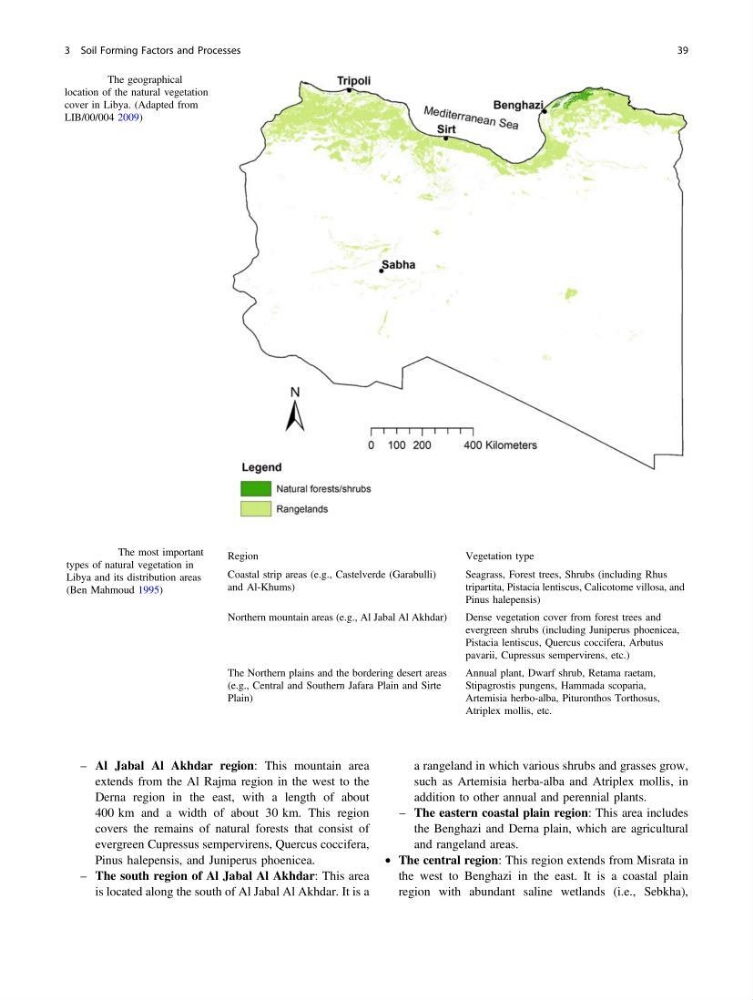
Fig. 3.6 The geographical
location of the natural vegetation
cover in Libya. (Adapted from
LIB/00/004 2009)
Table 3.1 The most important
types of natural vegetation in
Libya and its distribution areas
(Ben Mahmoud 1995)
Region
Vegetation type
Coastal strip areas (e.g., Castelverde (Garabulli)
and Al-Khums)
Seagrass, Forest trees, Shrubs (including Rhus
tripartita, Pistacia lentiscus, Calicotome villosa, and
Pinus halepensis)
Northern mountain areas (e.g., Al Jabal Al Akhdar)
Dense vegetation cover from forest trees and
evergreen shrubs (including Juniperus phoenicea,
Pistacia lentiscus, Quercus coccifera, Arbutus
pavarii, Cupressus sempervirens, etc.)
The Northern plains and the bordering desert areas
(e.g., Central and Southern Jafara Plain and Sirte
Plain)
Annual plant, Dwarf shrub, Retama raetam,
Stipagrostis pungens, Hammada scoparia,
Artemisia herbo-alba, Pituronthos Torthosus,
Atriplex mollis, etc.
3 Soil Forming Factors and Processes
39
extends from the Al Rajma region in the west to the
Derna region in the east, with a length of about
400 km and a width of about 30 km. This region
covers the remains of natural forests that consist of
evergreen Cupressus sempervirens, Quercus coccifera,
Pinus halepensis, and Juniperus phoenicea.
– The south region of Al Jabal Al Akhdar: This area
is located along the south of Al Jabal Al Akhdar. It is a
a rangeland in which various shrubs and grasses grow,
such as Artemisia herba-alba and Atriplex mollis, in
addition to other annual and perennial plants.
– The eastern coastal plain region: This area includes
the Benghazi and Derna plain, which are agricultural
and rangeland areas.
• The central region: This region extends from Misrata in
the west to Benghazi in the east. It is a coastal plain
region with abundant saline wetlands (i.e., Sebkha),
Fig. 3.6 The geographical
location of the natural vegetation
cover in Libya. (Adapted from
LIB/00/004 2009)
Table 3.1 The most important
types of natural vegetation in
Libya and its distribution areas
(Ben Mahmoud 1995)
Region
Vegetation type
Coastal strip areas (e.g., Castelverde (Garabulli)
and Al-Khums)
Seagrass, Forest trees, Shrubs (including Rhus
tripartita, Pistacia lentiscus, Calicotome villosa, and
Pinus halepensis)
Northern mountain areas (e.g., Al Jabal Al Akhdar)
Dense vegetation cover from forest trees and
evergreen shrubs (including Juniperus phoenicea,
Pistacia lentiscus, Quercus coccifera, Arbutus
pavarii, Cupressus sempervirens, etc.)
The Northern plains and the bordering desert areas
(e.g., Central and Southern Jafara Plain and Sirte
Plain)
Annual plant, Dwarf shrub, Retama raetam,
Stipagrostis pungens, Hammada scoparia,
Artemisia herbo-alba, Pituronthos Torthosus,
Atriplex mollis, etc.
3 Soil Forming Factors and Processes
39