

interspersed with some sand dunes of mixtures of the
desert and marine origin, which is mostly rangeland with
a low precipitation rate.
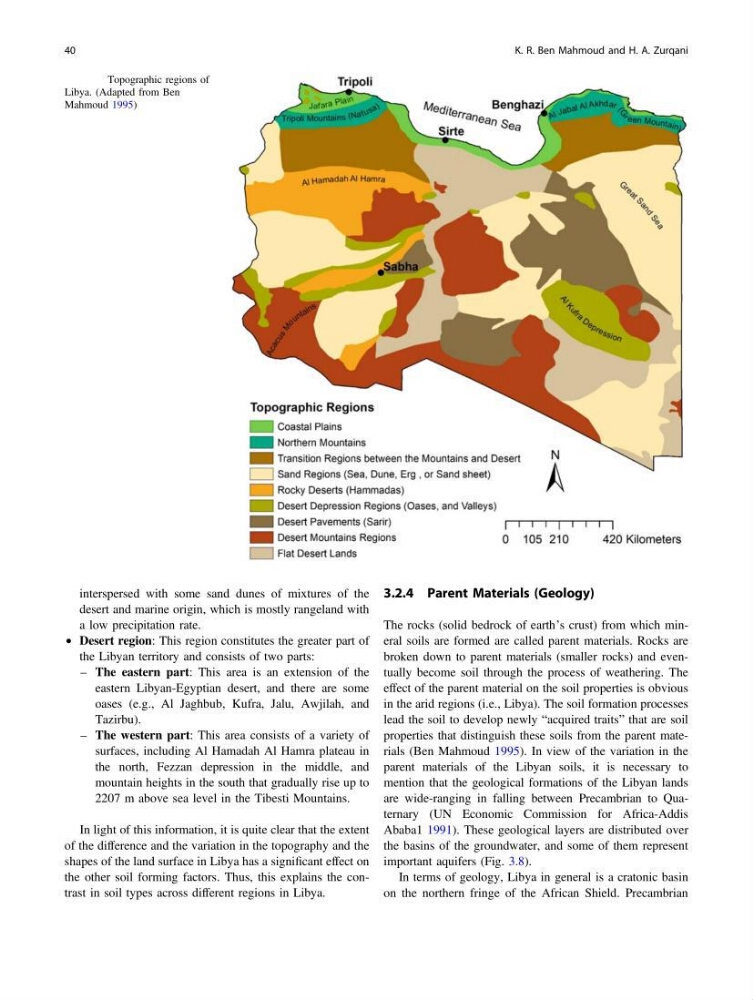
• Desert region: This region constitutes the greater part of
the Libyan territory and consists of two parts:
– The eastern part: This area is an extension of the
eastern Libyan-Egyptian desert, and there are some
oases (e.g., Al Jaghbub, Kufra, Jalu, Awjilah, and
Tazirbu).
– The western part: This area consists of a variety of
surfaces, including Al Hamadah Al Hamra plateau in
the north, Fezzan depression in the middle, and
mountain heights in the south that gradually rise up to
2207 m above sea level in the Tibesti Mountains.
In light of this information, it is quite clear that the extent
of the difference and the variation in the topography and the
shapes of the land surface in Libya has a significant effect on
the other soil forming factors. Thus, this explains the contrast in soil types across different regions in Libya.
3.2.4 Parent Materials (Geology)
The rocks (solid bedrock of earth’s crust) from which mineral soils are formed are called parent materials. Rocks are
broken down to parent materials (smaller rocks) and eventually become soil through the process of weathering. The
effect of the parent material on the soil properties is obvious
in the arid regions (i.e., Libya). The soil formation processes
lead the soil to develop newly “acquired traits” that are soil
properties that distinguish these soils from the parent materials (Ben Mahmoud 1995). In view of the variation in the
parent materials of the Libyan soils, it is necessary to
mention that the geological formations of the Libyan lands
are wide-ranging in falling between Precambrian to Quaternary (UN Economic Commission for Africa-Addis
Ababa1 1991). These geological layers are distributed over
the basins of the groundwater, and some of them represent
important aquifers (Fig. 3.8).
In terms of geology, Libya in general is a cratonic basin
on the northern fringe of the African Shield. Precambrian
Fig. 3.7 Topographic regions of
Libya. (Adapted from Ben
Mahmoud 1995)
40
K. R. Ben Mahmoud and H. A. Zurqani
desert and marine origin, which is mostly rangeland with
a low precipitation rate.
• Desert region: This region constitutes the greater part of
the Libyan territory and consists of two parts:
– The eastern part: This area is an extension of the
eastern Libyan-Egyptian desert, and there are some
oases (e.g., Al Jaghbub, Kufra, Jalu, Awjilah, and
Tazirbu).
– The western part: This area consists of a variety of
surfaces, including Al Hamadah Al Hamra plateau in
the north, Fezzan depression in the middle, and
mountain heights in the south that gradually rise up to
2207 m above sea level in the Tibesti Mountains.
In light of this information, it is quite clear that the extent
of the difference and the variation in the topography and the
shapes of the land surface in Libya has a significant effect on
the other soil forming factors. Thus, this explains the contrast in soil types across different regions in Libya.
3.2.4 Parent Materials (Geology)
The rocks (solid bedrock of earth’s crust) from which mineral soils are formed are called parent materials. Rocks are
broken down to parent materials (smaller rocks) and eventually become soil through the process of weathering. The
effect of the parent material on the soil properties is obvious
in the arid regions (i.e., Libya). The soil formation processes
lead the soil to develop newly “acquired traits” that are soil
properties that distinguish these soils from the parent materials (Ben Mahmoud 1995). In view of the variation in the
parent materials of the Libyan soils, it is necessary to
mention that the geological formations of the Libyan lands
are wide-ranging in falling between Precambrian to Quaternary (UN Economic Commission for Africa-Addis
Ababa1 1991). These geological layers are distributed over
the basins of the groundwater, and some of them represent
important aquifers (Fig. 3.8).
In terms of geology, Libya in general is a cratonic basin
on the northern fringe of the African Shield. Precambrian
Fig. 3.7 Topographic regions of
Libya. (Adapted from Ben
Mahmoud 1995)
40
K. R. Ben Mahmoud and H. A. Zurqani