

2.2.5 Development of Soil Research in Libya
Agricultural research was established on small scale in the
early 1940s at Sidi Al Masri near Tripoli to serve the Italian
Agricultural Settlers. In the early 1950s to late 1960s, the
Ministry of Agriculture became affiliated with the Doctorate
of Plant and Animal Production, along with AR. In 1970, the
Agricultural Research Centre (ARC) was established at
Tripoli to serve as an umbrella organization for implementation of AR in the country with an adopted national AR
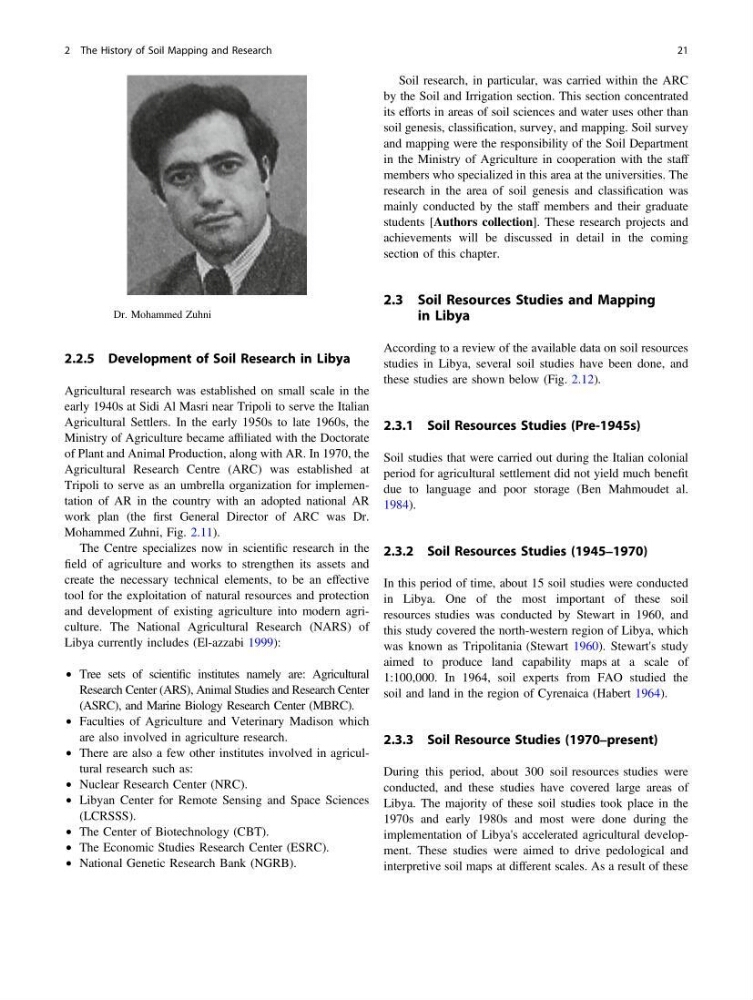
work plan (the first General Director of ARC was Dr.
Mohammed Zuhni, Fig. 2.11).
The Centre specializes now in scientific research in the
field of agriculture and works to strengthen its assets and
create the necessary technical elements, to be an effective
tool for the exploitation of natural resources and protection
and development of existing agriculture into modern agriculture. The National Agricultural Research (NARS) of
Libya currently includes (El-azzabi 1999):
• Tree sets of scientific institutes namely are: Agricultural
Research Center (ARS), Animal Studies and Research Center
(ASRC), and Marine Biology Research Center (MBRC).
• Faculties of Agriculture and Veterinary Madison which
are also involved in agriculture research.
• There are also a few other institutes involved in agricultural research such as:
• Nuclear Research Center (NRC).
• Libyan Center for Remote Sensing and Space Sciences
(LCRSSS).
• The Center of Biotechnology (CBT).
• The Economic Studies Research Center (ESRC).
• National Genetic Research Bank (NGRB).
Soil research, in particular, was carried within the ARC
by the Soil and Irrigation section. This section concentrated
its efforts in areas of soil sciences and water uses other than
soil genesis, classification, survey, and mapping. Soil survey
and mapping were the responsibility of the Soil Department
in the Ministry of Agriculture in cooperation with the staff
members who specialized in this area at the universities. The
research in the area of soil genesis and classification was
mainly conducted by the staff members and their graduate
students [Authors collection]. These research projects and
achievements will be discussed in detail in the coming
section of this chapter.
2.3 Soil Resources Studies and Mapping
in Libya
According to a review of the available data on soil resources
studies in Libya, several soil studies have been done, and
these studies are shown below (Fig. 2.12).
2.3.1 Soil Resources Studies (Pre-1945s)
Soil studies that were carried out during the Italian colonial
period for agricultural settlement did not yield much benefit
due to language and poor storage (Ben Mahmoudet al.
1984).
2.3.2 Soil Resources Studies (1945–1970)
In this period of time, about 15 soil studies were conducted
in Libya. One of the most important of these soil
resources studies was conducted by Stewart in 1960, and
this study covered the north-western region of Libya, which
was known as Tripolitania (Stewart 1960). Stewart's study
aimed to produce land capability maps at a scale of
1:100,000. In 1964, soil experts from FAO studied the
soil and land in the region of Cyrenaica (Habert 1964).
2.3.3 Soil Resource Studies (1970–present)
During this period, about 300 soil resources studies were
conducted, and these studies have covered large areas of
Libya. The majority of these soil studies took place in the
1970s and early 1980s and most were done during the
implementation of Libya's accelerated agricultural development. These studies were aimed to drive pedological and
interpretive soil maps at different scales. As a result of these
Fig. 2.11 Dr. Mohammed Zuhni
2 The History of Soil Mapping and Research
21
Agricultural research was established on small scale in the
early 1940s at Sidi Al Masri near Tripoli to serve the Italian
Agricultural Settlers. In the early 1950s to late 1960s, the
Ministry of Agriculture became affiliated with the Doctorate
of Plant and Animal Production, along with AR. In 1970, the
Agricultural Research Centre (ARC) was established at
Tripoli to serve as an umbrella organization for implementation of AR in the country with an adopted national AR
work plan (the first General Director of ARC was Dr.
Mohammed Zuhni, Fig. 2.11).
The Centre specializes now in scientific research in the
field of agriculture and works to strengthen its assets and
create the necessary technical elements, to be an effective
tool for the exploitation of natural resources and protection
and development of existing agriculture into modern agriculture. The National Agricultural Research (NARS) of
Libya currently includes (El-azzabi 1999):
• Tree sets of scientific institutes namely are: Agricultural
Research Center (ARS), Animal Studies and Research Center
(ASRC), and Marine Biology Research Center (MBRC).
• Faculties of Agriculture and Veterinary Madison which
are also involved in agriculture research.
• There are also a few other institutes involved in agricultural research such as:
• Nuclear Research Center (NRC).
• Libyan Center for Remote Sensing and Space Sciences
(LCRSSS).
• The Center of Biotechnology (CBT).
• The Economic Studies Research Center (ESRC).
• National Genetic Research Bank (NGRB).
Soil research, in particular, was carried within the ARC
by the Soil and Irrigation section. This section concentrated
its efforts in areas of soil sciences and water uses other than
soil genesis, classification, survey, and mapping. Soil survey
and mapping were the responsibility of the Soil Department
in the Ministry of Agriculture in cooperation with the staff
members who specialized in this area at the universities. The
research in the area of soil genesis and classification was
mainly conducted by the staff members and their graduate
students [Authors collection]. These research projects and
achievements will be discussed in detail in the coming
section of this chapter.
2.3 Soil Resources Studies and Mapping
in Libya
According to a review of the available data on soil resources
studies in Libya, several soil studies have been done, and
these studies are shown below (Fig. 2.12).
2.3.1 Soil Resources Studies (Pre-1945s)
Soil studies that were carried out during the Italian colonial
period for agricultural settlement did not yield much benefit
due to language and poor storage (Ben Mahmoudet al.
1984).
2.3.2 Soil Resources Studies (1945–1970)
In this period of time, about 15 soil studies were conducted
in Libya. One of the most important of these soil
resources studies was conducted by Stewart in 1960, and
this study covered the north-western region of Libya, which
was known as Tripolitania (Stewart 1960). Stewart's study
aimed to produce land capability maps at a scale of
1:100,000. In 1964, soil experts from FAO studied the
soil and land in the region of Cyrenaica (Habert 1964).
2.3.3 Soil Resource Studies (1970–present)
During this period, about 300 soil resources studies were
conducted, and these studies have covered large areas of
Libya. The majority of these soil studies took place in the
1970s and early 1980s and most were done during the
implementation of Libya's accelerated agricultural development. These studies were aimed to drive pedological and
interpretive soil maps at different scales. As a result of these
Fig. 2.11 Dr. Mohammed Zuhni
2 The History of Soil Mapping and Research
21