

et al. 2012). Most of the coastal areas are at risk because of
the seawater intrusion resulting in salinity problems, caused
by subsequent irrigation through local wells. Seawater
intrusion has led to a high percentage of salts in some irrigation water, which in turn has led to the deterioration of
fertility and low productivity of the soil. For instance, a
critical problem has been observed in the north-western
coastal strip areas, which is one of the most important
agricultural lands in Libya that holds about 50% of the total
irrigated land in the country and produces about 60% of the
total agricultural production. Saline soils in Libya cover
approximately 12% of the north region, 16.5% of the west
region, and 23.4% of the middle region (Ben Mahmoud
1995). Many studies related to soil salinity assessment and
mapping were conducted in Libya using different methods
(Zurqani et al. 2012; Nwer et al. 2013, 2014; Atman and
Lateh 2013; Zurqani et al. 2018). The results of these studies
showed that most coastal areas are affected by salinity.
Besides, the presence of closed depressions that are usually
near to the water table and covered with a salt crust, known
as Sabkhas (Fig. 1.6).
These Sabkhas are covered with a thin water layer during
the winter season, but during the hot season, they are always
dry, and their basins are usually covered by a salt film
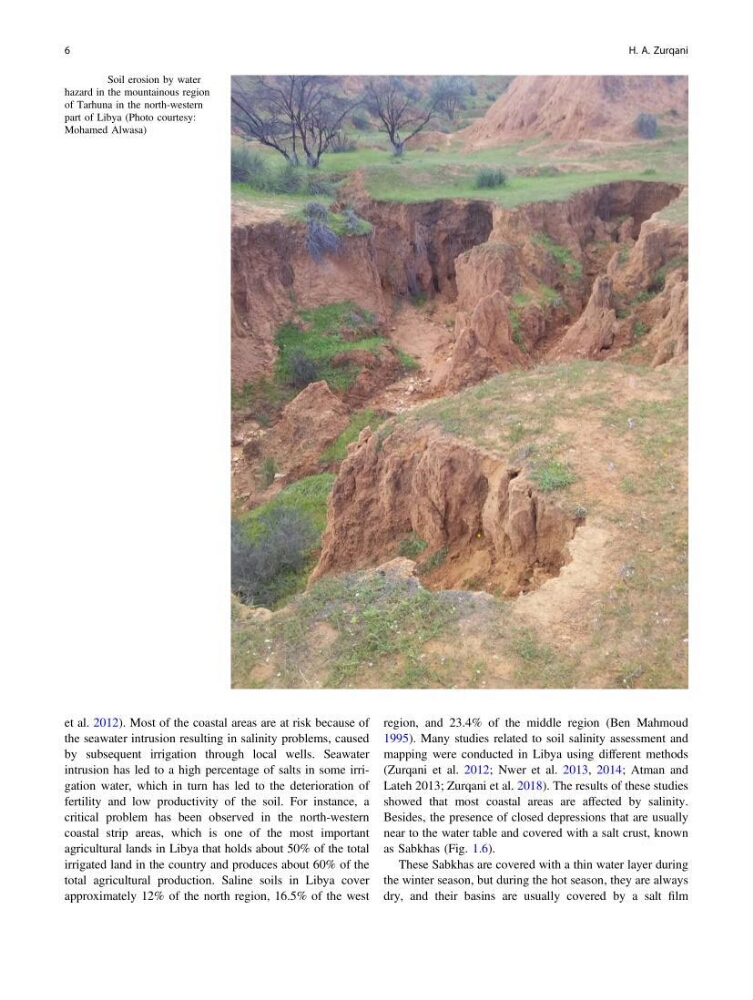
Fig. 1.5 Soil erosion by water
hazard in the mountainous region
of Tarhuna in the north-western
part of Libya (Photo courtesy:
Mohamed Alwasa)
6
H. A. Zurqani
the seawater intrusion resulting in salinity problems, caused
by subsequent irrigation through local wells. Seawater
intrusion has led to a high percentage of salts in some irrigation water, which in turn has led to the deterioration of
fertility and low productivity of the soil. For instance, a
critical problem has been observed in the north-western
coastal strip areas, which is one of the most important
agricultural lands in Libya that holds about 50% of the total
irrigated land in the country and produces about 60% of the
total agricultural production. Saline soils in Libya cover
approximately 12% of the north region, 16.5% of the west
region, and 23.4% of the middle region (Ben Mahmoud
1995). Many studies related to soil salinity assessment and
mapping were conducted in Libya using different methods
(Zurqani et al. 2012; Nwer et al. 2013, 2014; Atman and
Lateh 2013; Zurqani et al. 2018). The results of these studies
showed that most coastal areas are affected by salinity.
Besides, the presence of closed depressions that are usually
near to the water table and covered with a salt crust, known
as Sabkhas (Fig. 1.6).
These Sabkhas are covered with a thin water layer during
the winter season, but during the hot season, they are always
dry, and their basins are usually covered by a salt film
Fig. 1.5 Soil erosion by water
hazard in the mountainous region
of Tarhuna in the north-western
part of Libya (Photo courtesy:
Mohamed Alwasa)
6
H. A. Zurqani