

revegetation. In this case, the rehabilitation of these soils
becomes critical or impossible.
Over the past three decades, Libya has taken measures to
control soil erosion (e.g., afforestation, sand dune stabilization with dry materials, petroleum emulsion, and synthetic
rubber) (Yigini et al. 2013). Yet further steps are needed to
help prevent or stop the erosions. Farming systems that rotate crops can effectively reduce soil erosion, sharply
reducing the period of time that the soil is exposed to water
and wind. Soil erosion by wind can be reduced by planting
rows of trees at right angles that can prevail the wind to
break its force and provide shelter for the field just beyond.
Soil erosion by water can also be controlled by using
mechanical measures, such as terracing, which is by far
considered one of the most effective practices for controlling
runoff and reducing soil erosion.
1.2.2 Salinity
Salinization is the primary type of desertification and soil
degradation in Libya. Soil salinity problems started to be
noticed in the country after the increasing agricultural
activities, coupled with an increasing population (Zurqani
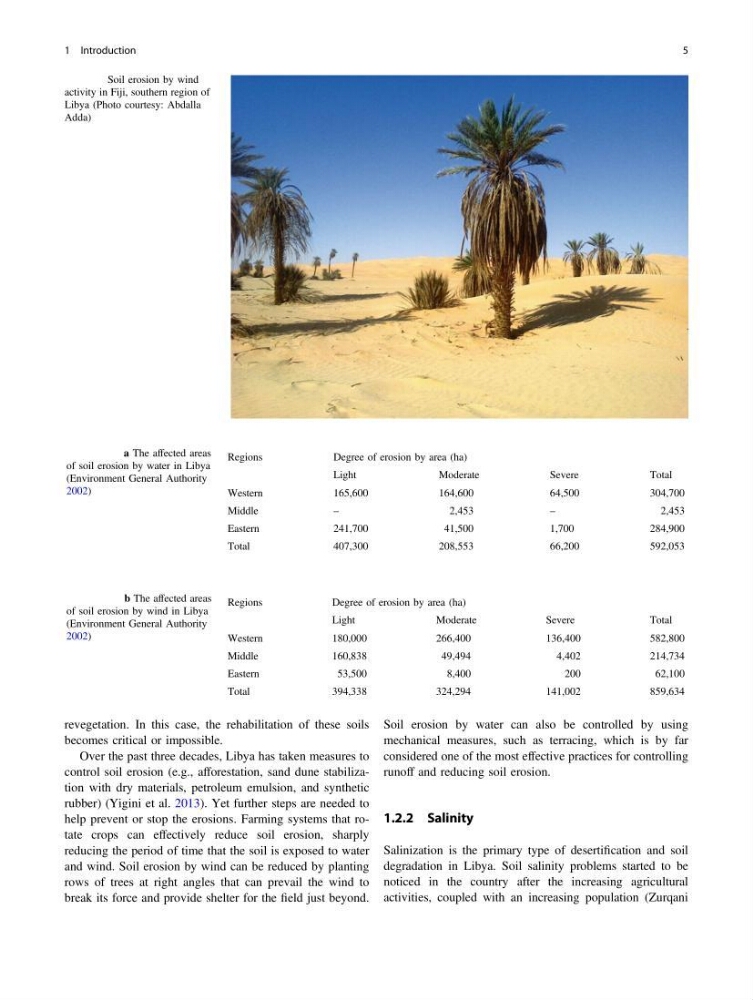
Fig. 1.4 Soil erosion by wind
activity in Fiji, southern region of
Libya (Photo courtesy: Abdalla
Adda)
Table 1.1a a The affected areas
of soil erosion by water in Libya
(Environment General Authority
2002)
Regions
Degree of erosion by area (ha)
Light
Moderate
Severe
Total
Western
165,600
164,600
64,500
304,700
Middle
–
2,453
–
2,453
Eastern
241,700
41,500
1,700
284,900
Total
407,300
208,553
66,200
592,053
Table 1.1b b The affected areas
of soil erosion by wind in Libya
(Environment General Authority
2002)
Regions
Degree of erosion by area (ha)
Light
Moderate
Severe
Total
Western
180,000
266,400
136,400
582,800
Middle
160,838
49,494
4,402
214,734
Eastern
53,500
8,400
200
62,100
Total
394,338
324,294
141,002
859,634
1 Introduction
5
becomes critical or impossible.
Over the past three decades, Libya has taken measures to
control soil erosion (e.g., afforestation, sand dune stabilization with dry materials, petroleum emulsion, and synthetic
rubber) (Yigini et al. 2013). Yet further steps are needed to
help prevent or stop the erosions. Farming systems that rotate crops can effectively reduce soil erosion, sharply
reducing the period of time that the soil is exposed to water
and wind. Soil erosion by wind can be reduced by planting
rows of trees at right angles that can prevail the wind to
break its force and provide shelter for the field just beyond.
Soil erosion by water can also be controlled by using
mechanical measures, such as terracing, which is by far
considered one of the most effective practices for controlling
runoff and reducing soil erosion.
1.2.2 Salinity
Salinization is the primary type of desertification and soil
degradation in Libya. Soil salinity problems started to be
noticed in the country after the increasing agricultural
activities, coupled with an increasing population (Zurqani
Fig. 1.4 Soil erosion by wind
activity in Fiji, southern region of
Libya (Photo courtesy: Abdalla
Adda)
Table 1.1a a The affected areas
of soil erosion by water in Libya
(Environment General Authority
2002)
Regions
Degree of erosion by area (ha)
Light
Moderate
Severe
Total
Western
165,600
164,600
64,500
304,700
Middle
–
2,453
–
2,453
Eastern
241,700
41,500
1,700
284,900
Total
407,300
208,553
66,200
592,053
Table 1.1b b The affected areas
of soil erosion by wind in Libya
(Environment General Authority
2002)
Regions
Degree of erosion by area (ha)
Light
Moderate
Severe
Total
Western
180,000
266,400
136,400
582,800
Middle
160,838
49,494
4,402
214,734
Eastern
53,500
8,400
200
62,100
Total
394,338
324,294
141,002
859,634
1 Introduction
5