

land degradation and desertification. The wealth created by
oil has led to a huge investment in agriculture. Nevertheless,
agricultural development has put severe pressure on local
ecosystems, especially in sensitive and fragile areas. This
was because of the change in production patterns, and the
need to produce more food for the growing population. The
rapid expansion of the irrigated areas in Libya has put
pressure on resources already at stress. The irrigated area has
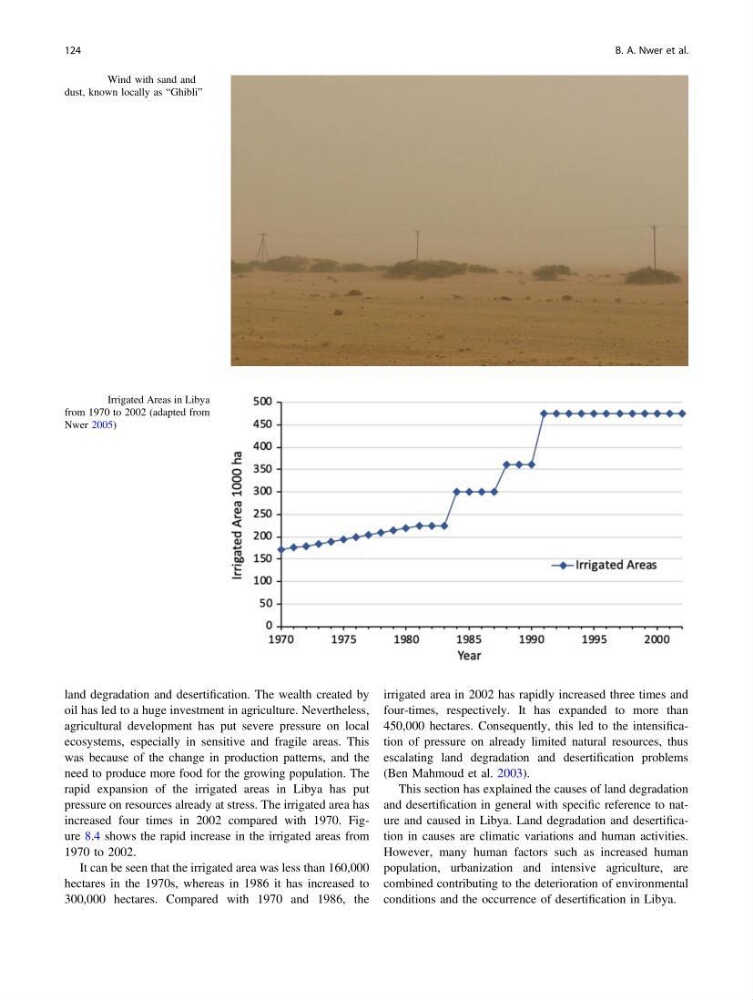
increased four times in 2002 compared with 1970. Figure 8.4 shows the rapid increase in the irrigated areas from
1970 to 2002.
It can be seen that the irrigated area was less than 160,000
hectares in the 1970s, whereas in 1986 it has increased to
300,000 hectares. Compared with 1970 and 1986, the
irrigated area in 2002 has rapidly increased three times and
four-times, respectively. It has expanded to more than
450,000 hectares. Consequently, this led to the intensification of pressure on already limited natural resources, thus
escalating land degradation and desertification problems
(Ben Mahmoud et al. 2003).
This section has explained the causes of land degradation
and desertification in general with specific reference to nature and caused in Libya. Land degradation and desertification in causes are climatic variations and human activities.
However, many human factors such as increased human
population, urbanization and intensive agriculture, are
combined contributing to the deterioration of environmental
conditions and the occurrence of desertification in Libya.
Fig. 8.3 Wind with sand and
dust, known locally as “Ghibli”
Fig. 8.4 Irrigated Areas in Libya
from 1970 to 2002 (adapted from
Nwer 2005)
124
B. A. Nwer et al.
oil has led to a huge investment in agriculture. Nevertheless,
agricultural development has put severe pressure on local
ecosystems, especially in sensitive and fragile areas. This
was because of the change in production patterns, and the
need to produce more food for the growing population. The
rapid expansion of the irrigated areas in Libya has put
pressure on resources already at stress. The irrigated area has
increased four times in 2002 compared with 1970. Figure 8.4 shows the rapid increase in the irrigated areas from
1970 to 2002.
It can be seen that the irrigated area was less than 160,000
hectares in the 1970s, whereas in 1986 it has increased to
300,000 hectares. Compared with 1970 and 1986, the
irrigated area in 2002 has rapidly increased three times and
four-times, respectively. It has expanded to more than
450,000 hectares. Consequently, this led to the intensification of pressure on already limited natural resources, thus
escalating land degradation and desertification problems
(Ben Mahmoud et al. 2003).
This section has explained the causes of land degradation
and desertification in general with specific reference to nature and caused in Libya. Land degradation and desertification in causes are climatic variations and human activities.
However, many human factors such as increased human
population, urbanization and intensive agriculture, are
combined contributing to the deterioration of environmental
conditions and the occurrence of desertification in Libya.
Fig. 8.3 Wind with sand and
dust, known locally as “Ghibli”
Fig. 8.4 Irrigated Areas in Libya
from 1970 to 2002 (adapted from
Nwer 2005)
124
B. A. Nwer et al.