

such as the southern Mediterranean, cracks can form by
desiccation during dry summers, causing extreme dissection
of the slopes. A major problem in the climate in this region is
that the winter rainfall, which causes erosion, does not
coincide with the vegetation cover that protects the soil
surface, especially in cultivated cropland and heavily grazed
pasture. The Mediterranean climates do not favor the
development of a dense vegetation cover on most slopes,
which are poorly stabilized at ground level. As a result, areas
with Mediterranean type climates are traditionally classified
as areas with high potential erosion rates (Saunders and
Young 1983; Brown 1990).
Libya is no different from other parts of arid and
semi-arid zones in terms of the climatic conditions and human activities being the main reasons behind land degradation and desertification (Zurqani et al. 2019). However,
many human factors are combined, contributing to the
deterioration of environmental conditions and the occurrence
of desertification in Libya. Urbanization can intensify land
degradation and desertification. FAO (2015) stated that
urbanization has led to over 25% of highly fertile lands
being converted to urban areas.
The discovery of oil and development of the agriculture
sector in the country has also contributed to the process of
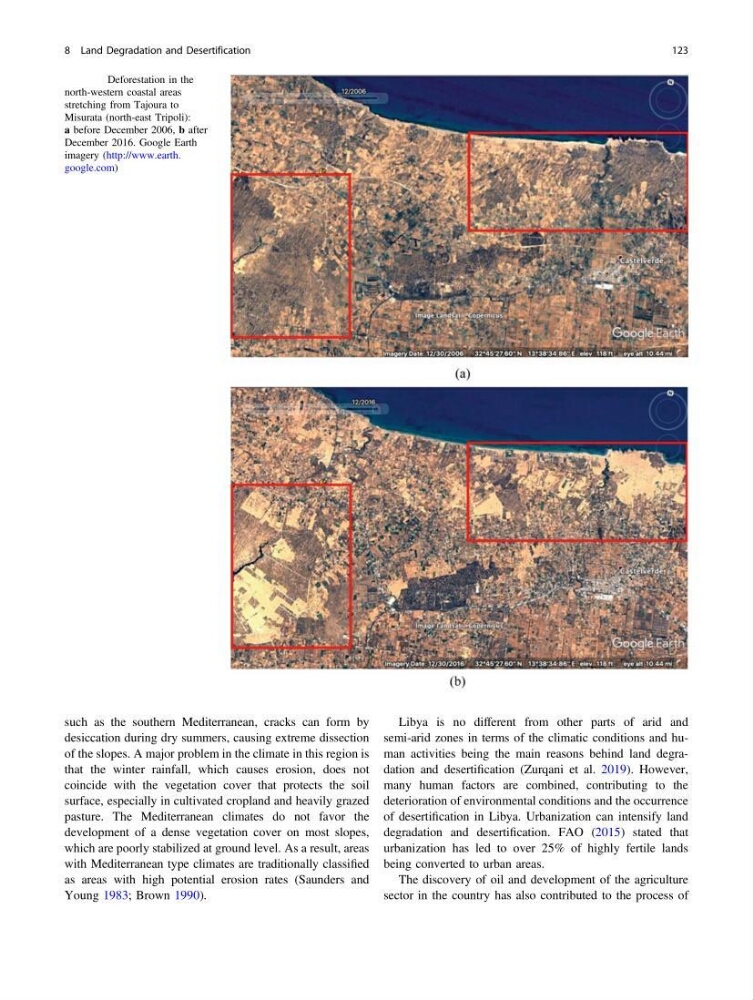
Fig. 8.2 Deforestation in the
north-western coastal areas
stretching from Tajoura to
Misurata (north-east Tripoli):
a before December 2006, b after
December 2016. Google Earth
imagery (http://www.earth.
google.com)
8 Land Degradation and Desertification
123
desiccation during dry summers, causing extreme dissection
of the slopes. A major problem in the climate in this region is
that the winter rainfall, which causes erosion, does not
coincide with the vegetation cover that protects the soil
surface, especially in cultivated cropland and heavily grazed
pasture. The Mediterranean climates do not favor the
development of a dense vegetation cover on most slopes,
which are poorly stabilized at ground level. As a result, areas
with Mediterranean type climates are traditionally classified
as areas with high potential erosion rates (Saunders and
Young 1983; Brown 1990).
Libya is no different from other parts of arid and
semi-arid zones in terms of the climatic conditions and human activities being the main reasons behind land degradation and desertification (Zurqani et al. 2019). However,
many human factors are combined, contributing to the
deterioration of environmental conditions and the occurrence
of desertification in Libya. Urbanization can intensify land
degradation and desertification. FAO (2015) stated that
urbanization has led to over 25% of highly fertile lands
being converted to urban areas.
The discovery of oil and development of the agriculture
sector in the country has also contributed to the process of
Fig. 8.2 Deforestation in the
north-western coastal areas
stretching from Tajoura to
Misurata (north-east Tripoli):
a before December 2006, b after
December 2016. Google Earth
imagery (http://www.earth.
google.com)
8 Land Degradation and Desertification
123