

These factors vary from one site to another in response to
changes in external and internal influences in the air system
(Emgaili 1993). For example, in the spring and autumn,
strong southerly winds, known locally as “Ghibli” blow
from the desert, filling the air with sand and dust and raising
the temperature to approximately 50 °C (Fig. 8.3). These
strong winds are a major erosion factor in the desert,
transporting sand from one place to another.
As previously mentioned in the climate section, the climate in Libya can be divided into two main climate conditions: arid climate inland and Mediterranean climate on the
coast, see Chaps. 1 and 3. As for aridic conditions and
drought, it is well documented and discussed. However, the
nature of the Mediterranean climatic condition could contribute to land degradation and desertification. According to
Sevink (1988), climatic characteristics of the Mediterranean
region include rare freezing, hot summers with at least two
to three dry months, and cool rainy winters; precipitation
often falls as storms of high intensity which produce torrential runoff (Bradbury 1981). Because of these violent
storms, the Mediterranean climate is described as one of the
most aggressive with respect to erosion. Also, in regions
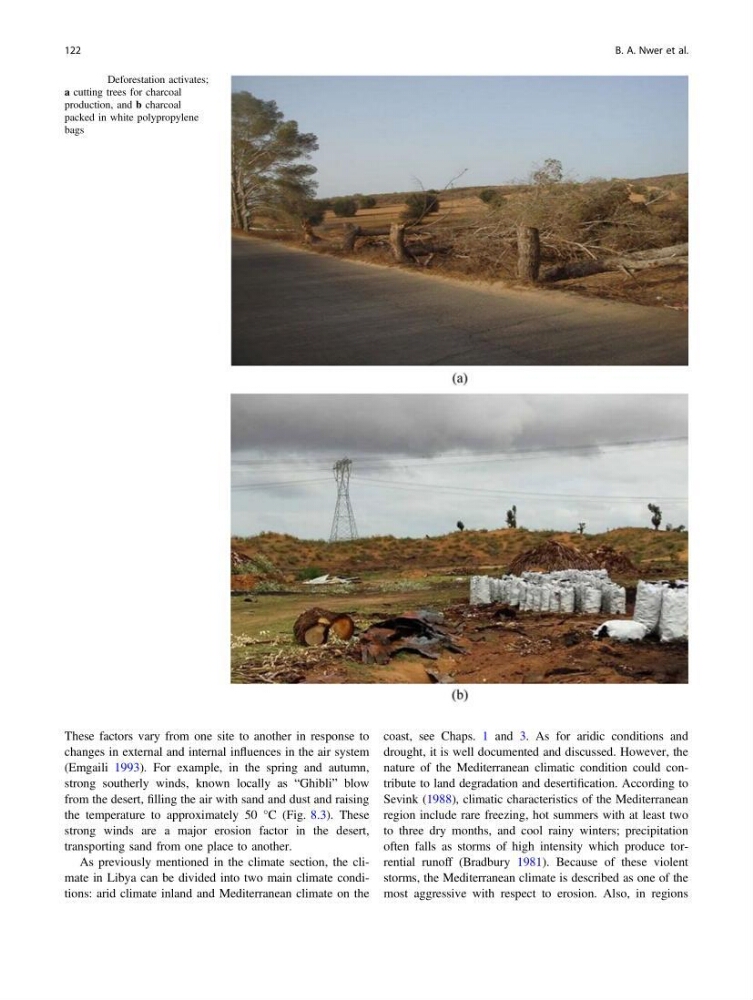
Fig. 8.1 Deforestation activates;
a cutting trees for charcoal
production, and b charcoal
packed in white polypropylene
bags
122
B. A. Nwer et al.
changes in external and internal influences in the air system
(Emgaili 1993). For example, in the spring and autumn,
strong southerly winds, known locally as “Ghibli” blow
from the desert, filling the air with sand and dust and raising
the temperature to approximately 50 °C (Fig. 8.3). These
strong winds are a major erosion factor in the desert,
transporting sand from one place to another.
As previously mentioned in the climate section, the climate in Libya can be divided into two main climate conditions: arid climate inland and Mediterranean climate on the
coast, see Chaps. 1 and 3. As for aridic conditions and
drought, it is well documented and discussed. However, the
nature of the Mediterranean climatic condition could contribute to land degradation and desertification. According to
Sevink (1988), climatic characteristics of the Mediterranean
region include rare freezing, hot summers with at least two
to three dry months, and cool rainy winters; precipitation
often falls as storms of high intensity which produce torrential runoff (Bradbury 1981). Because of these violent
storms, the Mediterranean climate is described as one of the
most aggressive with respect to erosion. Also, in regions
Fig. 8.1 Deforestation activates;
a cutting trees for charcoal
production, and b charcoal
packed in white polypropylene
bags
122
B. A. Nwer et al.