

8.3.2 Consequences of Desertification
The impact of the land degrading process varies according to
the natural characteristics of the land. These characteristics
include soil type, slope, vegetation, and climate. Therefore,
the degradation process could take place in one site and may
not cause the same degradation in another site. This is due to
the fact that soil characteristics, topography, and climatic
conditions are different. So, similar rates of soil loss will be
different as a result of erosive rainstorms occurring above
different soil types and slope degrees. Therefore, identification of reasons behind land degradation must recognize the
natural interactions between different elements in the landscape which affect degradation, and also the site-specificity
of degradation. For instance, thunderstorms and flash floods
increase the problem of soil erosion by water extensively
(IPCC 2001; GTZ 2009).
Land degradation adverse consequences are both environmental and socio-economic. It weakens the structure and
functions of environmental systems such as the biogeochemical cycles (i.e. carbon, hydrological, and nutrient
cycles) which are threatening the survival of human beings.
This put at risk more than 1 billion people in developing
countries in their livelihoods and economic wellbeing, and
their nutritional status (World Bank 1998). According to
ACSAD (2007), more than 40% of the Libyan population
are affected by desertification.
According to the UN (1992), land degradation can also
cause food and water scarcity, loss of income, resource
conflicts, and environmental deterioration. Poverty is closely
linked to land degradation. Most of the affected areas are
rural poor, and the land is the main provider for their income
to survive. Usually, competition among people in those areas
takes place for declining natural resources. Therefore, the
land becomes further degraded and the cycle of poverty is
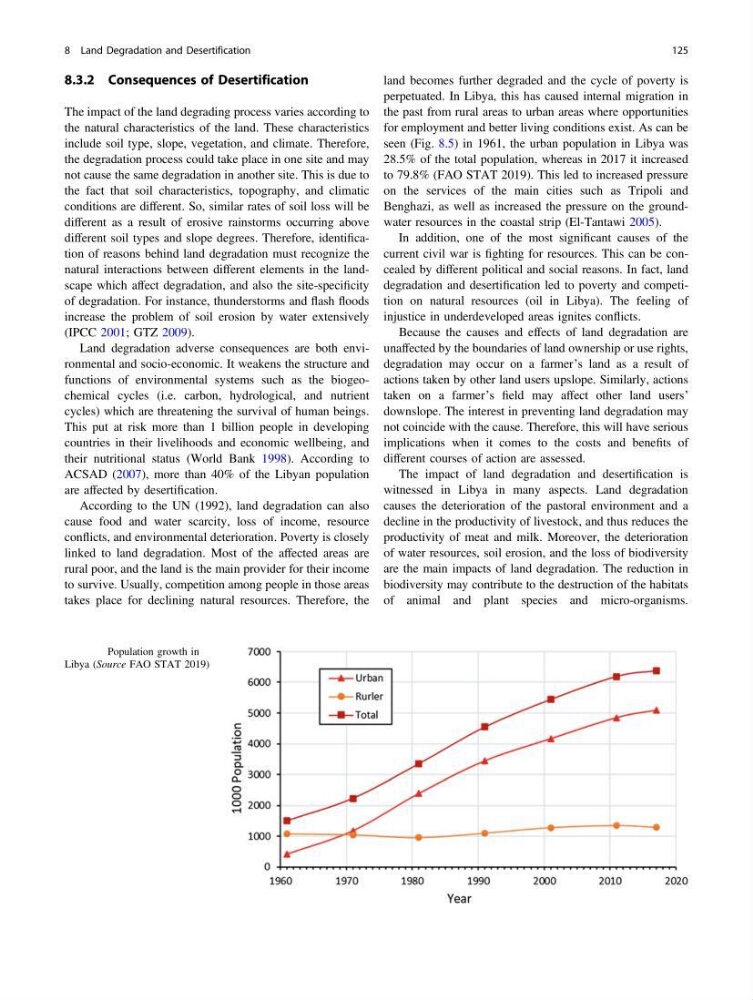
perpetuated. In Libya, this has caused internal migration in
the past from rural areas to urban areas where opportunities
for employment and better living conditions exist. As can be
seen (Fig. 8.5) in 1961, the urban population in Libya was
28.5% of the total population, whereas in 2017 it increased
to 79.8% (FAO STAT 2019). This led to increased pressure
on the services of the main cities such as Tripoli and
Benghazi, as well as increased the pressure on the groundwater resources in the coastal strip (El-Tantawi 2005).
In addition, one of the most significant causes of the
current civil war is fighting for resources. This can be concealed by different political and social reasons. In fact, land
degradation and desertification led to poverty and competition on natural resources (oil in Libya). The feeling of
injustice in underdeveloped areas ignites conflicts.
Because the causes and effects of land degradation are
unaffected by the boundaries of land ownership or use rights,
degradation may occur on a farmer’s land as a result of
actions taken by other land users upslope. Similarly, actions
taken on a farmer’s field may affect other land users’
downslope. The interest in preventing land degradation may
not coincide with the cause. Therefore, this will have serious
implications when it comes to the costs and benefits of
different courses of action are assessed.
The impact of land degradation and desertification is
witnessed in Libya in many aspects. Land degradation
causes the deterioration of the pastoral environment and a
decline in the productivity of livestock, and thus reduces the
productivity of meat and milk. Moreover, the deterioration
of water resources, soil erosion, and the loss of biodiversity
are the main impacts of land degradation. The reduction in
biodiversity may contribute to the destruction of the habitats
of animal and plant species and micro-organisms.
Fig. 8.5 Population growth in
Libya (Source FAO STAT 2019)
8 Land Degradation and Desertification
125
The impact of the land degrading process varies according to
the natural characteristics of the land. These characteristics
include soil type, slope, vegetation, and climate. Therefore,
the degradation process could take place in one site and may
not cause the same degradation in another site. This is due to
the fact that soil characteristics, topography, and climatic
conditions are different. So, similar rates of soil loss will be
different as a result of erosive rainstorms occurring above
different soil types and slope degrees. Therefore, identification of reasons behind land degradation must recognize the
natural interactions between different elements in the landscape which affect degradation, and also the site-specificity
of degradation. For instance, thunderstorms and flash floods
increase the problem of soil erosion by water extensively
(IPCC 2001; GTZ 2009).
Land degradation adverse consequences are both environmental and socio-economic. It weakens the structure and
functions of environmental systems such as the biogeochemical cycles (i.e. carbon, hydrological, and nutrient
cycles) which are threatening the survival of human beings.
This put at risk more than 1 billion people in developing
countries in their livelihoods and economic wellbeing, and
their nutritional status (World Bank 1998). According to
ACSAD (2007), more than 40% of the Libyan population
are affected by desertification.
According to the UN (1992), land degradation can also
cause food and water scarcity, loss of income, resource
conflicts, and environmental deterioration. Poverty is closely
linked to land degradation. Most of the affected areas are
rural poor, and the land is the main provider for their income
to survive. Usually, competition among people in those areas
takes place for declining natural resources. Therefore, the
land becomes further degraded and the cycle of poverty is
perpetuated. In Libya, this has caused internal migration in
the past from rural areas to urban areas where opportunities
for employment and better living conditions exist. As can be
seen (Fig. 8.5) in 1961, the urban population in Libya was
28.5% of the total population, whereas in 2017 it increased
to 79.8% (FAO STAT 2019). This led to increased pressure
on the services of the main cities such as Tripoli and
Benghazi, as well as increased the pressure on the groundwater resources in the coastal strip (El-Tantawi 2005).
In addition, one of the most significant causes of the
current civil war is fighting for resources. This can be concealed by different political and social reasons. In fact, land
degradation and desertification led to poverty and competition on natural resources (oil in Libya). The feeling of
injustice in underdeveloped areas ignites conflicts.
Because the causes and effects of land degradation are
unaffected by the boundaries of land ownership or use rights,
degradation may occur on a farmer’s land as a result of
actions taken by other land users upslope. Similarly, actions
taken on a farmer’s field may affect other land users’
downslope. The interest in preventing land degradation may
not coincide with the cause. Therefore, this will have serious
implications when it comes to the costs and benefits of
different courses of action are assessed.
The impact of land degradation and desertification is
witnessed in Libya in many aspects. Land degradation
causes the deterioration of the pastoral environment and a
decline in the productivity of livestock, and thus reduces the
productivity of meat and milk. Moreover, the deterioration
of water resources, soil erosion, and the loss of biodiversity
are the main impacts of land degradation. The reduction in
biodiversity may contribute to the destruction of the habitats
of animal and plant species and micro-organisms.
Fig. 8.5 Population growth in
Libya (Source FAO STAT 2019)
8 Land Degradation and Desertification
125