

fenugreek T. stellata formed an effective symbiosis with the
cultivated M. sativa (Fig. 7.14). Nodules of Lupinus varius
are shown in Fig. 7.15. Twelve groups, regardless of their
host plant or place of isolation, were formed from the
numerical analysis. Two groups of these isolates can be
selected for use as an inoculum for (Lupinus spp.) in land
affected by salinity, while isolates of some other groups,
such as alfalfa, can be used for forage crops in lands less
affected by salinity. The results of the physiological characteristics of isolates showed that they were distinguished in
their tolerance to the environmental conditions from which
they were isolated. Most of them grew at a temperature
above 40 °C, and most isolates of Lupine varius were
extreme in their tolerance, growing even at temperatures
above 47 °C. The tolerance of isolates to salinity differed
between sensitive, which does not grow in a concentration of
1%, to an extreme in its resistance, which grows up to 9%
(Fig. 7.16).
The Melilotus officinalis plant is one of the pastoral
leguminous plants (Fig. 7.17) and is similar in appearance to
the Medicago sativa (Fig. 7.18). It is endemic and has spread
throughout the country. The plant is considered droughttolerant but is very sensitive to salinity. Melilotus sp. plants
have a symbiotic relationship with rhizobia, but there is no
sufficient information about the biochemical and physiological properties and their symbiotic characteristics. For this
reason, an investigation was adopted to study the physiological properties of pure isolates of bacteria that coexist
symbiotically with the M. officinalis plant grown in Fezzan.
Two groups were obtained from the numerical taxonomy of
isolates at a similarity level of 81%. The results of the
physiological characteristics showed differences between the
groups of isolates. With the exception of sensitivity to most
of the tested heavy metal toxins, most isolates adapted to the
tolerance to NaCl, from sensitive (unable to grow at 1%
NaCl) to extremely tolerant (growing up to 5%.) Most of the
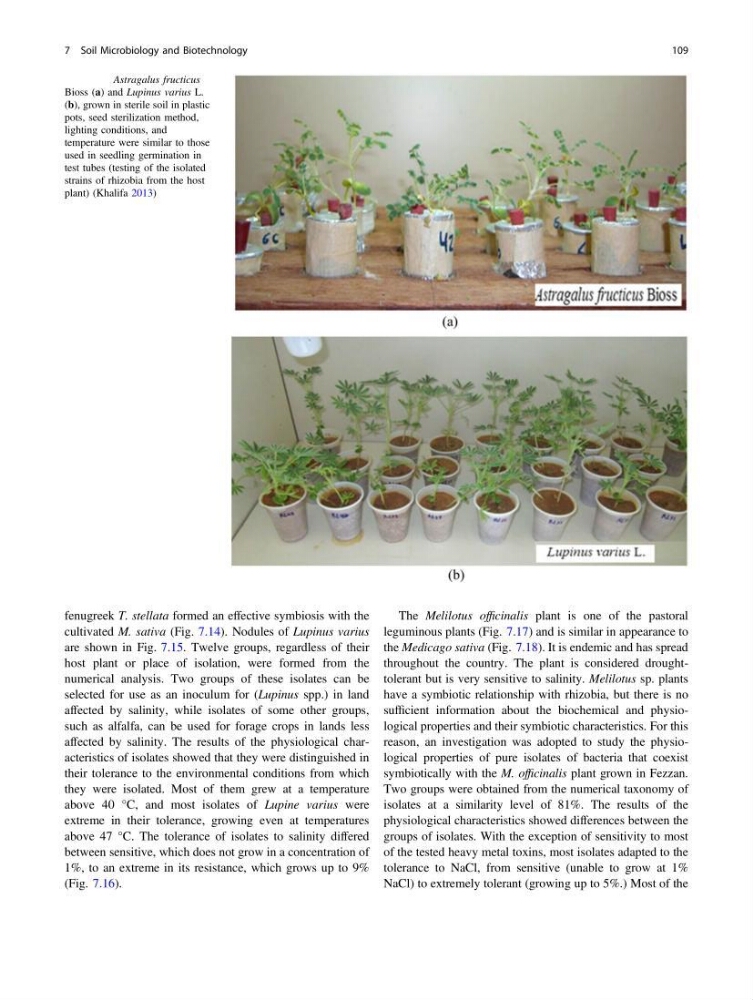
Fig. 7.12 Astragalus fructicus
Bioss (a) and Lupinus varius L.
(b), grown in sterile soil in plastic
pots, seed sterilization method,
lighting conditions, and
temperature were similar to those
used in seedling germination in
test tubes (testing of the isolated
strains of rhizobia from the host
plant) (Khalifa 2013)
7 Soil Microbiology and Biotechnology
109
cultivated M. sativa (Fig. 7.14). Nodules of Lupinus varius
are shown in Fig. 7.15. Twelve groups, regardless of their
host plant or place of isolation, were formed from the
numerical analysis. Two groups of these isolates can be
selected for use as an inoculum for (Lupinus spp.) in land
affected by salinity, while isolates of some other groups,
such as alfalfa, can be used for forage crops in lands less
affected by salinity. The results of the physiological characteristics of isolates showed that they were distinguished in
their tolerance to the environmental conditions from which
they were isolated. Most of them grew at a temperature
above 40 °C, and most isolates of Lupine varius were
extreme in their tolerance, growing even at temperatures
above 47 °C. The tolerance of isolates to salinity differed
between sensitive, which does not grow in a concentration of
1%, to an extreme in its resistance, which grows up to 9%
(Fig. 7.16).
The Melilotus officinalis plant is one of the pastoral
leguminous plants (Fig. 7.17) and is similar in appearance to
the Medicago sativa (Fig. 7.18). It is endemic and has spread
throughout the country. The plant is considered droughttolerant but is very sensitive to salinity. Melilotus sp. plants
have a symbiotic relationship with rhizobia, but there is no
sufficient information about the biochemical and physiological properties and their symbiotic characteristics. For this
reason, an investigation was adopted to study the physiological properties of pure isolates of bacteria that coexist
symbiotically with the M. officinalis plant grown in Fezzan.
Two groups were obtained from the numerical taxonomy of
isolates at a similarity level of 81%. The results of the
physiological characteristics showed differences between the
groups of isolates. With the exception of sensitivity to most
of the tested heavy metal toxins, most isolates adapted to the
tolerance to NaCl, from sensitive (unable to grow at 1%
NaCl) to extremely tolerant (growing up to 5%.) Most of the
Fig. 7.12 Astragalus fructicus
Bioss (a) and Lupinus varius L.
(b), grown in sterile soil in plastic
pots, seed sterilization method,
lighting conditions, and
temperature were similar to those
used in seedling germination in
test tubes (testing of the isolated
strains of rhizobia from the host
plant) (Khalifa 2013)
7 Soil Microbiology and Biotechnology
109