

leguminous plants; testing the ability of these isolates to
withstand environmental and chemical stress; studying
phenotypic variation; and comparing it with isolated reference strains from different geographical regions. These goals
were chosen in order to obtain strains resistant to various
environmental factors that hinder the symbiotic process and
the biological fixation of nitrogen.
7.5.2 Challenges of the Symbiotic Nitrogen
Fixation
The tendency to use biofertilizer by root nodules bacteria
instead of chemical fertilization has had a positive impact on
the environment, especially in arid and semi-arid areas.
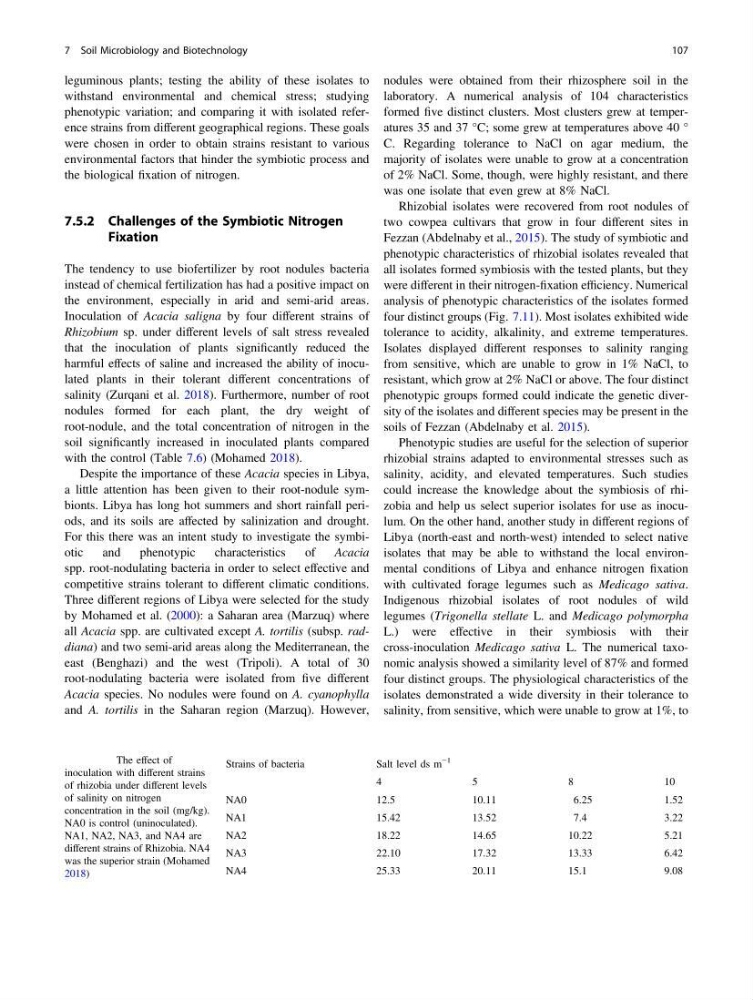
Inoculation of Acacia saligna by four different strains of
Rhizobium sp. under different levels of salt stress revealed
that the inoculation of plants significantly reduced the
harmful effects of saline and increased the ability of inoculated plants in their tolerant different concentrations of
salinity (Zurqani et al. 2018). Furthermore, number of root
nodules formed for each plant, the dry weight of
root-nodule, and the total concentration of nitrogen in the
soil significantly increased in inoculated plants compared
with the control (Table 7.6) (Mohamed 2018).
Despite the importance of these Acacia species in Libya,
a little attention has been given to their root-nodule symbionts. Libya has long hot summers and short rainfall periods, and its soils are affected by salinization and drought.
For this there was an intent study to investigate the symbiotic
and
phenotypic
characteristics
of
Acacia
spp. root-nodulating bacteria in order to select effective and
competitive strains tolerant to different climatic conditions.
Three different regions of Libya were selected for the study
by Mohamed et al. (2000): a Saharan area (Marzuq) where
all Acacia spp. are cultivated except A. tortilis (subsp. raddiana) and two semi-arid areas along the Mediterranean, the
east (Benghazi) and the west (Tripoli). A total of 30
root-nodulating bacteria were isolated from five different
Acacia species. No nodules were found on A. cyanophylla
and A. tortilis in the Saharan region (Marzuq). However,
nodules were obtained from their rhizosphere soil in the
laboratory. A numerical analysis of 104 characteristics
formed five distinct clusters. Most clusters grew at temperatures 35 and 37 °C; some grew at temperatures above 40 °
C. Regarding tolerance to NaCl on agar medium, the
majority of isolates were unable to grow at a concentration
of 2% NaCl. Some, though, were highly resistant, and there
was one isolate that even grew at 8% NaCl.
Rhizobial isolates were recovered from root nodules of
two cowpea cultivars that grow in four different sites in
Fezzan (Abdelnaby et al., 2015). The study of symbiotic and
phenotypic characteristics of rhizobial isolates revealed that
all isolates formed symbiosis with the tested plants, but they
were different in their nitrogen-fixation efficiency. Numerical
analysis of phenotypic characteristics of the isolates formed
four distinct groups (Fig. 7.11). Most isolates exhibited wide
tolerance to acidity, alkalinity, and extreme temperatures.
Isolates displayed different responses to salinity ranging
from sensitive, which are unable to grow in 1% NaCl, to
resistant, which grow at 2% NaCl or above. The four distinct
phenotypic groups formed could indicate the genetic diversity of the isolates and different species may be present in the
soils of Fezzan (Abdelnaby et al. 2015).
Phenotypic studies are useful for the selection of superior
rhizobial strains adapted to environmental stresses such as
salinity, acidity, and elevated temperatures. Such studies
could increase the knowledge about the symbiosis of rhizobia and help us select superior isolates for use as inoculum. On the other hand, another study in different regions of
Libya (north-east and north-west) intended to select native
isolates that may be able to withstand the local environmental conditions of Libya and enhance nitrogen fixation
with cultivated forage legumes such as Medicago sativa.
Indigenous rhizobial isolates of root nodules of wild
legumes (Trigonella stellate L. and Medicago polymorpha
L.) were effective in their symbiosis with their
cross-inoculation Medicago sativa L. The numerical taxonomic analysis showed a similarity level of 87% and formed
four distinct groups. The physiological characteristics of the
isolates demonstrated a wide diversity in their tolerance to
salinity, from sensitive, which were unable to grow at 1%, to
Table 7.6 The effect of
inoculation with different strains
of rhizobia under different levels
of salinity on nitrogen
concentration in the soil (mg/kg).
NA0 is control (uninoculated).
NA1, NA2, NA3, and NA4 are
different strains of Rhizobia. NA4
was the superior strain (Mohamed
2018)
Strains of bacteria
Salt level ds m
−1
4
5
8
1 0
NA0
12.5
10.11
6.25
1.52
NA1
15.42
13.52
7.4
3.22
NA2
18.22
14.65
10.22
5.21
NA3
22.10
17.32
13.33
6.42
NA4
25.33
20.11
15.1
9.08
7 Soil Microbiology and Biotechnology
107
withstand environmental and chemical stress; studying
phenotypic variation; and comparing it with isolated reference strains from different geographical regions. These goals
were chosen in order to obtain strains resistant to various
environmental factors that hinder the symbiotic process and
the biological fixation of nitrogen.
7.5.2 Challenges of the Symbiotic Nitrogen
Fixation
The tendency to use biofertilizer by root nodules bacteria
instead of chemical fertilization has had a positive impact on
the environment, especially in arid and semi-arid areas.
Inoculation of Acacia saligna by four different strains of
Rhizobium sp. under different levels of salt stress revealed
that the inoculation of plants significantly reduced the
harmful effects of saline and increased the ability of inoculated plants in their tolerant different concentrations of
salinity (Zurqani et al. 2018). Furthermore, number of root
nodules formed for each plant, the dry weight of
root-nodule, and the total concentration of nitrogen in the
soil significantly increased in inoculated plants compared
with the control (Table 7.6) (Mohamed 2018).
Despite the importance of these Acacia species in Libya,
a little attention has been given to their root-nodule symbionts. Libya has long hot summers and short rainfall periods, and its soils are affected by salinization and drought.
For this there was an intent study to investigate the symbiotic
and
phenotypic
characteristics
of
Acacia
spp. root-nodulating bacteria in order to select effective and
competitive strains tolerant to different climatic conditions.
Three different regions of Libya were selected for the study
by Mohamed et al. (2000): a Saharan area (Marzuq) where
all Acacia spp. are cultivated except A. tortilis (subsp. raddiana) and two semi-arid areas along the Mediterranean, the
east (Benghazi) and the west (Tripoli). A total of 30
root-nodulating bacteria were isolated from five different
Acacia species. No nodules were found on A. cyanophylla
and A. tortilis in the Saharan region (Marzuq). However,
nodules were obtained from their rhizosphere soil in the
laboratory. A numerical analysis of 104 characteristics
formed five distinct clusters. Most clusters grew at temperatures 35 and 37 °C; some grew at temperatures above 40 °
C. Regarding tolerance to NaCl on agar medium, the
majority of isolates were unable to grow at a concentration
of 2% NaCl. Some, though, were highly resistant, and there
was one isolate that even grew at 8% NaCl.
Rhizobial isolates were recovered from root nodules of
two cowpea cultivars that grow in four different sites in
Fezzan (Abdelnaby et al., 2015). The study of symbiotic and
phenotypic characteristics of rhizobial isolates revealed that
all isolates formed symbiosis with the tested plants, but they
were different in their nitrogen-fixation efficiency. Numerical
analysis of phenotypic characteristics of the isolates formed
four distinct groups (Fig. 7.11). Most isolates exhibited wide
tolerance to acidity, alkalinity, and extreme temperatures.
Isolates displayed different responses to salinity ranging
from sensitive, which are unable to grow in 1% NaCl, to
resistant, which grow at 2% NaCl or above. The four distinct
phenotypic groups formed could indicate the genetic diversity of the isolates and different species may be present in the
soils of Fezzan (Abdelnaby et al. 2015).
Phenotypic studies are useful for the selection of superior
rhizobial strains adapted to environmental stresses such as
salinity, acidity, and elevated temperatures. Such studies
could increase the knowledge about the symbiosis of rhizobia and help us select superior isolates for use as inoculum. On the other hand, another study in different regions of
Libya (north-east and north-west) intended to select native
isolates that may be able to withstand the local environmental conditions of Libya and enhance nitrogen fixation
with cultivated forage legumes such as Medicago sativa.
Indigenous rhizobial isolates of root nodules of wild
legumes (Trigonella stellate L. and Medicago polymorpha
L.) were effective in their symbiosis with their
cross-inoculation Medicago sativa L. The numerical taxonomic analysis showed a similarity level of 87% and formed
four distinct groups. The physiological characteristics of the
isolates demonstrated a wide diversity in their tolerance to
salinity, from sensitive, which were unable to grow at 1%, to
Table 7.6 The effect of
inoculation with different strains
of rhizobia under different levels
of salinity on nitrogen
concentration in the soil (mg/kg).
NA0 is control (uninoculated).
NA1, NA2, NA3, and NA4 are
different strains of Rhizobia. NA4
was the superior strain (Mohamed
2018)
Strains of bacteria
Salt level ds m
−1
4
5
8
1 0
NA0
12.5
10.11
6.25
1.52
NA1
15.42
13.52
7.4
3.22
NA2
18.22
14.65
10.22
5.21
NA3
22.10
17.32
13.33
6.42
NA4
25.33
20.11
15.1
9.08
7 Soil Microbiology and Biotechnology
107