

not exceed the annual average of 20 mm. Groundwater is the
main source for both drinking and irrigation systems.
Environmental stresses like high summer temperature,
salinity, drought, low soil fertility, and wind are the major
challenges that Libyan farmers face (Zurqani et al. 2019).
Nevertheless, this large area of land was placed into cultivation, and different legumes and cereal crops are cultivated
in the oases. Cowpea is one of the earliest legume crops
known to the inhabitants of Fezzan. It has gained a wide
popularity between farmers in many oases because it is used
mainly as a source of food. Although Libyan flora is rich in
leguminous plants and occupies the third position among
other families, studies related to the description and characterization of symbiotic rhizobia with these plants are still
limited and have been limited to some cultivated crops and
woody legumes (Mohamed et al. 2000; El Sadi 2004), as
well as some types of wild clover (Medicago spp.)
(Mohamed 2018).
Many Libyan wild plants are threatened with extinction
due to drought, salinity, and overgrazing (Zurqani et al.
2018). That is why the interest in these plants in terms of
preserving their seeds and their propagation was urgent and
received some attention from those interested in agriculture
and the environment. However, research on endemic rhizobia that is compatible with these plants has not been provided with adequate attention, and information about their
physiological properties and their symbiotic features is still
limited. The most important goals that researchers sought in
their studies and research include: searching for symbiotic
rhizobia with some wild leguminous plants that are abundant
in arid and semi-arid lands from Libya; testing the ability of
isolates to symbiosis and nitrogen fixation with cultivated
Table 7.5 List of analyzed samples with basic information, herbarium voucher numbers, identification, and GenBank accession number.
Tirmania 1, 2, 3, and 4 collected from lower region of Al Hamada Al Hamra; meanwhile Terfezia from upper region of Al Hamada Al Hamra
(north-west of Libya) (Bouzadi et al. 2017)
Herbarium voucher at Herbarium Juva
Truffle Centre
a
DNA voucher deposited at the Slovenian
Forestry Institute
a
EMBL nucleotide sequence database
accession numbers
Tirmania 1-2008/HHU
E09_4_13
FN395012
Tirmania 2-2008/HHU
E09_4_14
FN395013
Tirmania 3-2008/HHU
E09_4_15
FN395014
Tirmania 4-2008/HHU
E09_4_23
FN395015
Terfezia 5-2008/HHL
E09_4_22
FN395016
a The samples (ascocarps) were deposited in Herbarium of Juva Truffle Centre, Finland and parallelly in the Herbarium and Mycotheca at the
Slovenian Forestry Institute (ascocarps and extracted DNA)
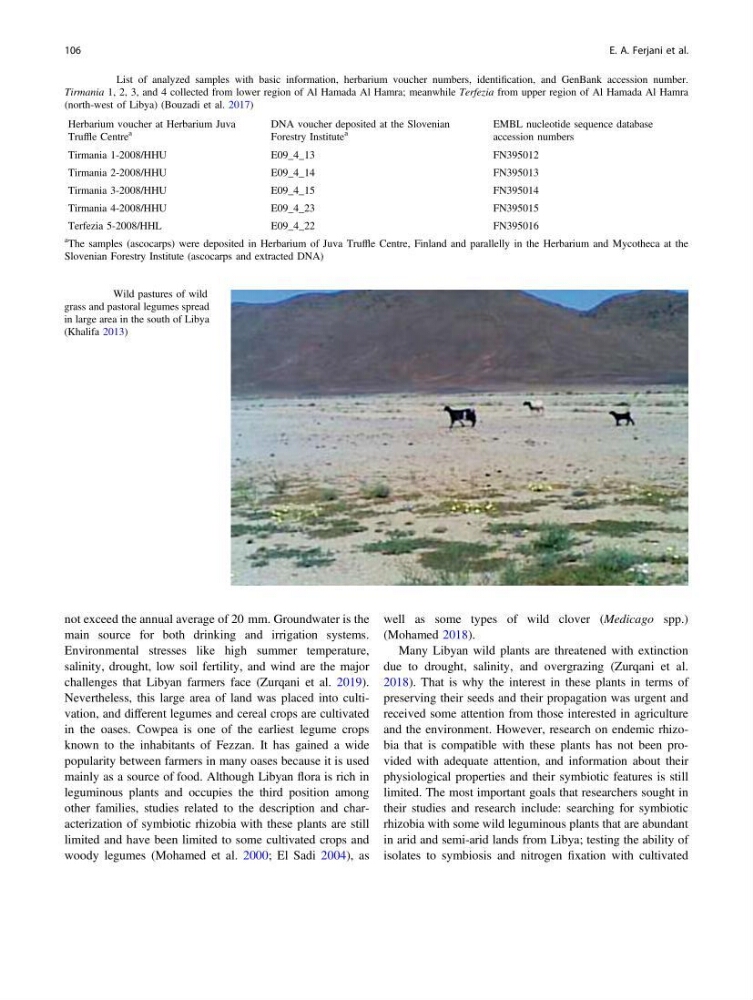
Fig. 7.10 Wild pastures of wild
grass and pastoral legumes spread
in large area in the south of Libya
(Khalifa 2013)
106
E. A. Ferjani et al.
main source for both drinking and irrigation systems.
Environmental stresses like high summer temperature,
salinity, drought, low soil fertility, and wind are the major
challenges that Libyan farmers face (Zurqani et al. 2019).
Nevertheless, this large area of land was placed into cultivation, and different legumes and cereal crops are cultivated
in the oases. Cowpea is one of the earliest legume crops
known to the inhabitants of Fezzan. It has gained a wide
popularity between farmers in many oases because it is used
mainly as a source of food. Although Libyan flora is rich in
leguminous plants and occupies the third position among
other families, studies related to the description and characterization of symbiotic rhizobia with these plants are still
limited and have been limited to some cultivated crops and
woody legumes (Mohamed et al. 2000; El Sadi 2004), as
well as some types of wild clover (Medicago spp.)
(Mohamed 2018).
Many Libyan wild plants are threatened with extinction
due to drought, salinity, and overgrazing (Zurqani et al.
2018). That is why the interest in these plants in terms of
preserving their seeds and their propagation was urgent and
received some attention from those interested in agriculture
and the environment. However, research on endemic rhizobia that is compatible with these plants has not been provided with adequate attention, and information about their
physiological properties and their symbiotic features is still
limited. The most important goals that researchers sought in
their studies and research include: searching for symbiotic
rhizobia with some wild leguminous plants that are abundant
in arid and semi-arid lands from Libya; testing the ability of
isolates to symbiosis and nitrogen fixation with cultivated
Table 7.5 List of analyzed samples with basic information, herbarium voucher numbers, identification, and GenBank accession number.
Tirmania 1, 2, 3, and 4 collected from lower region of Al Hamada Al Hamra; meanwhile Terfezia from upper region of Al Hamada Al Hamra
(north-west of Libya) (Bouzadi et al. 2017)
Herbarium voucher at Herbarium Juva
Truffle Centre
a
DNA voucher deposited at the Slovenian
Forestry Institute
a
EMBL nucleotide sequence database
accession numbers
Tirmania 1-2008/HHU
E09_4_13
FN395012
Tirmania 2-2008/HHU
E09_4_14
FN395013
Tirmania 3-2008/HHU
E09_4_15
FN395014
Tirmania 4-2008/HHU
E09_4_23
FN395015
Terfezia 5-2008/HHL
E09_4_22
FN395016
a The samples (ascocarps) were deposited in Herbarium of Juva Truffle Centre, Finland and parallelly in the Herbarium and Mycotheca at the
Slovenian Forestry Institute (ascocarps and extracted DNA)
Fig. 7.10 Wild pastures of wild
grass and pastoral legumes spread
in large area in the south of Libya
(Khalifa 2013)
106
E. A. Ferjani et al.