

samples exposed to pollution recorded high concentration of
heavy metals and were the poorest in fungal population and
diversity. Four fungal genera were isolated Aspergillus,
Penicillium, Rhizopus, and Fusarium, of which Fusarium is
the most abundant, and may consider one of the resistance
fungi to industrial dusts due to its large spores numbers
isolated from polluted area (Mlitan 2013). Another study
revealed that the sites near Misurata were affected by
industrial waste water pollution. The isolated microbial flora
consists of four fungal genera belonging to Aspergillus,
Penicillium, Rhizopus, and Fusarium. Fusarium and one of
the Aspergillus species (Aspergillus sp3) may influence
resistance fungi to industrial waste water (Mlitan et al. 2015).
There are many publications and references issued for the
inventory and classification of fungi in Libyan soil. For
example: a list of fungi, arranged alphabetically in their
classes, followed by a host and substrate index, was published in 1965 under the title “A list of plant pathogenic and
other fungi of Cyrenaica (Libya).”
The list also includes notes on the general geography,
vegetation, and cultivated crops of the region (Kran and
Jürgen 1965). There is also a reference study with a more
recent history, which includes a reference list of Libyan fungi
titled “Check List of Libyan Fungi.” This list was one of the
University of Tripoli’s publications for the year 1981
(El-Buni and Rattan 1981). Furthermore, a critical checklist
of novel fungal taxa having original localities in the arid
Middle East region introduced between 1940 and 2000 is
presented. The list considers 246 taxonomic units at the
species and subspecies levels. The taxa are grouped according to major classes of fungi. For each taxon, the reference,
country of origin, and nature of the original substratum are
provided (Mouchacca 2005). The checklist and the accompanying bibliography are intended to stimulate the taxonomic
research on the mycobiota of this particular arid region.
7.5 Benefits and Limitations of Biological
Nitrogen Fixation in Libyan Soil
7.5.1 Pastoral Legumes Scattered in Arid
and Semi-arid Regions of Libya
Agricultural and pastoral lands are limited, especially in arid
and semi-arid regions that suffer from various desertification
factors such as drought, heat, and salinity. Leguminous
plants in Libya are estimated at approximately 208 species
and are considered to be the third family in terms of the
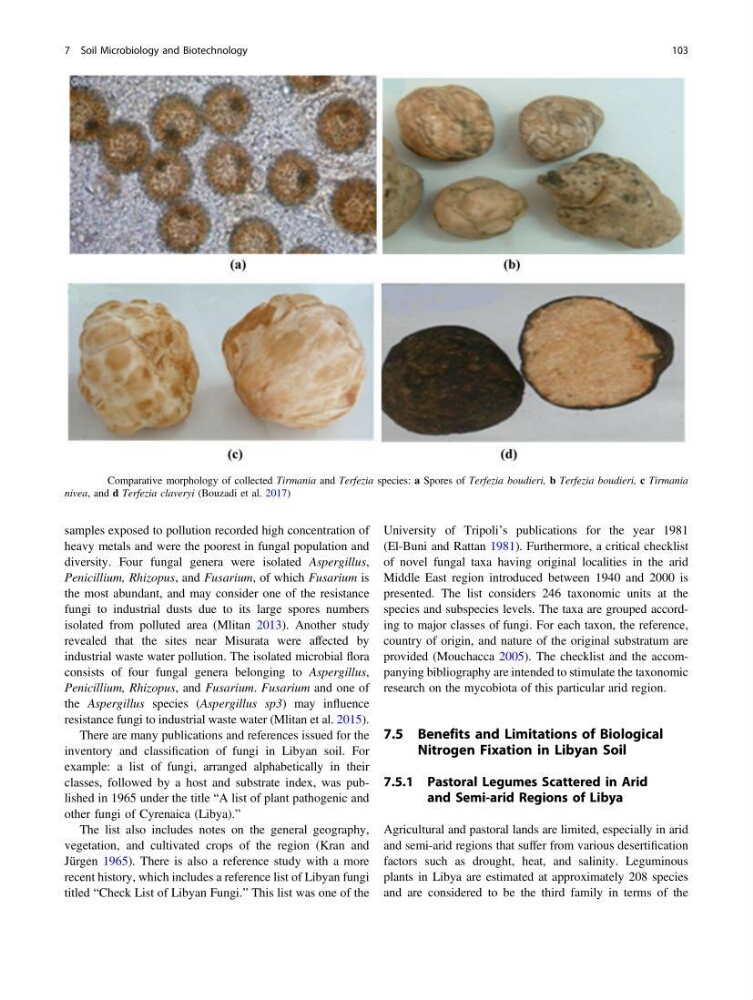
Fig. 7.7 Comparative morphology of collected Tirmania and Terfezia species: a Spores of Terfezia boudieri, b Terfezia boudieri, c Tirmania
nivea, and d Terfezia claveryi (Bouzadi et al. 2017)
7 Soil Microbiology and Biotechnology
103
heavy metals and were the poorest in fungal population and
diversity. Four fungal genera were isolated Aspergillus,
Penicillium, Rhizopus, and Fusarium, of which Fusarium is
the most abundant, and may consider one of the resistance
fungi to industrial dusts due to its large spores numbers
isolated from polluted area (Mlitan 2013). Another study
revealed that the sites near Misurata were affected by
industrial waste water pollution. The isolated microbial flora
consists of four fungal genera belonging to Aspergillus,
Penicillium, Rhizopus, and Fusarium. Fusarium and one of
the Aspergillus species (Aspergillus sp3) may influence
resistance fungi to industrial waste water (Mlitan et al. 2015).
There are many publications and references issued for the
inventory and classification of fungi in Libyan soil. For
example: a list of fungi, arranged alphabetically in their
classes, followed by a host and substrate index, was published in 1965 under the title “A list of plant pathogenic and
other fungi of Cyrenaica (Libya).”
The list also includes notes on the general geography,
vegetation, and cultivated crops of the region (Kran and
Jürgen 1965). There is also a reference study with a more
recent history, which includes a reference list of Libyan fungi
titled “Check List of Libyan Fungi.” This list was one of the
University of Tripoli’s publications for the year 1981
(El-Buni and Rattan 1981). Furthermore, a critical checklist
of novel fungal taxa having original localities in the arid
Middle East region introduced between 1940 and 2000 is
presented. The list considers 246 taxonomic units at the
species and subspecies levels. The taxa are grouped according to major classes of fungi. For each taxon, the reference,
country of origin, and nature of the original substratum are
provided (Mouchacca 2005). The checklist and the accompanying bibliography are intended to stimulate the taxonomic
research on the mycobiota of this particular arid region.
7.5 Benefits and Limitations of Biological
Nitrogen Fixation in Libyan Soil
7.5.1 Pastoral Legumes Scattered in Arid
and Semi-arid Regions of Libya
Agricultural and pastoral lands are limited, especially in arid
and semi-arid regions that suffer from various desertification
factors such as drought, heat, and salinity. Leguminous
plants in Libya are estimated at approximately 208 species
and are considered to be the third family in terms of the
Fig. 7.7 Comparative morphology of collected Tirmania and Terfezia species: a Spores of Terfezia boudieri, b Terfezia boudieri, c Tirmania
nivea, and d Terfezia claveryi (Bouzadi et al. 2017)
7 Soil Microbiology and Biotechnology
103