

showed that Glomus spp. was the predominate genus compared to the other two genera (Marei 2019).
Another type offungus known as desert wild truffles, which
are mostly endemic to arid and semi-arid areas, grow naturally
in many parts of Libya, especially in Hamada Al Hamra (west
region). The development of desert truffle is linked to the
amount of rainfall during the winter. The truffle is composed of
an ascoma (the edible part) which develops underground and
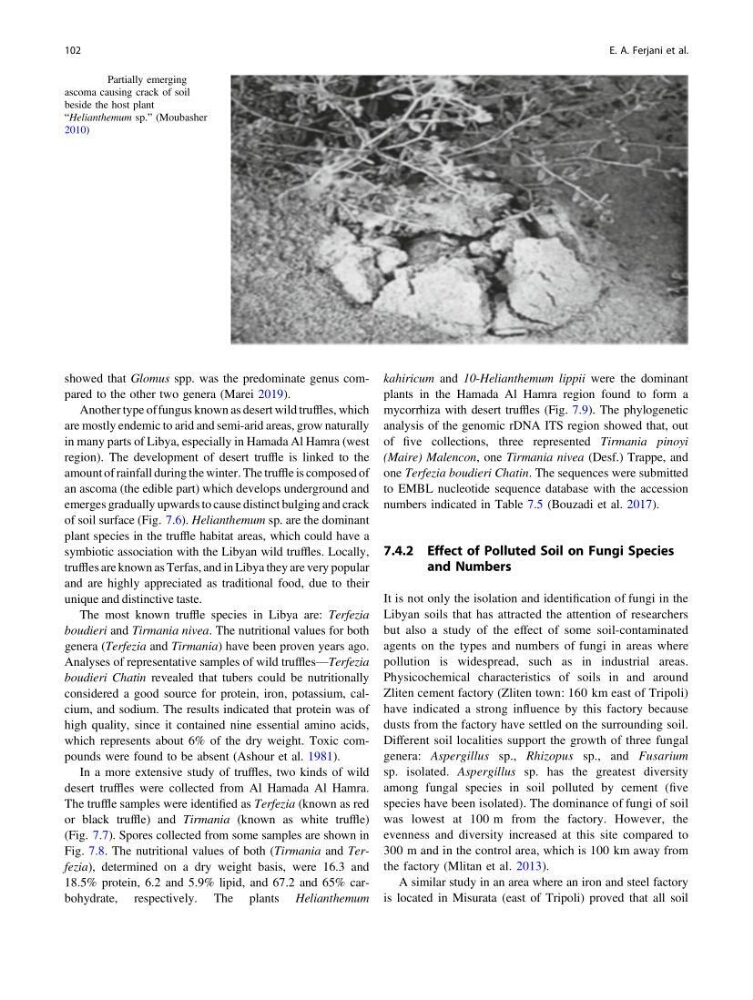
emerges gradually upwards to cause distinct bulging and crack
of soil surface (Fig. 7.6). Helianthemum sp. are the dominant
plant species in the truffle habitat areas, which could have a
symbiotic association with the Libyan wild truffles. Locally,
truffles are known as Terfas, and in Libya they are very popular
and are highly appreciated as traditional food, due to their
unique and distinctive taste.
The most known truffle species in Libya are: Terfezia
boudieri and Tirmania nivea. The nutritional values for both
genera (Terfezia and Tirmania) have been proven years ago.
Analyses of representative samples of wild truffles—Terfezia
boudieri Chatin revealed that tubers could be nutritionally
considered a good source for protein, iron, potassium, calcium, and sodium. The results indicated that protein was of
high quality, since it contained nine essential amino acids,
which represents about 6% of the dry weight. Toxic compounds were found to be absent (Ashour et al. 1981).
In a more extensive study of truffles, two kinds of wild
desert truffles were collected from Al Hamada Al Hamra.
The truffle samples were identified as Terfezia (known as red
or black truffle) and Tirmania (known as white truffle)
(Fig. 7.7). Spores collected from some samples are shown in
Fig. 7.8. The nutritional values of both (Tirmania and Terfezia), determined on a dry weight basis, were 16.3 and
18.5% protein, 6.2 and 5.9% lipid, and 67.2 and 65% carbohydrate, respectively. The plants Helianthemum
kahiricum and 10-Helianthemum lippii were the dominant
plants in the Hamada Al Hamra region found to form a
mycorrhiza with desert truffles (Fig. 7.9). The phylogenetic
analysis of the genomic rDNA ITS region showed that, out
of five collections, three represented Tirmania pinoyi
(Maire) Malencon, one Tirmania nivea (Desf.) Trappe, and
one Terfezia boudieri Chatin. The sequences were submitted
to EMBL nucleotide sequence database with the accession
numbers indicated in Table 7.5 (Bouzadi et al. 2017).
7.4.2 Effect of Polluted Soil on Fungi Species
and Numbers
It is not only the isolation and identification of fungi in the
Libyan soils that has attracted the attention of researchers
but also a study of the effect of some soil-contaminated
agents on the types and numbers of fungi in areas where
pollution is widespread, such as in industrial areas.
Physicochemical characteristics of soils in and around
Zliten cement factory (Zliten town: 160 km east of Tripoli)
have indicated a strong influence by this factory because
dusts from the factory have settled on the surrounding soil.
Different soil localities support the growth of three fungal
genera: Aspergillus sp., Rhizopus sp., and Fusarium
sp. isolated. Aspergillus sp. has the greatest diversity
among fungal species in soil polluted by cement (five
species have been isolated). The dominance of fungi of soil
was lowest at 100 m from the factory. However, the
evenness and diversity increased at this site compared to
300 m and in the control area, which is 100 km away from
the factory (Mlitan et al. 2013).
A similar study in an area where an iron and steel factory
is located in Misurata (east of Tripoli) proved that all soil
Fig. 7.6 Partially emerging
ascoma causing crack of soil
beside the host plant
“Helianthemum sp.” (Moubasher
2010)
102
E. A. Ferjani et al.
Another type offungus known as desert wild truffles, which
are mostly endemic to arid and semi-arid areas, grow naturally
in many parts of Libya, especially in Hamada Al Hamra (west
region). The development of desert truffle is linked to the
amount of rainfall during the winter. The truffle is composed of
an ascoma (the edible part) which develops underground and
emerges gradually upwards to cause distinct bulging and crack
of soil surface (Fig. 7.6). Helianthemum sp. are the dominant
plant species in the truffle habitat areas, which could have a
symbiotic association with the Libyan wild truffles. Locally,
truffles are known as Terfas, and in Libya they are very popular
and are highly appreciated as traditional food, due to their
unique and distinctive taste.
The most known truffle species in Libya are: Terfezia
boudieri and Tirmania nivea. The nutritional values for both
genera (Terfezia and Tirmania) have been proven years ago.
Analyses of representative samples of wild truffles—Terfezia
boudieri Chatin revealed that tubers could be nutritionally
considered a good source for protein, iron, potassium, calcium, and sodium. The results indicated that protein was of
high quality, since it contained nine essential amino acids,
which represents about 6% of the dry weight. Toxic compounds were found to be absent (Ashour et al. 1981).
In a more extensive study of truffles, two kinds of wild
desert truffles were collected from Al Hamada Al Hamra.
The truffle samples were identified as Terfezia (known as red
or black truffle) and Tirmania (known as white truffle)
(Fig. 7.7). Spores collected from some samples are shown in
Fig. 7.8. The nutritional values of both (Tirmania and Terfezia), determined on a dry weight basis, were 16.3 and
18.5% protein, 6.2 and 5.9% lipid, and 67.2 and 65% carbohydrate, respectively. The plants Helianthemum
kahiricum and 10-Helianthemum lippii were the dominant
plants in the Hamada Al Hamra region found to form a
mycorrhiza with desert truffles (Fig. 7.9). The phylogenetic
analysis of the genomic rDNA ITS region showed that, out
of five collections, three represented Tirmania pinoyi
(Maire) Malencon, one Tirmania nivea (Desf.) Trappe, and
one Terfezia boudieri Chatin. The sequences were submitted
to EMBL nucleotide sequence database with the accession
numbers indicated in Table 7.5 (Bouzadi et al. 2017).
7.4.2 Effect of Polluted Soil on Fungi Species
and Numbers
It is not only the isolation and identification of fungi in the
Libyan soils that has attracted the attention of researchers
but also a study of the effect of some soil-contaminated
agents on the types and numbers of fungi in areas where
pollution is widespread, such as in industrial areas.
Physicochemical characteristics of soils in and around
Zliten cement factory (Zliten town: 160 km east of Tripoli)
have indicated a strong influence by this factory because
dusts from the factory have settled on the surrounding soil.
Different soil localities support the growth of three fungal
genera: Aspergillus sp., Rhizopus sp., and Fusarium
sp. isolated. Aspergillus sp. has the greatest diversity
among fungal species in soil polluted by cement (five
species have been isolated). The dominance of fungi of soil
was lowest at 100 m from the factory. However, the
evenness and diversity increased at this site compared to
300 m and in the control area, which is 100 km away from
the factory (Mlitan et al. 2013).
A similar study in an area where an iron and steel factory
is located in Misurata (east of Tripoli) proved that all soil
Fig. 7.6 Partially emerging
ascoma causing crack of soil
beside the host plant
“Helianthemum sp.” (Moubasher
2010)
102
E. A. Ferjani et al.