

more species. This attention expanded to use some molecular tools to define and classify mycorrhizas. Arbuscular
mycorrhizal fungi (AMF) are omnipresent soil inhabitants
that are able to form symbiotic associations with root systems of most plant species.
In order to investigate occurrence and distribution of
AMF in the Al Jabal Al Akhthar area, east of Libya, roots
and rhizosphere soil of 49 cultivated plants belonging to
seven families from eight locations were collected. All
examined plants were colonized by AMF, and spores
abundance ranged from 121 to 992 spores/100 g soil. Spores
extracted from soil morphologically identified to genus
Glomus was the most abundant genus in all studied locations, followed by Acaulospora, Gigaspora and Scutellospora (AL Ani and Mehjin 2016).
Biodiversity (phenotypic and phylogenetic) of AMF
recovered from Juniperus phoenicea L. and Rhamnus
lycioides L. rhizosphere in Al Jabal Al Akhdar was investigated. Spores recovered from soils ranged between 6 and
169 spores g-1soil. The morphology and phylogenetic
analysis of 21 sequences of the internal transcribed spacer
(ITS) rDNA out of 31 isolated AMF, related them to 11
undescribed species affiliating to eight genera submitted to
the GenBank nucleotide sequence under accession numbers
from MF599206 to MF599226. A maximum relative abundance (RA) corresponding to 38.7% was recorded for
Claroideoglomus etunicatum, followed by Gigaspora
sp. and Entrophospora infrequens with RA of 12.9%.
Entrophospora infrequens, Glomus epigaeus, and Rhizophagus intraradices were least encountered in all locations
with low RA 3.2%. Phylogenetic analysis results highlighted
the dominance of Claroideoglomus etunicatum and Gigaspora sp. colonizing both R. lycioides and J. phoenicea in the
examined locations (Jadallah et al. 2017).
A study on indigenous mycorrhizal spore was performed
in Benghazi region (east of Libya) to determine the presence
of AMF spores in a field cultivated with wheat crops (Triticum aestivum L.) during the vegetative stage. Three genera
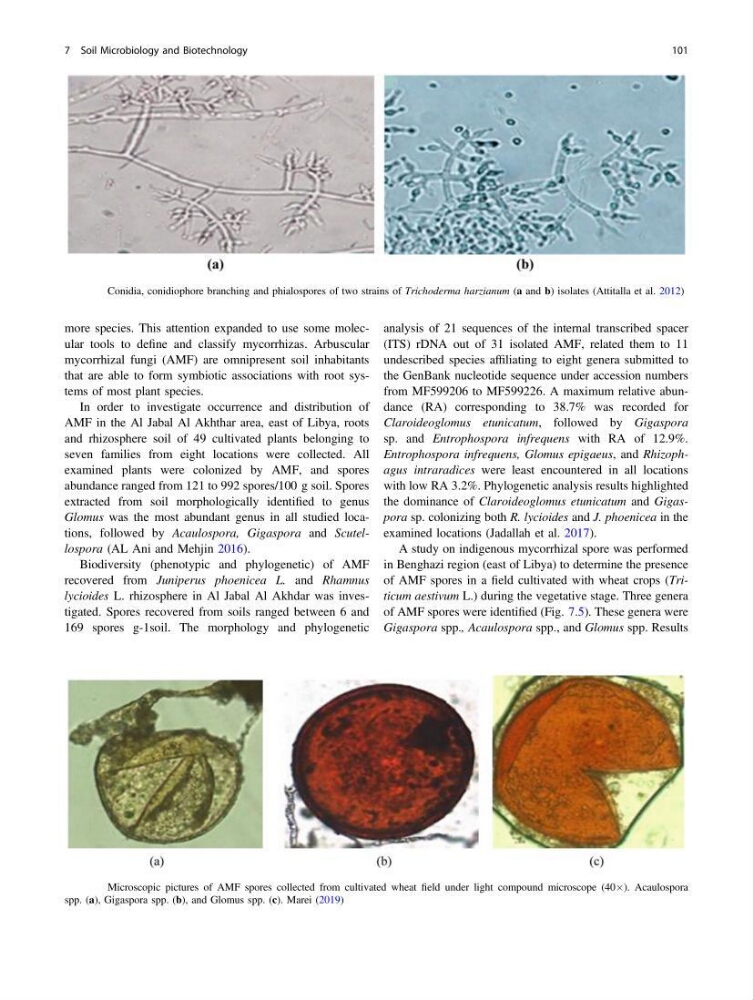
of AMF spores were identified (Fig. 7.5). These genera were
Gigaspora spp., Acaulospora spp., and Glomus spp. Results
Fig. 7.4 Conidia, conidiophore branching and phialospores of two strains of Trichoderma harzianum (a and b) isolates (Attitalla et al. 2012)
Fig. 7.5 Microscopic pictures of AMF spores collected from cultivated wheat field under light compound microscope (40Â). Acaulospora
spp. (a), Gigaspora spp. (b), and Glomus spp. (c). Marei (2019)
7 Soil Microbiology and Biotechnology
101
mycorrhizal fungi (AMF) are omnipresent soil inhabitants
that are able to form symbiotic associations with root systems of most plant species.
In order to investigate occurrence and distribution of
AMF in the Al Jabal Al Akhthar area, east of Libya, roots
and rhizosphere soil of 49 cultivated plants belonging to
seven families from eight locations were collected. All
examined plants were colonized by AMF, and spores
abundance ranged from 121 to 992 spores/100 g soil. Spores
extracted from soil morphologically identified to genus
Glomus was the most abundant genus in all studied locations, followed by Acaulospora, Gigaspora and Scutellospora (AL Ani and Mehjin 2016).
Biodiversity (phenotypic and phylogenetic) of AMF
recovered from Juniperus phoenicea L. and Rhamnus
lycioides L. rhizosphere in Al Jabal Al Akhdar was investigated. Spores recovered from soils ranged between 6 and
169 spores g-1soil. The morphology and phylogenetic
analysis of 21 sequences of the internal transcribed spacer
(ITS) rDNA out of 31 isolated AMF, related them to 11
undescribed species affiliating to eight genera submitted to
the GenBank nucleotide sequence under accession numbers
from MF599206 to MF599226. A maximum relative abundance (RA) corresponding to 38.7% was recorded for
Claroideoglomus etunicatum, followed by Gigaspora
sp. and Entrophospora infrequens with RA of 12.9%.
Entrophospora infrequens, Glomus epigaeus, and Rhizophagus intraradices were least encountered in all locations
with low RA 3.2%. Phylogenetic analysis results highlighted
the dominance of Claroideoglomus etunicatum and Gigaspora sp. colonizing both R. lycioides and J. phoenicea in the
examined locations (Jadallah et al. 2017).
A study on indigenous mycorrhizal spore was performed
in Benghazi region (east of Libya) to determine the presence
of AMF spores in a field cultivated with wheat crops (Triticum aestivum L.) during the vegetative stage. Three genera
of AMF spores were identified (Fig. 7.5). These genera were
Gigaspora spp., Acaulospora spp., and Glomus spp. Results
Fig. 7.4 Conidia, conidiophore branching and phialospores of two strains of Trichoderma harzianum (a and b) isolates (Attitalla et al. 2012)
Fig. 7.5 Microscopic pictures of AMF spores collected from cultivated wheat field under light compound microscope (40Â). Acaulospora
spp. (a), Gigaspora spp. (b), and Glomus spp. (c). Marei (2019)
7 Soil Microbiology and Biotechnology
101