

of incubation at a concentration between 200 and 800 ppm
(Abdallah et al. 2005b).
The effect of biological and chemical control on degree of
infection and percentage of wilt disease of Fusarium wilt
(Fusarium oxysporum) on two tomato cultivars appeared
that the degree of infection in the non-treated plants
increased by 72.0 and 73.6%, while in the treated ones it
reduced to 24.4 and 2.1% (Buhidma et al. 2007).
The biological control using Trichoderma viride and
Aspergillus sp. was carried out in vitro on three fungi:
Fusarium solani, Alternaria alternate, and Stemphylium
botryosum. The results show a decrease in growth length of
pathogenic fungi due to the presence of antagonistic fungi.
The biological control using the mycorrhizae (A: Glomus
intraradices and B: G. etunicatum) and Rhizobium sp. bacteria revealed general reduction in death ratios of seed before
and after germination and also reduction in the infection
rates. In the green house condition, using the same biological
control agents leads to increase in the length, the fresh and
dry weight of vegetative and root system, and the number of
root nodules (Abdulla 2007).
Trichoderma sp. are widely distributed and nearly present
in all soils and other natural habitats, especially those containing well-decomposed organic matter. Soils with very low
organic matter are not favorable for the development of
Trichoderma (Shaban 1986). The investigation on the fungal
flora with special attention to Trichoderma revealed that
Trichoderma occurred in moderate frequency in the soil and
was isolated from five samples among 23 soil samples collected from Al Jabal Al Akhdar region. The isolated Trichoderma counted 0.5–1 Â 10
3 CFU g
−1 dry soil and
identified as Trichoderma harzianum. Aspergillus and
Penicillium sp. were the most frequent fungi isolated from
the tested soil and were averaged 8.3 and 5.5 CFU mg
−1
soil, respectively. Several other genera (Mucor, Fusarium,
Alternaria, and Curvularia) were also isolated in moderate,
low, or rare frequencies on the studied culture media. Trichoderma can be identified by distinctive morphological
characters such as rapid growth, bright green, or white
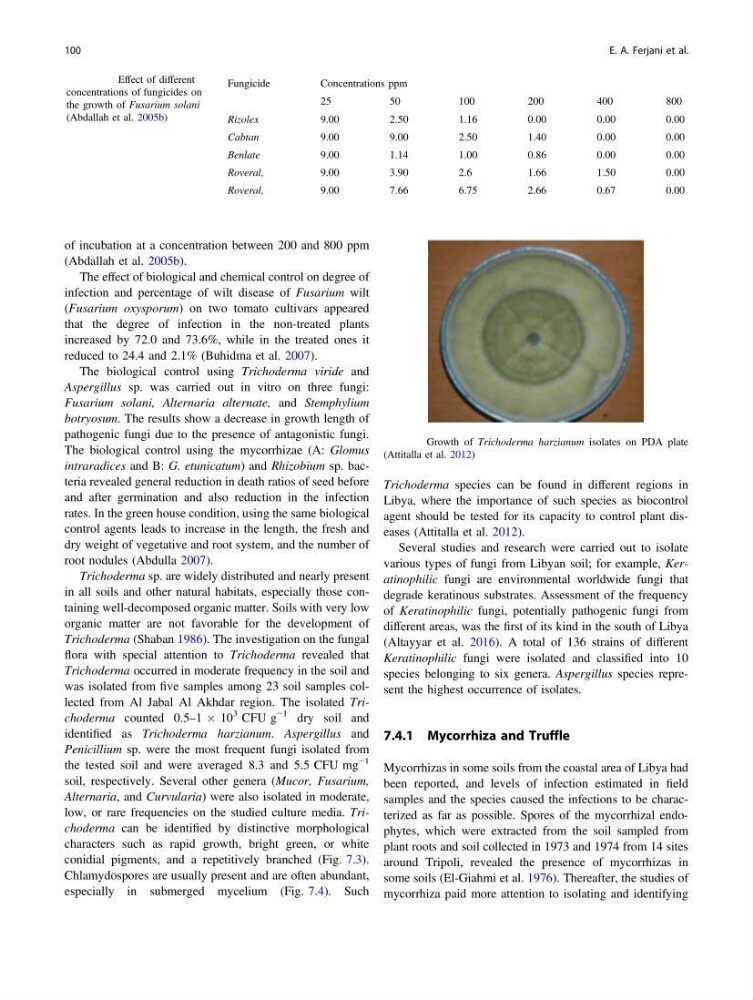
conidial pigments, and a repetitively branched (Fig. 7.3).
Chlamydospores are usually present and are often abundant,
especially in submerged mycelium (Fig. 7.4). Such
Trichoderma species can be found in different regions in
Libya, where the importance of such species as biocontrol
agent should be tested for its capacity to control plant diseases (Attitalla et al. 2012).
Several studies and research were carried out to isolate
various types of fungi from Libyan soil; for example, Keratinophilic fungi are environmental worldwide fungi that
degrade keratinous substrates. Assessment of the frequency
of Keratinophilic fungi, potentially pathogenic fungi from
different areas, was the first of its kind in the south of Libya
(Altayyar et al. 2016). A total of 136 strains of different
Keratinophilic fungi were isolated and classified into 10
species belonging to six genera. Aspergillus species represent the highest occurrence of isolates.
7.4.1 Mycorrhiza and Truffle
Mycorrhizas in some soils from the coastal area of Libya had
been reported, and levels of infection estimated in field
samples and the species caused the infections to be characterized as far as possible. Spores of the mycorrhizal endophytes, which were extracted from the soil sampled from
plant roots and soil collected in 1973 and 1974 from 14 sites
around Tripoli, revealed the presence of mycorrhizas in
some soils (El-Giahmi et al. 1976). Thereafter, the studies of
mycorrhiza paid more attention to isolating and identifying
Table 7.4 Effect of different
concentrations of fungicides on
the growth of Fusarium solani
(Abdallah et al. 2005b)
Fungicide
Concentrations ppm
25
50
100
200
400
800
Rizolex
9.00
2.50
1.16
0.00
0.00
0.00
Cabtan
9.00
9.00
2.50
1.40
0.00
0.00
Benlate
9.00
1.14
1.00
0.86
0.00
0.00
Roveral,
9.00
3.90
2.6
1.66
1.50
0.00
Roveral,
9.00
7.66
6.75
2.66
0.67
0.00
Fig. 7.3 Growth of Trichoderma harzianum isolates on PDA plate
(Attitalla et al. 2012)
100
E. A. Ferjani et al.
(Abdallah et al. 2005b).
The effect of biological and chemical control on degree of
infection and percentage of wilt disease of Fusarium wilt
(Fusarium oxysporum) on two tomato cultivars appeared
that the degree of infection in the non-treated plants
increased by 72.0 and 73.6%, while in the treated ones it
reduced to 24.4 and 2.1% (Buhidma et al. 2007).
The biological control using Trichoderma viride and
Aspergillus sp. was carried out in vitro on three fungi:
Fusarium solani, Alternaria alternate, and Stemphylium
botryosum. The results show a decrease in growth length of
pathogenic fungi due to the presence of antagonistic fungi.
The biological control using the mycorrhizae (A: Glomus
intraradices and B: G. etunicatum) and Rhizobium sp. bacteria revealed general reduction in death ratios of seed before
and after germination and also reduction in the infection
rates. In the green house condition, using the same biological
control agents leads to increase in the length, the fresh and
dry weight of vegetative and root system, and the number of
root nodules (Abdulla 2007).
Trichoderma sp. are widely distributed and nearly present
in all soils and other natural habitats, especially those containing well-decomposed organic matter. Soils with very low
organic matter are not favorable for the development of
Trichoderma (Shaban 1986). The investigation on the fungal
flora with special attention to Trichoderma revealed that
Trichoderma occurred in moderate frequency in the soil and
was isolated from five samples among 23 soil samples collected from Al Jabal Al Akhdar region. The isolated Trichoderma counted 0.5–1 Â 10
3 CFU g
−1 dry soil and
identified as Trichoderma harzianum. Aspergillus and
Penicillium sp. were the most frequent fungi isolated from
the tested soil and were averaged 8.3 and 5.5 CFU mg
−1
soil, respectively. Several other genera (Mucor, Fusarium,
Alternaria, and Curvularia) were also isolated in moderate,
low, or rare frequencies on the studied culture media. Trichoderma can be identified by distinctive morphological
characters such as rapid growth, bright green, or white
conidial pigments, and a repetitively branched (Fig. 7.3).
Chlamydospores are usually present and are often abundant,
especially in submerged mycelium (Fig. 7.4). Such
Trichoderma species can be found in different regions in
Libya, where the importance of such species as biocontrol
agent should be tested for its capacity to control plant diseases (Attitalla et al. 2012).
Several studies and research were carried out to isolate
various types of fungi from Libyan soil; for example, Keratinophilic fungi are environmental worldwide fungi that
degrade keratinous substrates. Assessment of the frequency
of Keratinophilic fungi, potentially pathogenic fungi from
different areas, was the first of its kind in the south of Libya
(Altayyar et al. 2016). A total of 136 strains of different
Keratinophilic fungi were isolated and classified into 10
species belonging to six genera. Aspergillus species represent the highest occurrence of isolates.
7.4.1 Mycorrhiza and Truffle
Mycorrhizas in some soils from the coastal area of Libya had
been reported, and levels of infection estimated in field
samples and the species caused the infections to be characterized as far as possible. Spores of the mycorrhizal endophytes, which were extracted from the soil sampled from
plant roots and soil collected in 1973 and 1974 from 14 sites
around Tripoli, revealed the presence of mycorrhizas in
some soils (El-Giahmi et al. 1976). Thereafter, the studies of
mycorrhiza paid more attention to isolating and identifying
Table 7.4 Effect of different
concentrations of fungicides on
the growth of Fusarium solani
(Abdallah et al. 2005b)
Fungicide
Concentrations ppm
25
50
100
200
400
800
Rizolex
9.00
2.50
1.16
0.00
0.00
0.00
Cabtan
9.00
9.00
2.50
1.40
0.00
0.00
Benlate
9.00
1.14
1.00
0.86
0.00
0.00
Roveral,
9.00
3.90
2.6
1.66
1.50
0.00
Roveral,
9.00
7.66
6.75
2.66
0.67
0.00
Fig. 7.3 Growth of Trichoderma harzianum isolates on PDA plate
(Attitalla et al. 2012)
100
E. A. Ferjani et al.