

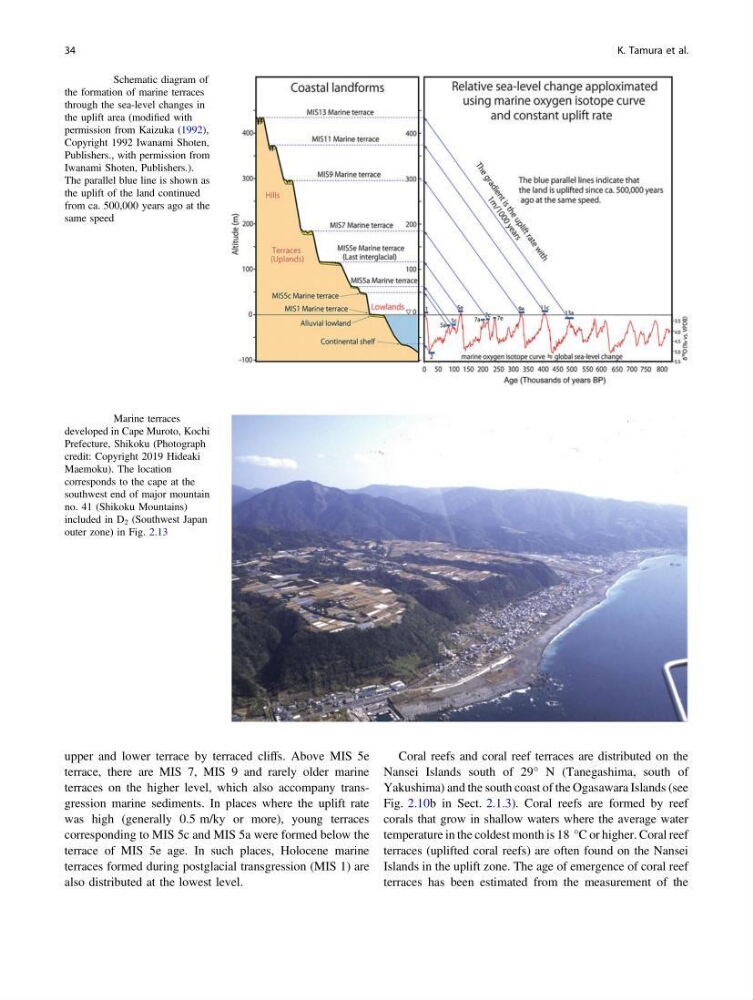
upper and lower terrace by terraced cliffs. Above MIS 5e
terrace, there are MIS 7, MIS 9 and rarely older marine
terraces on the higher level, which also accompany transgression marine sediments. In places where the uplift rate
was high (generally 0.5 m/ky or more), young terraces
corresponding to MIS 5c and MIS 5a were formed below the
terrace of MIS 5e age. In such places, Holocene marine
terraces formed during postglacial transgression (MIS 1) are
also distributed at the lowest level.
Coral reefs and coral reef terraces are distributed on the
Nansei Islands south of 29° N (Tanegashima, south of
Yakushima) and the south coast of the Ogasawara Islands (see
Fig. 2.10b in Sect. 2.1.3). Coral reefs are formed by reef
corals that grow in shallow waters where the average water
temperature in the coldest month is 18 °C or higher. Coral reef
terraces (uplifted coral reefs) are often found on the Nansei
Islands in the uplift zone. The age of emergence of coral reef
terraces has been estimated from the measurement of the
Fig. 2.20 Schematic diagram of
the formation of marine terraces
through the sea-level changes in
the uplift area (modified with
permission from Kaizuka (1992),
Copyright 1992 Iwanami Shoten,
Publishers., with permission from
Iwanami Shoten, Publishers.).
The parallel blue line is shown as
the uplift of the land continued
from ca. 500,000 years ago at the
same speed
Fig. 2.21 Marine terraces
developed in Cape Muroto, Kochi
Prefecture, Shikoku (Photograph
credit: Copyright 2019 Hideaki
Maemoku). The location
corresponds to the cape at the
southwest end of major mountain
no. 41 (Shikoku Mountains)
included in D 2 (Southwest Japan
outer zone) in Fig. 2.13
34
K. Tamura et al.
terrace, there are MIS 7, MIS 9 and rarely older marine
terraces on the higher level, which also accompany transgression marine sediments. In places where the uplift rate
was high (generally 0.5 m/ky or more), young terraces
corresponding to MIS 5c and MIS 5a were formed below the
terrace of MIS 5e age. In such places, Holocene marine
terraces formed during postglacial transgression (MIS 1) are
also distributed at the lowest level.
Coral reefs and coral reef terraces are distributed on the
Nansei Islands south of 29° N (Tanegashima, south of
Yakushima) and the south coast of the Ogasawara Islands (see
Fig. 2.10b in Sect. 2.1.3). Coral reefs are formed by reef
corals that grow in shallow waters where the average water
temperature in the coldest month is 18 °C or higher. Coral reef
terraces (uplifted coral reefs) are often found on the Nansei
Islands in the uplift zone. The age of emergence of coral reef
terraces has been estimated from the measurement of the
Fig. 2.20 Schematic diagram of
the formation of marine terraces
through the sea-level changes in
the uplift area (modified with
permission from Kaizuka (1992),
Copyright 1992 Iwanami Shoten,
Publishers., with permission from
Iwanami Shoten, Publishers.).
The parallel blue line is shown as
the uplift of the land continued
from ca. 500,000 years ago at the
same speed
Fig. 2.21 Marine terraces
developed in Cape Muroto, Kochi
Prefecture, Shikoku (Photograph
credit: Copyright 2019 Hideaki
Maemoku). The location
corresponds to the cape at the
southwest end of major mountain
no. 41 (Shikoku Mountains)
included in D 2 (Southwest Japan
outer zone) in Fig. 2.13
34
K. Tamura et al.