

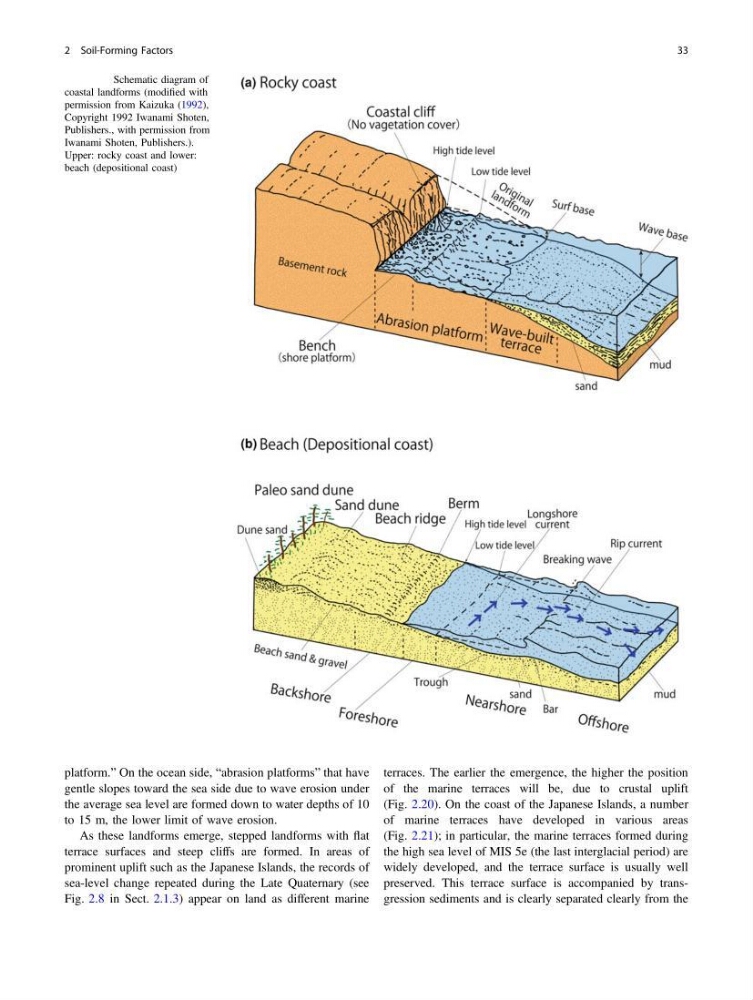
platform.” On the ocean side, “abrasion platforms” that have
gentle slopes toward the sea side due to wave erosion under
the average sea level are formed down to water depths of 10
to 15 m, the lower limit of wave erosion.
As these landforms emerge, stepped landforms with flat
terrace surfaces and steep cliffs are formed. In areas of
prominent uplift such as the Japanese Islands, the records of
sea-level change repeated during the Late Quaternary (see
Fig. 2.8 in Sect. 2.1.3) appear on land as different marine
terraces. The earlier the emergence, the higher the position
of the marine terraces will be, due to crustal uplift
(Fig. 2.20). On the coast of the Japanese Islands, a number
of marine terraces have developed in various areas
(Fig. 2.21); in particular, the marine terraces formed during
the high sea level of MIS 5e (the last interglacial period) are
widely developed, and the terrace surface is usually well
preserved. This terrace surface is accompanied by transgression sediments and is clearly separated clearly from the
Fig. 2.19 Schematic diagram of
coastal landforms (modified with
permission from Kaizuka (1992),
Copyright 1992 Iwanami Shoten,
Publishers., with permission from
Iwanami Shoten, Publishers.).
Upper: rocky coast and lower:
beach (depositional coast)
2 Soil-Forming Factors
33
gentle slopes toward the sea side due to wave erosion under
the average sea level are formed down to water depths of 10
to 15 m, the lower limit of wave erosion.
As these landforms emerge, stepped landforms with flat
terrace surfaces and steep cliffs are formed. In areas of
prominent uplift such as the Japanese Islands, the records of
sea-level change repeated during the Late Quaternary (see
Fig. 2.8 in Sect. 2.1.3) appear on land as different marine
terraces. The earlier the emergence, the higher the position
of the marine terraces will be, due to crustal uplift
(Fig. 2.20). On the coast of the Japanese Islands, a number
of marine terraces have developed in various areas
(Fig. 2.21); in particular, the marine terraces formed during
the high sea level of MIS 5e (the last interglacial period) are
widely developed, and the terrace surface is usually well
preserved. This terrace surface is accompanied by transgression sediments and is clearly separated clearly from the
Fig. 2.19 Schematic diagram of
coastal landforms (modified with
permission from Kaizuka (1992),
Copyright 1992 Iwanami Shoten,
Publishers., with permission from
Iwanami Shoten, Publishers.).
Upper: rocky coast and lower:
beach (depositional coast)
2 Soil-Forming Factors
33