

are high in the water of the Shirakawa River (Kobayashi
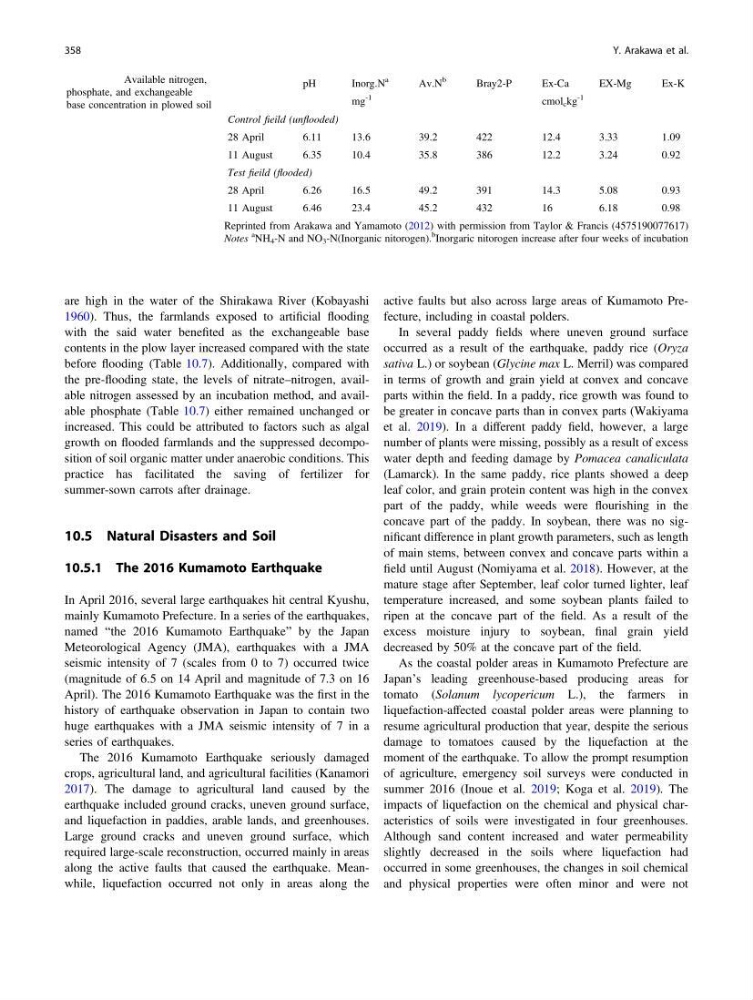
1960). Thus, the farmlands exposed to artificial flooding
with the said water benefited as the exchangeable base
contents in the plow layer increased compared with the state
before flooding (Table 10.7). Additionally, compared with
the pre-flooding state, the levels of nitrate–nitrogen, available nitrogen assessed by an incubation method, and available phosphate (Table 10.7) either remained unchanged or
increased. This could be attributed to factors such as algal
growth on flooded farmlands and the suppressed decomposition of soil organic matter under anaerobic conditions. This
practice has facilitated the saving of fertilizer for
summer-sown carrots after drainage.
10.5 Natural Disasters and Soil
10.5.1 The 2016 Kumamoto Earthquake
In April 2016, several large earthquakes hit central Kyushu,
mainly Kumamoto Prefecture. In a series of the earthquakes,
named “the 2016 Kumamoto Earthquake” by the Japan
Meteorological Agency (JMA), earthquakes with a JMA
seismic intensity of 7 (scales from 0 to 7) occurred twice
(magnitude of 6.5 on 14 April and magnitude of 7.3 on 16
April). The 2016 Kumamoto Earthquake was the first in the
history of earthquake observation in Japan to contain two
huge earthquakes with a JMA seismic intensity of 7 in a
series of earthquakes.
The 2016 Kumamoto Earthquake seriously damaged
crops, agricultural land, and agricultural facilities (Kanamori
2017). The damage to agricultural land caused by the
earthquake included ground cracks, uneven ground surface,
and liquefaction in paddies, arable lands, and greenhouses.
Large ground cracks and uneven ground surface, which
required large-scale reconstruction, occurred mainly in areas
along the active faults that caused the earthquake. Meanwhile, liquefaction occurred not only in areas along the
active faults but also across large areas of Kumamoto Prefecture, including in coastal polders.
In several paddy fields where uneven ground surface
occurred as a result of the earthquake, paddy rice (Oryza
sativa L.) or soybean (Glycine max L. Merril) was compared
in terms of growth and grain yield at convex and concave
parts within the field. In a paddy, rice growth was found to
be greater in concave parts than in convex parts (Wakiyama
et al. 2019). In a different paddy field, however, a large
number of plants were missing, possibly as a result of excess
water depth and feeding damage by Pomacea canaliculata
(Lamarck). In the same paddy, rice plants showed a deep
leaf color, and grain protein content was high in the convex
part of the paddy, while weeds were flourishing in the
concave part of the paddy. In soybean, there was no significant difference in plant growth parameters, such as length
of main stems, between convex and concave parts within a
field until August (Nomiyama et al. 2018). However, at the
mature stage after September, leaf color turned lighter, leaf
temperature increased, and some soybean plants failed to
ripen at the concave part of the field. As a result of the
excess moisture injury to soybean, final grain yield
decreased by 50% at the concave part of the field.
As the coastal polder areas in Kumamoto Prefecture are
Japan’s leading greenhouse-based producing areas for
tomato (Solanum lycopericum L.), the farmers in
liquefaction-affected coastal polder areas were planning to
resume agricultural production that year, despite the serious
damage to tomatoes caused by the liquefaction at the
moment of the earthquake. To allow the prompt resumption
of agriculture, emergency soil surveys were conducted in
summer 2016 (Inoue et al. 2019; Koga et al. 2019). The
impacts of liquefaction on the chemical and physical characteristics of soils were investigated in four greenhouses.
Although sand content increased and water permeability
slightly decreased in the soils where liquefaction had
occurred in some greenhouses, the changes in soil chemical
and physical properties were often minor and were not
Table 10.7 Available nitrogen,
phosphate, and exchangeable
base concentration in plowed soil
pH
Inorg.N
a
Av.N
b
Bray2-P
Ex-Ca
EX-Mg
Ex-K
mg
-1
cmol c kg
-1
Control fieild (unflooded)
28 April
6.11
13.6
39.2
422
12.4
3.33
1.09
11 August
6.35
10.4
35.8
386
12.2
3.24
0.92
Test fieild (flooded)
28 April
6.26
16.5
49.2
391
14.3
5.08
0.93
11 August
6.46
23.4
45.2
432
16
6.18
0.98
Reprinted from Arakawa and Yamamoto (2012) with permission from Taylor & Francis (4575190077617)
Notes
a NH 4 -N and NO 3 -N(Inorganic nitorogen).
b
Inorgaric nitorogen increase after four weeks of incubation
358
Y. Arakawa et al.
1960). Thus, the farmlands exposed to artificial flooding
with the said water benefited as the exchangeable base
contents in the plow layer increased compared with the state
before flooding (Table 10.7). Additionally, compared with
the pre-flooding state, the levels of nitrate–nitrogen, available nitrogen assessed by an incubation method, and available phosphate (Table 10.7) either remained unchanged or
increased. This could be attributed to factors such as algal
growth on flooded farmlands and the suppressed decomposition of soil organic matter under anaerobic conditions. This
practice has facilitated the saving of fertilizer for
summer-sown carrots after drainage.
10.5 Natural Disasters and Soil
10.5.1 The 2016 Kumamoto Earthquake
In April 2016, several large earthquakes hit central Kyushu,
mainly Kumamoto Prefecture. In a series of the earthquakes,
named “the 2016 Kumamoto Earthquake” by the Japan
Meteorological Agency (JMA), earthquakes with a JMA
seismic intensity of 7 (scales from 0 to 7) occurred twice
(magnitude of 6.5 on 14 April and magnitude of 7.3 on 16
April). The 2016 Kumamoto Earthquake was the first in the
history of earthquake observation in Japan to contain two
huge earthquakes with a JMA seismic intensity of 7 in a
series of earthquakes.
The 2016 Kumamoto Earthquake seriously damaged
crops, agricultural land, and agricultural facilities (Kanamori
2017). The damage to agricultural land caused by the
earthquake included ground cracks, uneven ground surface,
and liquefaction in paddies, arable lands, and greenhouses.
Large ground cracks and uneven ground surface, which
required large-scale reconstruction, occurred mainly in areas
along the active faults that caused the earthquake. Meanwhile, liquefaction occurred not only in areas along the
active faults but also across large areas of Kumamoto Prefecture, including in coastal polders.
In several paddy fields where uneven ground surface
occurred as a result of the earthquake, paddy rice (Oryza
sativa L.) or soybean (Glycine max L. Merril) was compared
in terms of growth and grain yield at convex and concave
parts within the field. In a paddy, rice growth was found to
be greater in concave parts than in convex parts (Wakiyama
et al. 2019). In a different paddy field, however, a large
number of plants were missing, possibly as a result of excess
water depth and feeding damage by Pomacea canaliculata
(Lamarck). In the same paddy, rice plants showed a deep
leaf color, and grain protein content was high in the convex
part of the paddy, while weeds were flourishing in the
concave part of the paddy. In soybean, there was no significant difference in plant growth parameters, such as length
of main stems, between convex and concave parts within a
field until August (Nomiyama et al. 2018). However, at the
mature stage after September, leaf color turned lighter, leaf
temperature increased, and some soybean plants failed to
ripen at the concave part of the field. As a result of the
excess moisture injury to soybean, final grain yield
decreased by 50% at the concave part of the field.
As the coastal polder areas in Kumamoto Prefecture are
Japan’s leading greenhouse-based producing areas for
tomato (Solanum lycopericum L.), the farmers in
liquefaction-affected coastal polder areas were planning to
resume agricultural production that year, despite the serious
damage to tomatoes caused by the liquefaction at the
moment of the earthquake. To allow the prompt resumption
of agriculture, emergency soil surveys were conducted in
summer 2016 (Inoue et al. 2019; Koga et al. 2019). The
impacts of liquefaction on the chemical and physical characteristics of soils were investigated in four greenhouses.
Although sand content increased and water permeability
slightly decreased in the soils where liquefaction had
occurred in some greenhouses, the changes in soil chemical
and physical properties were often minor and were not
Table 10.7 Available nitrogen,
phosphate, and exchangeable
base concentration in plowed soil
pH
Inorg.N
a
Av.N
b
Bray2-P
Ex-Ca
EX-Mg
Ex-K
mg
-1
cmol c kg
-1
Control fieild (unflooded)
28 April
6.11
13.6
39.2
422
12.4
3.33
1.09
11 August
6.35
10.4
35.8
386
12.2
3.24
0.92
Test fieild (flooded)
28 April
6.26
16.5
49.2
391
14.3
5.08
0.93
11 August
6.46
23.4
45.2
432
16
6.18
0.98
Reprinted from Arakawa and Yamamoto (2012) with permission from Taylor & Francis (4575190077617)
Notes
a NH 4 -N and NO 3 -N(Inorganic nitorogen).
b
Inorgaric nitorogen increase after four weeks of incubation
358
Y. Arakawa et al.