

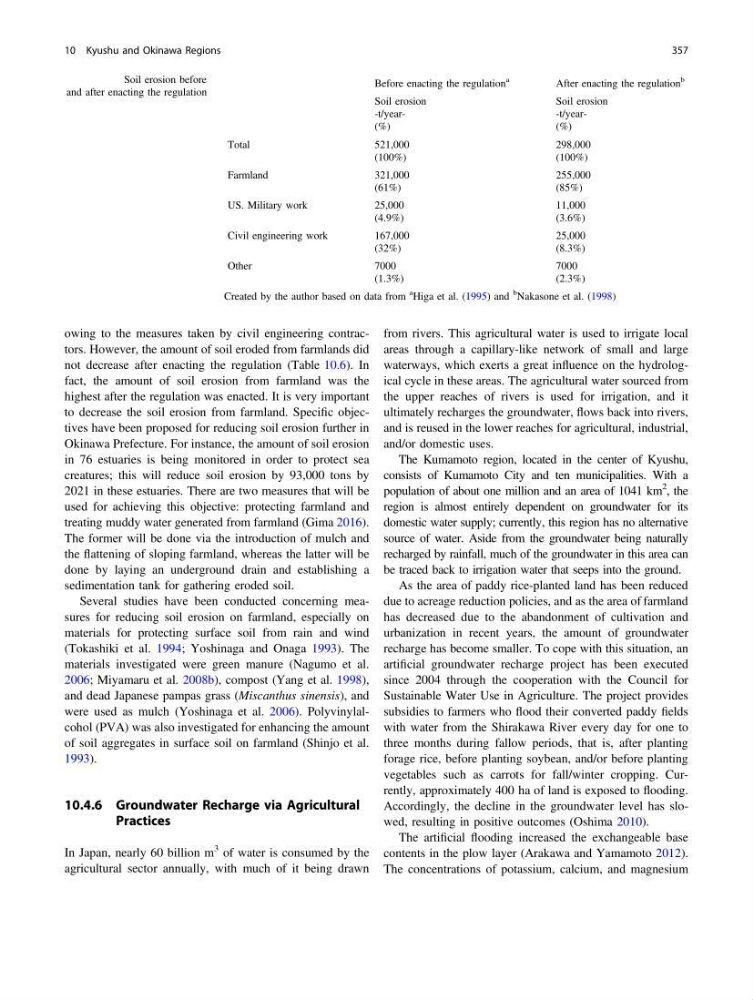
owing to the measures taken by civil engineering contractors. However, the amount of soil eroded from farmlands did
not decrease after enacting the regulation (Table 10.6). In
fact, the amount of soil erosion from farmland was the
highest after the regulation was enacted. It is very important
to decrease the soil erosion from farmland. Specific objectives have been proposed for reducing soil erosion further in
Okinawa Prefecture. For instance, the amount of soil erosion
in 76 estuaries is being monitored in order to protect sea
creatures; this will reduce soil erosion by 93,000 tons by
2021 in these estuaries. There are two measures that will be
used for achieving this objective: protecting farmland and
treating muddy water generated from farmland (Gima 2016).
The former will be done via the introduction of mulch and
the flattening of sloping farmland, whereas the latter will be
done by laying an underground drain and establishing a
sedimentation tank for gathering eroded soil.
Several studies have been conducted concerning measures for reducing soil erosion on farmland, especially on
materials for protecting surface soil from rain and wind
(Tokashiki et al. 1994; Yoshinaga and Onaga 1993). The
materials investigated were green manure (Nagumo et al.
2006; Miyamaru et al. 2008b), compost (Yang et al. 1998),
and dead Japanese pampas grass (Miscanthus sinensis), and
were used as mulch (Yoshinaga et al. 2006). Polyvinylalcohol (PVA) was also investigated for enhancing the amount
of soil aggregates in surface soil on farmland (Shinjo et al.
1993).
10.4.6 Groundwater Recharge via Agricultural
Practices
In Japan, nearly 60 billion m
3 of water is consumed by the
agricultural sector annually, with much of it being drawn
from rivers. This agricultural water is used to irrigate local
areas through a capillary-like network of small and large
waterways, which exerts a great influence on the hydrological cycle in these areas. The agricultural water sourced from
the upper reaches of rivers is used for irrigation, and it
ultimately recharges the groundwater, flows back into rivers,
and is reused in the lower reaches for agricultural, industrial,
and/or domestic uses.
The Kumamoto region, located in the center of Kyushu,
consists of Kumamoto City and ten municipalities. With a
population of about one million and an area of 1041 km
2
, the
region is almost entirely dependent on groundwater for its
domestic water supply; currently, this region has no alternative
source of water. Aside from the groundwater being naturally
recharged by rainfall, much of the groundwater in this area can
be traced back to irrigation water that seeps into the ground.
As the area of paddy rice-planted land has been reduced
due to acreage reduction policies, and as the area of farmland
has decreased due to the abandonment of cultivation and
urbanization in recent years, the amount of groundwater
recharge has become smaller. To cope with this situation, an
artificial groundwater recharge project has been executed
since 2004 through the cooperation with the Council for
Sustainable Water Use in Agriculture. The project provides
subsidies to farmers who flood their converted paddy fields
with water from the Shirakawa River every day for one to
three months during fallow periods, that is, after planting
forage rice, before planting soybean, and/or before planting
vegetables such as carrots for fall/winter cropping. Currently, approximately 400 ha of land is exposed to flooding.
Accordingly, the decline in the groundwater level has slowed, resulting in positive outcomes (Oshima 2010).
The artificial flooding increased the exchangeable base
contents in the plow layer (Arakawa and Yamamoto 2012).
The concentrations of potassium, calcium, and magnesium
Table 10.6 Soil erosion before
and after enacting the regulation
Before enacting the regulation
a
After enacting the regulation
b
Soil erosion
-t/year(%)
Soil erosion
-t/year(%)
Total
521,000
(100%)
298,000
(100%)
Farmland
321,000
(61%)
255,000
(85%)
US. Military work
25,000
(4.9%)
11,000
(3.6%)
Civil engineering work
167,000
(32%)
25,000
(8.3%)
Other
7000
(1.3%)
7000
(2.3%)
Created by the author based on data from
a Higa et al. (1995) and
b
Nakasone et al. (1998)
10 Kyushu and Okinawa Regions
357
not decrease after enacting the regulation (Table 10.6). In
fact, the amount of soil erosion from farmland was the
highest after the regulation was enacted. It is very important
to decrease the soil erosion from farmland. Specific objectives have been proposed for reducing soil erosion further in
Okinawa Prefecture. For instance, the amount of soil erosion
in 76 estuaries is being monitored in order to protect sea
creatures; this will reduce soil erosion by 93,000 tons by
2021 in these estuaries. There are two measures that will be
used for achieving this objective: protecting farmland and
treating muddy water generated from farmland (Gima 2016).
The former will be done via the introduction of mulch and
the flattening of sloping farmland, whereas the latter will be
done by laying an underground drain and establishing a
sedimentation tank for gathering eroded soil.
Several studies have been conducted concerning measures for reducing soil erosion on farmland, especially on
materials for protecting surface soil from rain and wind
(Tokashiki et al. 1994; Yoshinaga and Onaga 1993). The
materials investigated were green manure (Nagumo et al.
2006; Miyamaru et al. 2008b), compost (Yang et al. 1998),
and dead Japanese pampas grass (Miscanthus sinensis), and
were used as mulch (Yoshinaga et al. 2006). Polyvinylalcohol (PVA) was also investigated for enhancing the amount
of soil aggregates in surface soil on farmland (Shinjo et al.
1993).
10.4.6 Groundwater Recharge via Agricultural
Practices
In Japan, nearly 60 billion m
3 of water is consumed by the
agricultural sector annually, with much of it being drawn
from rivers. This agricultural water is used to irrigate local
areas through a capillary-like network of small and large
waterways, which exerts a great influence on the hydrological cycle in these areas. The agricultural water sourced from
the upper reaches of rivers is used for irrigation, and it
ultimately recharges the groundwater, flows back into rivers,
and is reused in the lower reaches for agricultural, industrial,
and/or domestic uses.
The Kumamoto region, located in the center of Kyushu,
consists of Kumamoto City and ten municipalities. With a
population of about one million and an area of 1041 km
2
, the
region is almost entirely dependent on groundwater for its
domestic water supply; currently, this region has no alternative
source of water. Aside from the groundwater being naturally
recharged by rainfall, much of the groundwater in this area can
be traced back to irrigation water that seeps into the ground.
As the area of paddy rice-planted land has been reduced
due to acreage reduction policies, and as the area of farmland
has decreased due to the abandonment of cultivation and
urbanization in recent years, the amount of groundwater
recharge has become smaller. To cope with this situation, an
artificial groundwater recharge project has been executed
since 2004 through the cooperation with the Council for
Sustainable Water Use in Agriculture. The project provides
subsidies to farmers who flood their converted paddy fields
with water from the Shirakawa River every day for one to
three months during fallow periods, that is, after planting
forage rice, before planting soybean, and/or before planting
vegetables such as carrots for fall/winter cropping. Currently, approximately 400 ha of land is exposed to flooding.
Accordingly, the decline in the groundwater level has slowed, resulting in positive outcomes (Oshima 2010).
The artificial flooding increased the exchangeable base
contents in the plow layer (Arakawa and Yamamoto 2012).
The concentrations of potassium, calcium, and magnesium
Table 10.6 Soil erosion before
and after enacting the regulation
Before enacting the regulation
a
After enacting the regulation
b
Soil erosion
-t/year(%)
Soil erosion
-t/year(%)
Total
521,000
(100%)
298,000
(100%)
Farmland
321,000
(61%)
255,000
(85%)
US. Military work
25,000
(4.9%)
11,000
(3.6%)
Civil engineering work
167,000
(32%)
25,000
(8.3%)
Other
7000
(1.3%)
7000
(2.3%)
Created by the author based on data from
a Higa et al. (1995) and
b
Nakasone et al. (1998)
10 Kyushu and Okinawa Regions
357