

expected to seriously decrease plant growth (Koga et al.
2019). Sugiyama et al. (2019) reported that there was no
clear difference in plant growth parameters affecting tomato
yields, such as the number of flowers, between
liquefaction-affected and unaffected plots in the greenhouse.
The possible reason for the minor impact on soils and crops
in greenhouses in this earthquake was that sand released as a
result of liquefaction was visually detectable on the ground
surface, but the total amount of sand released was substantially limited.
10.5.2 Coastal Flood Caused by Typhoon No. 18
The Kyushu and Okinawa regions are frequently hit by typhoons and often suffer from storm surge disasters. Typhoon
No. 18, in September 1999, produced coastal flooding
through a combination of a stormy wind exceeding 50 m/s
and high tide, which caused seawater, including
water-bottom sediment, flowing back from rivers to flow
onto agricultural lands near the coast in Uto-gun (Uto-shi)
and Yatsushiro-gun in Kumamoto Prefecture within Shiranui
Bay. No yield was obtained from the paddy fields, greenhouses, and orchards just before harvest. Furthermore, a high
level of salt remained in the soil, and it was necessary to
promptly remove deposits and salt and restart farming.
To remove salt from high-salinity soils, soils must be
washed with a sufficient amount of fresh water. However, the
salt removal effect decreased in fields such as those with
poor drainage, clayey soil, and with hardpan in the lower
layer of the surface; therefore, the drainage performance of
the field should be ensured. Yamamoto et al. (1996) reported
that permeability was improved and the salt removal effect
was increased by allowing excessive water on the ground to
be moved to a collecting head of ordinary underdrain via a
combination
of
ordinary
underdrainage
and
sub-underdrainage or mole underdrainage construction. It
was also reported that in addition to the construction of
ordinary underdrain and mole underdrain, the combination
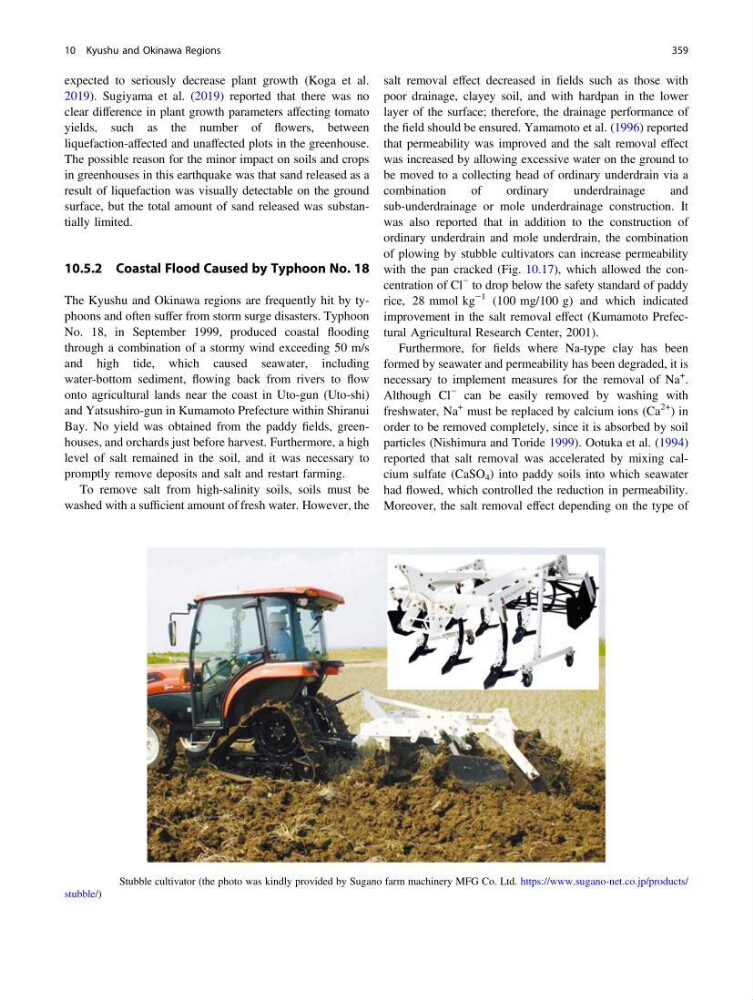
of plowing by stubble cultivators can increase permeability
with the pan cracked (Fig. 10.17), which allowed the concentration of Cl
− to drop below the safety standard of paddy
rice, 28 mmol kg
−1 (100 mg/100 g) and which indicated
improvement in the salt removal effect (Kumamoto Prefectural Agricultural Research Center, 2001).
Furthermore, for fields where Na-type clay has been
formed by seawater and permeability has been degraded, it is
necessary to implement measures for the removal of Na
+
.
Although Cl
− can be easily removed by washing with
freshwater, Na
+ must be replaced by calcium ions (Ca
2+ ) in
order to be removed completely, since it is absorbed by soil
particles (Nishimura and Toride 1999). Ootuka et al. (1994)
reported that salt removal was accelerated by mixing calcium sulfate (CaSO 4 ) into paddy soils into which seawater
had flowed, which controlled the reduction in permeability.
Moreover, the salt removal effect depending on the type of
Fig. 10.17 Stubble cultivator (the photo was kindly provided by Sugano farm machinery MFG Co. Ltd. https://www.sugano-net.co.jp/products/
stubble/)
10 Kyushu and Okinawa Regions
359
2019). Sugiyama et al. (2019) reported that there was no
clear difference in plant growth parameters affecting tomato
yields, such as the number of flowers, between
liquefaction-affected and unaffected plots in the greenhouse.
The possible reason for the minor impact on soils and crops
in greenhouses in this earthquake was that sand released as a
result of liquefaction was visually detectable on the ground
surface, but the total amount of sand released was substantially limited.
10.5.2 Coastal Flood Caused by Typhoon No. 18
The Kyushu and Okinawa regions are frequently hit by typhoons and often suffer from storm surge disasters. Typhoon
No. 18, in September 1999, produced coastal flooding
through a combination of a stormy wind exceeding 50 m/s
and high tide, which caused seawater, including
water-bottom sediment, flowing back from rivers to flow
onto agricultural lands near the coast in Uto-gun (Uto-shi)
and Yatsushiro-gun in Kumamoto Prefecture within Shiranui
Bay. No yield was obtained from the paddy fields, greenhouses, and orchards just before harvest. Furthermore, a high
level of salt remained in the soil, and it was necessary to
promptly remove deposits and salt and restart farming.
To remove salt from high-salinity soils, soils must be
washed with a sufficient amount of fresh water. However, the
salt removal effect decreased in fields such as those with
poor drainage, clayey soil, and with hardpan in the lower
layer of the surface; therefore, the drainage performance of
the field should be ensured. Yamamoto et al. (1996) reported
that permeability was improved and the salt removal effect
was increased by allowing excessive water on the ground to
be moved to a collecting head of ordinary underdrain via a
combination
of
ordinary
underdrainage
and
sub-underdrainage or mole underdrainage construction. It
was also reported that in addition to the construction of
ordinary underdrain and mole underdrain, the combination
of plowing by stubble cultivators can increase permeability
with the pan cracked (Fig. 10.17), which allowed the concentration of Cl
− to drop below the safety standard of paddy
rice, 28 mmol kg
−1 (100 mg/100 g) and which indicated
improvement in the salt removal effect (Kumamoto Prefectural Agricultural Research Center, 2001).
Furthermore, for fields where Na-type clay has been
formed by seawater and permeability has been degraded, it is
necessary to implement measures for the removal of Na
+
.
Although Cl
− can be easily removed by washing with
freshwater, Na
+ must be replaced by calcium ions (Ca
2+ ) in
order to be removed completely, since it is absorbed by soil
particles (Nishimura and Toride 1999). Ootuka et al. (1994)
reported that salt removal was accelerated by mixing calcium sulfate (CaSO 4 ) into paddy soils into which seawater
had flowed, which controlled the reduction in permeability.
Moreover, the salt removal effect depending on the type of
Fig. 10.17 Stubble cultivator (the photo was kindly provided by Sugano farm machinery MFG Co. Ltd. https://www.sugano-net.co.jp/products/
stubble/)
10 Kyushu and Okinawa Regions
359