

After the end of the last glacial period, sea level rose due
to the melting of the continental ice sheet and outside seawater again flowed into the Sea of Japan. The change in the
d
18 O values of planktonic foraminifera measured in marine
sediment cores from the Sea of Japan revealed that the
Oyashio Current also known as Okhotsk Current flowed into
the Sea of Japan since 15,500 years ago (Oba et al. 1991;
Okumura et al. 1996; Matsui et al. 1998). The Tsushima
Current began to flow into the Sea of Japan at full strength
around 10,000 years ago or later (Oba and Akasaka 1990).
After the last glacial maximum (MIS 2), the lowland vegetation of the Japanese Islands from Honshu to Hokkaido
changed, largely around 14,000 years ago and between
12,000 and 11,000 years ago in conformity with the arrival
of the Kuroshio Current and the Tsushima Current (Tsuji
1997). After about 9000 years ago, the influence of the
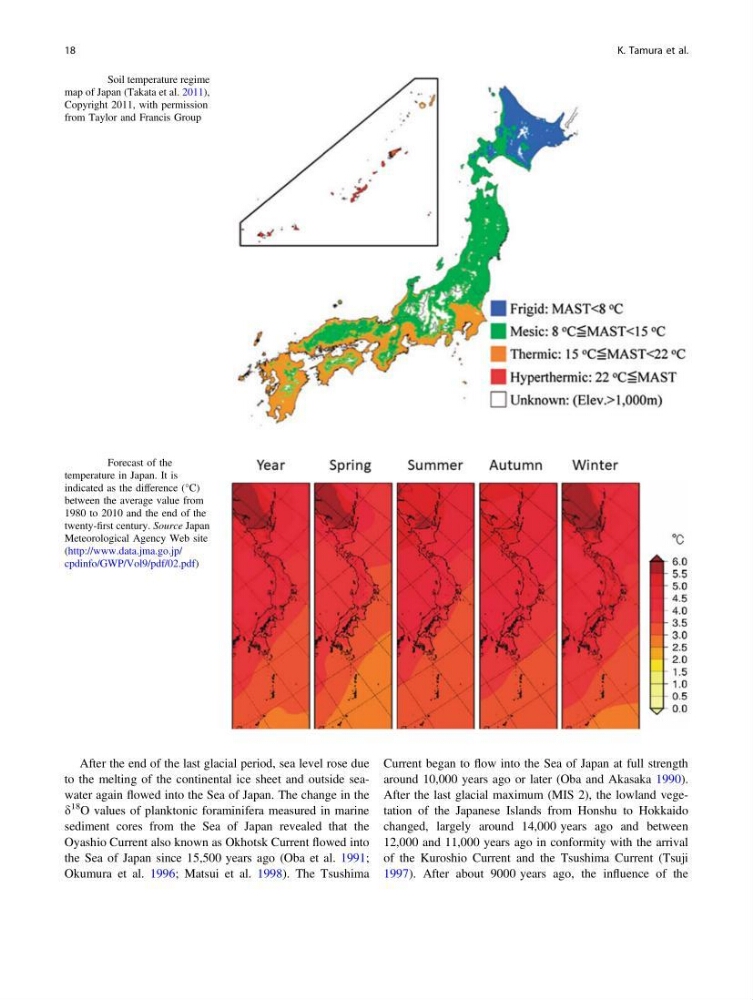
Fig. 2.5 Soil temperature regime
map of Japan (Takata et al. 2011),
Copyright 2011, with permission
from Taylor and Francis Group
Fig. 2.6 Forecast of the
temperature in Japan. It is
indicated as the difference (°C)
between the average value from
1980 to 2010 and the end of the
twenty-first century. Source Japan
Meteorological Agency Web site
(http://www.data.jma.go.jp/
cpdinfo/GWP/Vol9/pdf/02.pdf)
18
K. Tamura et al.
to the melting of the continental ice sheet and outside seawater again flowed into the Sea of Japan. The change in the
d
18 O values of planktonic foraminifera measured in marine
sediment cores from the Sea of Japan revealed that the
Oyashio Current also known as Okhotsk Current flowed into
the Sea of Japan since 15,500 years ago (Oba et al. 1991;
Okumura et al. 1996; Matsui et al. 1998). The Tsushima
Current began to flow into the Sea of Japan at full strength
around 10,000 years ago or later (Oba and Akasaka 1990).
After the last glacial maximum (MIS 2), the lowland vegetation of the Japanese Islands from Honshu to Hokkaido
changed, largely around 14,000 years ago and between
12,000 and 11,000 years ago in conformity with the arrival
of the Kuroshio Current and the Tsushima Current (Tsuji
1997). After about 9000 years ago, the influence of the
Fig. 2.5 Soil temperature regime
map of Japan (Takata et al. 2011),
Copyright 2011, with permission
from Taylor and Francis Group
Fig. 2.6 Forecast of the
temperature in Japan. It is
indicated as the difference (°C)
between the average value from
1980 to 2010 and the end of the
twenty-first century. Source Japan
Meteorological Agency Web site
(http://www.data.jma.go.jp/
cpdinfo/GWP/Vol9/pdf/02.pdf)
18
K. Tamura et al.