

on. Currently, most soybean production in Japan is conducted in rotational upland fields or fields converted from
paddy rice field (upland paddy field). Upland paddy fields
account for more than 80% of soybean fields in Saga and
Fukuoka Prefectures. In Japan, paddy rice cultivation in
alluvial soil is a major production system, and wheat and
soybean are recommended as the rotational crops. Rice
production is conducted mostly under waterlogged conditions during the cultivation period. These anaerobic conditions create soil reducing dissolved oxygen content and
oxidative–reductive potential and cause soil bacteria to
undergo anaerobic respiration. The effectiveness of energy
acquisition by anaerobic respiration depends on bacteria
species and strains. Soil bacteria that are highly effective in
terms of energy acquisition will be dominant under anaerobic conditions.
The genus Bradyrhizobium is a group of soil bacteria that
are active in symbiotic nitrogen fixation with soybean. The
nitrogen-fixing ability of soybean Bradyrhizobia depends on
the strains present and the environmental conditions
involved in the symbiosis. The major soybean-nodulating
rhizobia are Bradyrhizobium japonicum, Bradyrhizobium
diazoefficiens, Bradyrhizobium elkanii, and Ensifer
(Sinorhizobium) fredii. The major endosymbionts in Japan
are considered to be B. japonicum, B. diazoefficiens, and B.
elkanii in acidic–neutral soils and E. fredii in alkaline soils
(Saeki et al. 2006; Suzuki et al. 2008; Saeki et al. 2013).
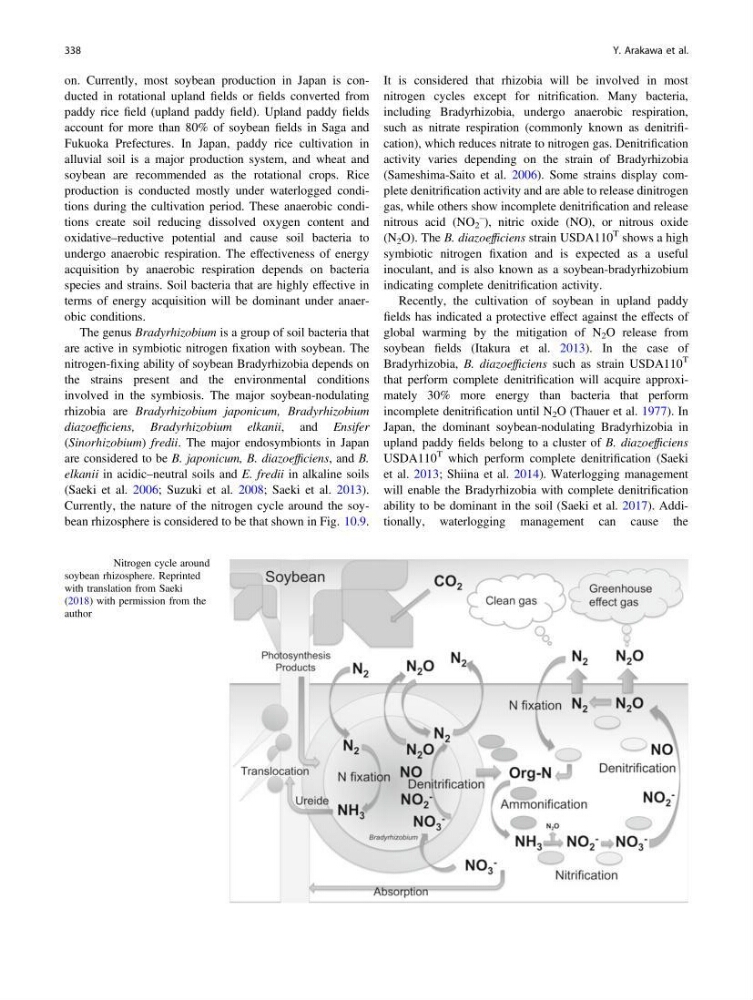
Currently, the nature of the nitrogen cycle around the soybean rhizosphere is considered to be that shown in Fig. 10.9.
It is considered that rhizobia will be involved in most
nitrogen cycles except for nitrification. Many bacteria,
including Bradyrhizobia, undergo anaerobic respiration,
such as nitrate respiration (commonly known as denitrification), which reduces nitrate to nitrogen gas. Denitrification
activity varies depending on the strain of Bradyrhizobia
(Sameshima-Saito et al. 2006). Some strains display complete denitrification activity and are able to release dinitrogen
gas, while others show incomplete denitrification and release
nitrous acid (NO 2
– ), nitric oxide (NO), or nitrous oxide
(N 2 O). The B. diazoefficiens strain USDA110
T shows a high
symbiotic nitrogen fixation and is expected as a useful
inoculant, and is also known as a soybean-bradyrhizobium
indicating complete denitrification activity.
Recently, the cultivation of soybean in upland paddy
fields has indicated a protective effect against the effects of
global warming by the mitigation of N 2 O release from
soybean fields (Itakura et al. 2013). In the case of
Bradyrhizobia, B. diazoefficiens such as strain USDA110
T
that perform complete denitrification will acquire approximately 30% more energy than bacteria that perform
incomplete denitrification until N 2 O (Thauer et al. 1977). In
Japan, the dominant soybean-nodulating Bradyrhizobia in
upland paddy fields belong to a cluster of B. diazoefficiens
USDA110
T which perform complete denitrification (Saeki
et al. 2013; Shiina et al. 2014). Waterlogging management
will enable the Bradyrhizobia with complete denitrification
ability to be dominant in the soil (Saeki et al. 2017). Additionally, waterlogging management can cause the
Fig. 10.9 Nitrogen cycle around
soybean rhizosphere. Reprinted
with translation from Saeki
(2018) with permission from the
author
338
Y. Arakawa et al.
paddy rice field (upland paddy field). Upland paddy fields
account for more than 80% of soybean fields in Saga and
Fukuoka Prefectures. In Japan, paddy rice cultivation in
alluvial soil is a major production system, and wheat and
soybean are recommended as the rotational crops. Rice
production is conducted mostly under waterlogged conditions during the cultivation period. These anaerobic conditions create soil reducing dissolved oxygen content and
oxidative–reductive potential and cause soil bacteria to
undergo anaerobic respiration. The effectiveness of energy
acquisition by anaerobic respiration depends on bacteria
species and strains. Soil bacteria that are highly effective in
terms of energy acquisition will be dominant under anaerobic conditions.
The genus Bradyrhizobium is a group of soil bacteria that
are active in symbiotic nitrogen fixation with soybean. The
nitrogen-fixing ability of soybean Bradyrhizobia depends on
the strains present and the environmental conditions
involved in the symbiosis. The major soybean-nodulating
rhizobia are Bradyrhizobium japonicum, Bradyrhizobium
diazoefficiens, Bradyrhizobium elkanii, and Ensifer
(Sinorhizobium) fredii. The major endosymbionts in Japan
are considered to be B. japonicum, B. diazoefficiens, and B.
elkanii in acidic–neutral soils and E. fredii in alkaline soils
(Saeki et al. 2006; Suzuki et al. 2008; Saeki et al. 2013).
Currently, the nature of the nitrogen cycle around the soybean rhizosphere is considered to be that shown in Fig. 10.9.
It is considered that rhizobia will be involved in most
nitrogen cycles except for nitrification. Many bacteria,
including Bradyrhizobia, undergo anaerobic respiration,
such as nitrate respiration (commonly known as denitrification), which reduces nitrate to nitrogen gas. Denitrification
activity varies depending on the strain of Bradyrhizobia
(Sameshima-Saito et al. 2006). Some strains display complete denitrification activity and are able to release dinitrogen
gas, while others show incomplete denitrification and release
nitrous acid (NO 2
– ), nitric oxide (NO), or nitrous oxide
(N 2 O). The B. diazoefficiens strain USDA110
T shows a high
symbiotic nitrogen fixation and is expected as a useful
inoculant, and is also known as a soybean-bradyrhizobium
indicating complete denitrification activity.
Recently, the cultivation of soybean in upland paddy
fields has indicated a protective effect against the effects of
global warming by the mitigation of N 2 O release from
soybean fields (Itakura et al. 2013). In the case of
Bradyrhizobia, B. diazoefficiens such as strain USDA110
T
that perform complete denitrification will acquire approximately 30% more energy than bacteria that perform
incomplete denitrification until N 2 O (Thauer et al. 1977). In
Japan, the dominant soybean-nodulating Bradyrhizobia in
upland paddy fields belong to a cluster of B. diazoefficiens
USDA110
T which perform complete denitrification (Saeki
et al. 2013; Shiina et al. 2014). Waterlogging management
will enable the Bradyrhizobia with complete denitrification
ability to be dominant in the soil (Saeki et al. 2017). Additionally, waterlogging management can cause the
Fig. 10.9 Nitrogen cycle around
soybean rhizosphere. Reprinted
with translation from Saeki
(2018) with permission from the
author
338
Y. Arakawa et al.