

neutralization of soil acidity under reductive conditions. An
almost-neutral pH is also suitable for activities of
Bradyrhizobia infecting host soybean. This phenomenon is
one of the merits of soybean cultivation in upland paddy
fields.
Most soybean production in Saga and Fukuoka Prefectures is conducted on upland paddy fields. This agricultural
system involves the management of soybean Bradyrhizobia,
both to increase the soybean yield and to mitigate the
emission of N 2 O gas from soybean fields. If soybean germination damage caused by excess soil water can be avoided
by the construction of ridges in the field, the rotational crop
production of paddy rice and soybean will allow good
agricultural performance for Asian monsoon regions.
10.2.4 Manure Application and Organic
Agriculture
In Kyushu, organic amendments made from crop residue
(rice straw, chaff, wheat straw, etc.) and animal manure and
food residues discharged from food processing factories are
frequently used. On the other hand, improper manure management can cause harm to the environment or lead to a
significant risk of air and water pollution, as manure contains
substantial quantities of N, much of which is in inorganic
forms. For example, Niimi (2002) reported that the extensive
application of dairy cattle slurry barnyard manure to upland
fields resulted in significant losses of N by ammonia
volatilization, nitrate leaching, and nitrous oxide emission.
Accordingly, it is necessary to develop circular agriculture,
in which organic resources are used effectively for both
sustainable production and environmental protection such as
the prevention of groundwater contamination. Additionally,
organic farming is gradually expanding in Kyushu. Organic
farming involves the use of organic fertilizers; however, the
nitrogen supply from organic fertilizers is often not sufficiently absorbed by crops, even though nitrogenous organic
constituents are fully contained, since the nitrogen in organic
constituents is absorbed by crops just after mineralization by
soil microorganisms. This is the major reason that organic
farming is less productive than conventional farming (Seufert et al. 2012).
One way to improve productivity in organic farming is to
co-apply different types of organic fertilizers with different
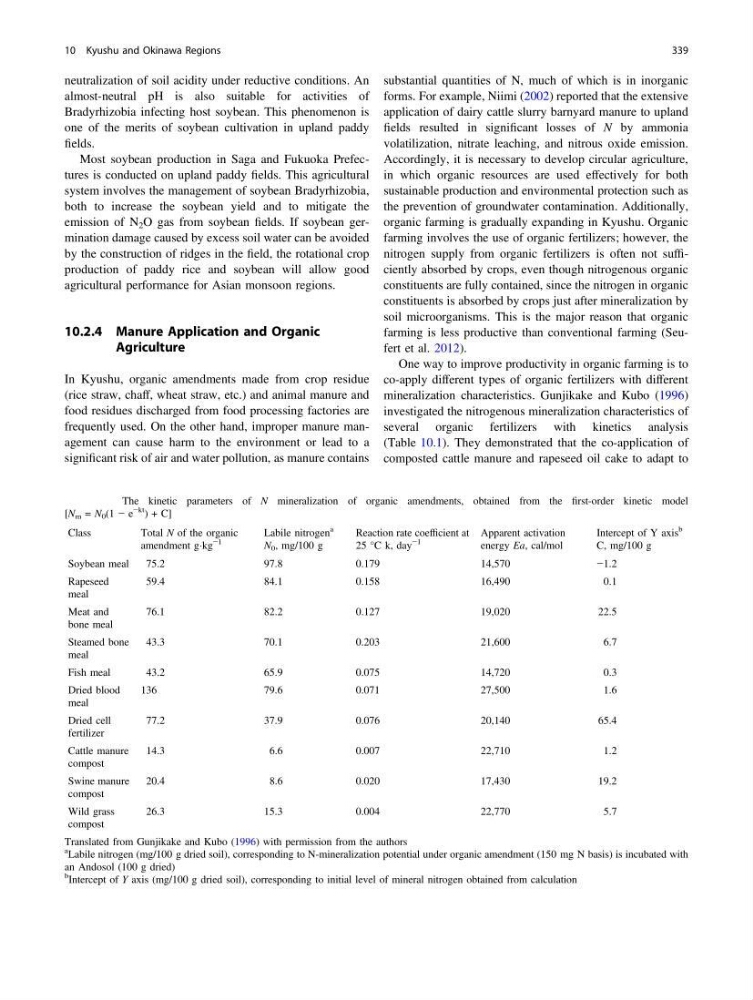
mineralization characteristics. Gunjikake and Kubo (1996)
investigated the nitrogenous mineralization characteristics of
several organic fertilizers with kinetics analysis
(Table 10.1). They demonstrated that the co-application of
composted cattle manure and rapeseed oil cake to adapt to
Table 10.1 The kinetic parameters of N mineralization of organic amendments, obtained from the first-order kinetic model
[N m = N 0 (1 − e
−kt ) + C]
Class
Total N of the organic
amendment gÁkg
−1
Labile nitrogen
a
N 0 , mg/100 g
Reaction rate coefficient at
25 °C k, day
−1
Apparent activation
energy Ea, cal/mol
Intercept of Y axis
b
C, mg/100 g
Soybean meal
75.2
97.8
0.179
14,570
−1.2
Rapeseed
meal
59.4
84.1
0.158
16,490
0.1
Meat and
bone meal
76.1
82.2
0.127
19,020
22.5
Steamed bone
meal
43.3
70.1
0.203
21,600
6.7
Fish meal
43.2
65.9
0.075
14,720
0.3
Dried blood
meal
136
79.6
0.071
27,500
1.6
Dried cell
fertilizer
77.2
37.9
0.076
20,140
65.4
Cattle manure
compost
14.3
6.6
0.007
22,710
1.2
Swine manure
compost
20.4
8.6
0.020
17,430
19.2
Wild grass
compost
26.3
15.3
0.004
22,770
5.7
Translated from Gunjikake and Kubo (1996) with permission from the authors
a Labile nitrogen (mg/100 g dried soil), corresponding to N-mineralization potential under organic amendment (150 mg N basis) is incubated with
an Andosol (100 g dried)
b
Intercept of Y axis (mg/100 g dried soil), corresponding to initial level of mineral nitrogen obtained from calculation
10 Kyushu and Okinawa Regions
339
almost-neutral pH is also suitable for activities of
Bradyrhizobia infecting host soybean. This phenomenon is
one of the merits of soybean cultivation in upland paddy
fields.
Most soybean production in Saga and Fukuoka Prefectures is conducted on upland paddy fields. This agricultural
system involves the management of soybean Bradyrhizobia,
both to increase the soybean yield and to mitigate the
emission of N 2 O gas from soybean fields. If soybean germination damage caused by excess soil water can be avoided
by the construction of ridges in the field, the rotational crop
production of paddy rice and soybean will allow good
agricultural performance for Asian monsoon regions.
10.2.4 Manure Application and Organic
Agriculture
In Kyushu, organic amendments made from crop residue
(rice straw, chaff, wheat straw, etc.) and animal manure and
food residues discharged from food processing factories are
frequently used. On the other hand, improper manure management can cause harm to the environment or lead to a
significant risk of air and water pollution, as manure contains
substantial quantities of N, much of which is in inorganic
forms. For example, Niimi (2002) reported that the extensive
application of dairy cattle slurry barnyard manure to upland
fields resulted in significant losses of N by ammonia
volatilization, nitrate leaching, and nitrous oxide emission.
Accordingly, it is necessary to develop circular agriculture,
in which organic resources are used effectively for both
sustainable production and environmental protection such as
the prevention of groundwater contamination. Additionally,
organic farming is gradually expanding in Kyushu. Organic
farming involves the use of organic fertilizers; however, the
nitrogen supply from organic fertilizers is often not sufficiently absorbed by crops, even though nitrogenous organic
constituents are fully contained, since the nitrogen in organic
constituents is absorbed by crops just after mineralization by
soil microorganisms. This is the major reason that organic
farming is less productive than conventional farming (Seufert et al. 2012).
One way to improve productivity in organic farming is to
co-apply different types of organic fertilizers with different
mineralization characteristics. Gunjikake and Kubo (1996)
investigated the nitrogenous mineralization characteristics of
several organic fertilizers with kinetics analysis
(Table 10.1). They demonstrated that the co-application of
composted cattle manure and rapeseed oil cake to adapt to
Table 10.1 The kinetic parameters of N mineralization of organic amendments, obtained from the first-order kinetic model
[N m = N 0 (1 − e
−kt ) + C]
Class
Total N of the organic
amendment gÁkg
−1
Labile nitrogen
a
N 0 , mg/100 g
Reaction rate coefficient at
25 °C k, day
−1
Apparent activation
energy Ea, cal/mol
Intercept of Y axis
b
C, mg/100 g
Soybean meal
75.2
97.8
0.179
14,570
−1.2
Rapeseed
meal
59.4
84.1
0.158
16,490
0.1
Meat and
bone meal
76.1
82.2
0.127
19,020
22.5
Steamed bone
meal
43.3
70.1
0.203
21,600
6.7
Fish meal
43.2
65.9
0.075
14,720
0.3
Dried blood
meal
136
79.6
0.071
27,500
1.6
Dried cell
fertilizer
77.2
37.9
0.076
20,140
65.4
Cattle manure
compost
14.3
6.6
0.007
22,710
1.2
Swine manure
compost
20.4
8.6
0.020
17,430
19.2
Wild grass
compost
26.3
15.3
0.004
22,770
5.7
Translated from Gunjikake and Kubo (1996) with permission from the authors
a Labile nitrogen (mg/100 g dried soil), corresponding to N-mineralization potential under organic amendment (150 mg N basis) is incubated with
an Andosol (100 g dried)
b
Intercept of Y axis (mg/100 g dried soil), corresponding to initial level of mineral nitrogen obtained from calculation
10 Kyushu and Okinawa Regions
339