

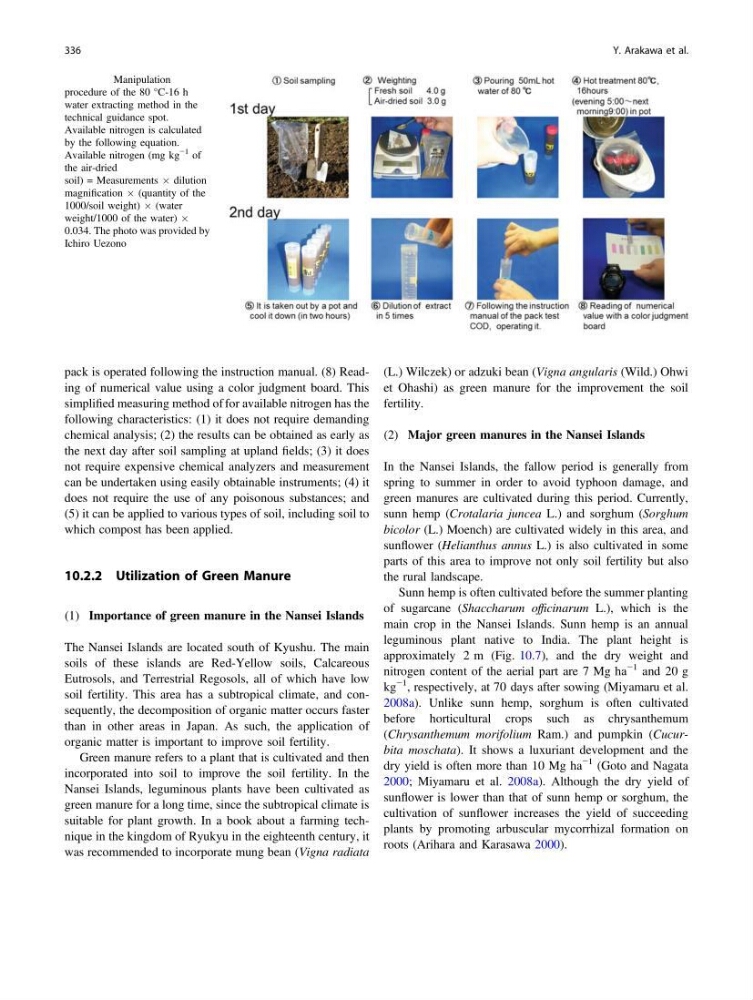
pack is operated following the instruction manual. (8) Reading of numerical value using a color judgment board. This
simplified measuring method of for available nitrogen has the
following characteristics: (1) it does not require demanding
chemical analysis; (2) the results can be obtained as early as
the next day after soil sampling at upland fields; (3) it does
not require expensive chemical analyzers and measurement
can be undertaken using easily obtainable instruments; (4) it
does not require the use of any poisonous substances; and
(5) it can be applied to various types of soil, including soil to
which compost has been applied.
10.2.2 Utilization of Green Manure
(1) Importance of green manure in the Nansei Islands
The Nansei Islands are located south of Kyushu. The main
soils of these islands are Red-Yellow soils, Calcareous
Eutrosols, and Terrestrial Regosols, all of which have low
soil fertility. This area has a subtropical climate, and consequently, the decomposition of organic matter occurs faster
than in other areas in Japan. As such, the application of
organic matter is important to improve soil fertility.
Green manure refers to a plant that is cultivated and then
incorporated into soil to improve the soil fertility. In the
Nansei Islands, leguminous plants have been cultivated as
green manure for a long time, since the subtropical climate is
suitable for plant growth. In a book about a farming technique in the kingdom of Ryukyu in the eighteenth century, it
was recommended to incorporate mung bean (Vigna radiata
(L.) Wilczek) or adzuki bean (Vigna angularis (Wild.) Ohwi
et Ohashi) as green manure for the improvement the soil
fertility.
(2) Major green manures in the Nansei Islands
In the Nansei Islands, the fallow period is generally from
spring to summer in order to avoid typhoon damage, and
green manures are cultivated during this period. Currently,
sunn hemp (Crotalaria juncea L.) and sorghum (Sorghum
bicolor (L.) Moench) are cultivated widely in this area, and
sunflower (Helianthus annus L.) is also cultivated in some
parts of this area to improve not only soil fertility but also
the rural landscape.
Sunn hemp is often cultivated before the summer planting
of sugarcane (Shaccharum officinarum L.), which is the
main crop in the Nansei Islands. Sunn hemp is an annual
leguminous plant native to India. The plant height is
approximately 2 m (Fig. 10.7), and the dry weight and
nitrogen content of the aerial part are 7 Mg ha
−1 and 20 g
kg
−1 , respectively, at 70 days after sowing (Miyamaru et al.
2008a). Unlike sunn hemp, sorghum is often cultivated
before horticultural crops such as chrysanthemum
(Chrysanthemum morifolium Ram.) and pumpkin (Cucurbita moschata). It shows a luxuriant development and the
dry yield is often more than 10 Mg ha
−1 (Goto and Nagata
2000; Miyamaru et al. 2008a). Although the dry yield of
sunflower is lower than that of sunn hemp or sorghum, the
cultivation of sunflower increases the yield of succeeding
plants by promoting arbuscular mycorrhizal formation on
roots (Arihara and Karasawa 2000).
Fig. 10.6 Manipulation
procedure of the 80 °C-16 h
water extracting method in the
technical guidance spot.
Available nitrogen is calculated
by the following equation.
Available nitrogen (mg kg
−1 of
the air-dried
soil) = Measurements  dilution
magnification  (quantity of the
1000/soil weight) Â (water
weight/1000 of the water) Â
0.034. The photo was provided by
Ichiro Uezono
336
Y. Arakawa et al.
simplified measuring method of for available nitrogen has the
following characteristics: (1) it does not require demanding
chemical analysis; (2) the results can be obtained as early as
the next day after soil sampling at upland fields; (3) it does
not require expensive chemical analyzers and measurement
can be undertaken using easily obtainable instruments; (4) it
does not require the use of any poisonous substances; and
(5) it can be applied to various types of soil, including soil to
which compost has been applied.
10.2.2 Utilization of Green Manure
(1) Importance of green manure in the Nansei Islands
The Nansei Islands are located south of Kyushu. The main
soils of these islands are Red-Yellow soils, Calcareous
Eutrosols, and Terrestrial Regosols, all of which have low
soil fertility. This area has a subtropical climate, and consequently, the decomposition of organic matter occurs faster
than in other areas in Japan. As such, the application of
organic matter is important to improve soil fertility.
Green manure refers to a plant that is cultivated and then
incorporated into soil to improve the soil fertility. In the
Nansei Islands, leguminous plants have been cultivated as
green manure for a long time, since the subtropical climate is
suitable for plant growth. In a book about a farming technique in the kingdom of Ryukyu in the eighteenth century, it
was recommended to incorporate mung bean (Vigna radiata
(L.) Wilczek) or adzuki bean (Vigna angularis (Wild.) Ohwi
et Ohashi) as green manure for the improvement the soil
fertility.
(2) Major green manures in the Nansei Islands
In the Nansei Islands, the fallow period is generally from
spring to summer in order to avoid typhoon damage, and
green manures are cultivated during this period. Currently,
sunn hemp (Crotalaria juncea L.) and sorghum (Sorghum
bicolor (L.) Moench) are cultivated widely in this area, and
sunflower (Helianthus annus L.) is also cultivated in some
parts of this area to improve not only soil fertility but also
the rural landscape.
Sunn hemp is often cultivated before the summer planting
of sugarcane (Shaccharum officinarum L.), which is the
main crop in the Nansei Islands. Sunn hemp is an annual
leguminous plant native to India. The plant height is
approximately 2 m (Fig. 10.7), and the dry weight and
nitrogen content of the aerial part are 7 Mg ha
−1 and 20 g
kg
−1 , respectively, at 70 days after sowing (Miyamaru et al.
2008a). Unlike sunn hemp, sorghum is often cultivated
before horticultural crops such as chrysanthemum
(Chrysanthemum morifolium Ram.) and pumpkin (Cucurbita moschata). It shows a luxuriant development and the
dry yield is often more than 10 Mg ha
−1 (Goto and Nagata
2000; Miyamaru et al. 2008a). Although the dry yield of
sunflower is lower than that of sunn hemp or sorghum, the
cultivation of sunflower increases the yield of succeeding
plants by promoting arbuscular mycorrhizal formation on
roots (Arihara and Karasawa 2000).
Fig. 10.6 Manipulation
procedure of the 80 °C-16 h
water extracting method in the
technical guidance spot.
Available nitrogen is calculated
by the following equation.
Available nitrogen (mg kg
−1 of
the air-dried
soil) = Measurements  dilution
magnification  (quantity of the
1000/soil weight) Â (water
weight/1000 of the water) Â
0.034. The photo was provided by
Ichiro Uezono
336
Y. Arakawa et al.