

Bora,” “An-ei Bora” and “Taishou Bora” in reference to the
historical periods in which each was erupted. Bora layers are
composed of coarse non-cemented pumice. On slopes, it
often slides easily and can cause landslide disasters. In upland fields, Bora inhibits water supply and plant root
extension. Therefore, the removal of Bora by machinery is
conducted if it appears from shallow depth. On the other
hand, weathered Bora is used as a gardening material due to
its excellent air and water permeability.
10.2 Methods of Soil Fertility Management
10.2.1 Rapid Evaluation of Available Nitrogen
in Upland Soils
Available nitrogen indicates the mineralization potential of
soil organic nitrogen that the soil slowly supplies to crops
and is an important parameter influencing the crop production potential.
In Japan, the official measurement method of available
nitrogen in upland soil has required four weeks of soil
incubation under aerobic conditions at 30 °C. However, this
incubation method is time consuming and labor intensive,
and few institutions provide available nitrogen data for
farmers as a soil diagnosis service, which makes it difficult
for farmers to determine soil fertility promptly. Although
many chemical extraction methods have been proposed,
these methods lack versatility and convenience. That is,
some methods cannot be applied to certain soil types or
require expensive analytical equipment. Thus, these methods
have not been adopted universally (Uezono et al. 2010a).
Uezono et al. (2012) developed a method that allows the
simple, rapid evaluation of available nitrogen in soil. The
method estimates available nitrogen by an incubation
method from the extracted nitrogen amount (organic nitrogen + ammonium nitrogen) by heating the soil in hot water
(80 °C) for 16 h extraction. This heating extracts easily
decomposable organic matter. At the same time, some of the
extracted organic matter is decomposed to ammonium
nitrogen during heating, and the amount of extracted
ammonium nitrogen increases over time. The source of the
ammonium nitrogen is protein-like nitrogen compounds that
are decomposed by the heat treatment. Therefore, in order to
estimate the amount of available nitrogen with high accuracy, it is necessary to calculate the total amount of
heating-extracted nitrogen using both the organic nitrogen
and ammonium nitrogen. The available nitrogen can be
estimated from the amount of nitrogen or organic carbon
extracted from the soil. The reason for this is that the hot
water extraction method provides a constant value of C/N
ratio of around 9 regardless of the soil type and production
and management history (Curtin et al. 2006; Moriizumi et al.
2015). From these results, the hot water extraction is likely
to extract easily decomposable organic matter that particularly undergoes nitrogen mineralization.
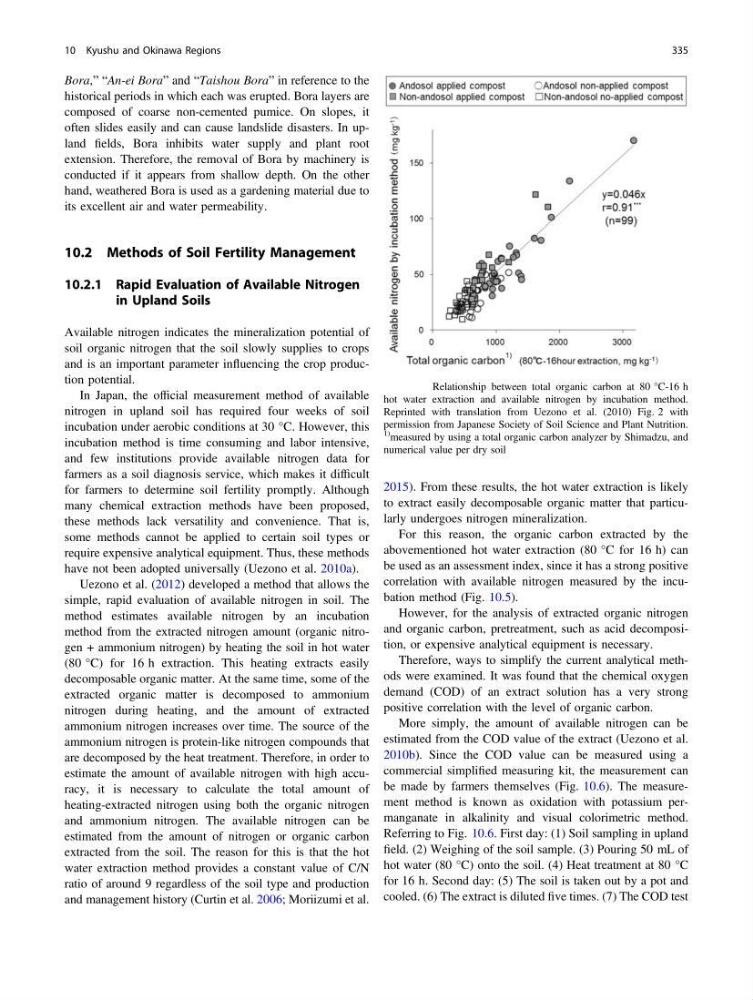
For this reason, the organic carbon extracted by the
abovementioned hot water extraction (80 °C for 16 h) can
be used as an assessment index, since it has a strong positive
correlation with available nitrogen measured by the incubation method (Fig. 10.5).
However, for the analysis of extracted organic nitrogen
and organic carbon, pretreatment, such as acid decomposition, or expensive analytical equipment is necessary.
Therefore, ways to simplify the current analytical methods were examined. It was found that the chemical oxygen
demand (COD) of an extract solution has a very strong
positive correlation with the level of organic carbon.
More simply, the amount of available nitrogen can be
estimated from the COD value of the extract (Uezono et al.
2010b). Since the COD value can be measured using a
commercial simplified measuring kit, the measurement can
be made by farmers themselves (Fig. 10.6). The measurement method is known as oxidation with potassium permanganate in alkalinity and visual colorimetric method.
Referring to Fig. 10.6. First day: (1) Soil sampling in upland
field. (2) Weighing of the soil sample. (3) Pouring 50 mL of
hot water (80 °C) onto the soil. (4) Heat treatment at 80 °C
for 16 h. Second day: (5) The soil is taken out by a pot and
cooled. (6) The extract is diluted five times. (7) The COD test
Fig. 10.5 Relationship between total organic carbon at 80 °C-16 h
hot water extraction and available nitrogen by incubation method.
Reprinted with translation from Uezono et al. (2010) Fig. 2 with
permission from Japanese Society of Soil Science and Plant Nutrition.
1)
measured by using a total organic carbon analyzer by Shimadzu, and
numerical value per dry soil
10 Kyushu and Okinawa Regions
335
historical periods in which each was erupted. Bora layers are
composed of coarse non-cemented pumice. On slopes, it
often slides easily and can cause landslide disasters. In upland fields, Bora inhibits water supply and plant root
extension. Therefore, the removal of Bora by machinery is
conducted if it appears from shallow depth. On the other
hand, weathered Bora is used as a gardening material due to
its excellent air and water permeability.
10.2 Methods of Soil Fertility Management
10.2.1 Rapid Evaluation of Available Nitrogen
in Upland Soils
Available nitrogen indicates the mineralization potential of
soil organic nitrogen that the soil slowly supplies to crops
and is an important parameter influencing the crop production potential.
In Japan, the official measurement method of available
nitrogen in upland soil has required four weeks of soil
incubation under aerobic conditions at 30 °C. However, this
incubation method is time consuming and labor intensive,
and few institutions provide available nitrogen data for
farmers as a soil diagnosis service, which makes it difficult
for farmers to determine soil fertility promptly. Although
many chemical extraction methods have been proposed,
these methods lack versatility and convenience. That is,
some methods cannot be applied to certain soil types or
require expensive analytical equipment. Thus, these methods
have not been adopted universally (Uezono et al. 2010a).
Uezono et al. (2012) developed a method that allows the
simple, rapid evaluation of available nitrogen in soil. The
method estimates available nitrogen by an incubation
method from the extracted nitrogen amount (organic nitrogen + ammonium nitrogen) by heating the soil in hot water
(80 °C) for 16 h extraction. This heating extracts easily
decomposable organic matter. At the same time, some of the
extracted organic matter is decomposed to ammonium
nitrogen during heating, and the amount of extracted
ammonium nitrogen increases over time. The source of the
ammonium nitrogen is protein-like nitrogen compounds that
are decomposed by the heat treatment. Therefore, in order to
estimate the amount of available nitrogen with high accuracy, it is necessary to calculate the total amount of
heating-extracted nitrogen using both the organic nitrogen
and ammonium nitrogen. The available nitrogen can be
estimated from the amount of nitrogen or organic carbon
extracted from the soil. The reason for this is that the hot
water extraction method provides a constant value of C/N
ratio of around 9 regardless of the soil type and production
and management history (Curtin et al. 2006; Moriizumi et al.
2015). From these results, the hot water extraction is likely
to extract easily decomposable organic matter that particularly undergoes nitrogen mineralization.
For this reason, the organic carbon extracted by the
abovementioned hot water extraction (80 °C for 16 h) can
be used as an assessment index, since it has a strong positive
correlation with available nitrogen measured by the incubation method (Fig. 10.5).
However, for the analysis of extracted organic nitrogen
and organic carbon, pretreatment, such as acid decomposition, or expensive analytical equipment is necessary.
Therefore, ways to simplify the current analytical methods were examined. It was found that the chemical oxygen
demand (COD) of an extract solution has a very strong
positive correlation with the level of organic carbon.
More simply, the amount of available nitrogen can be
estimated from the COD value of the extract (Uezono et al.
2010b). Since the COD value can be measured using a
commercial simplified measuring kit, the measurement can
be made by farmers themselves (Fig. 10.6). The measurement method is known as oxidation with potassium permanganate in alkalinity and visual colorimetric method.
Referring to Fig. 10.6. First day: (1) Soil sampling in upland
field. (2) Weighing of the soil sample. (3) Pouring 50 mL of
hot water (80 °C) onto the soil. (4) Heat treatment at 80 °C
for 16 h. Second day: (5) The soil is taken out by a pot and
cooled. (6) The extract is diluted five times. (7) The COD test
Fig. 10.5 Relationship between total organic carbon at 80 °C-16 h
hot water extraction and available nitrogen by incubation method.
Reprinted with translation from Uezono et al. (2010) Fig. 2 with
permission from Japanese Society of Soil Science and Plant Nutrition.
1)
measured by using a total organic carbon analyzer by Shimadzu, and
numerical value per dry soil
10 Kyushu and Okinawa Regions
335