

large amount of allophane and imogolite, the heavy application of phosphate is needed, as in ordinary Andosols, as a
countermeasure for phosphate fixation.
(3) Kora
“Kora” is the name given to indurated volcanic ash and
gravel layers that are distributed around Mt. Kaimon volcano, from which it was erupted, in the Satsuma Peninsula,
Kagoshima Prefecture. Kora is subdivided into five units, the
eruption dates of which are estimated at 4, 3.3, 2.3, 1.5, and
1.0 kya, respectively (Fujino and Kobayashi 1992). The
name “Kora” is related to “koura” (Japanese for “shell”) and
refers to the hardness of the deposit. The main problem
associated with the presence of Kora in cultivated fields is
the inhibition of plant root extension due to its hardness. The
removal of Kora by farm machinery has been conducted
under national and prefectural projects, and nowadays, its
distribution area has become so small that it was designated
as a “red data soil” that is considered as endangered (Japanese Society of Pedology 2000). However, soil horizons or
tephra layers with the problem of hardness similar to that of
Kora are seen in several volcanic areas in Kyushu. Kubotera
and Yamada (2000) divided these into two types. One type is
the subsurface horizons of Andosols with large amounts of
carbon and clay; this type is not hard in a moist state, but
when it is exposed at the surface and becomes dry, it shrinks
and forms hard soil blocks. This type should be thoroughly
pulverized immediately after exposure, and chemical
property improvements, for example, those involving the
heavy application of phosphate fertilizer, which are commonly conducted in Andosols, are also required. This type
includes “Nigatsuchi” around Aso volcano in Kumamoto
Prefecture and “Kashinomi” around Unzen volcano in
Nagasaki Prefecture. The existence of a similar type of soil
in the Azores, Portugal, was reported by Pinheiro (1997).
Another type is indurated tephra layers, such as Kora, which
have little humus and clay. This type is hard in both moist
and air-dried states, and pulverization and removal by
machinery are required for soil improvement. This type
includes Kora, “Hanamure” around Mt. Kuju in Oita Prefecture, and “Banban” on the somma of Aso volcano.
Indurated volcanic ashes in South America, namely “Tepetate” (Mexico), “Telpetate” (Nicaragua), and “Cangahua”
(Ecuador), probably belong to this type.
(4) Bora
“Bora” is the generic term for the pumice layers with various
degrees of weathering that are widely distributed in
Kagoshima and Miyazaki Prefectures. A representative Bora
unit is the Miike Bora, which was erupted from the Miike
crater, Miyazaki Prefecture, during activity of Kirishima
volcano 3 kya. Bora was also ejected from Sakurajima
volcano, an island in Kagoshima Bay that is still active at
present, at several times in the past; three major Bora units
were erupted from Sakurajima, in AD 1471, 1779, and 1914
(Kobayashi and Tamaike 2002), and are called “Bunmei
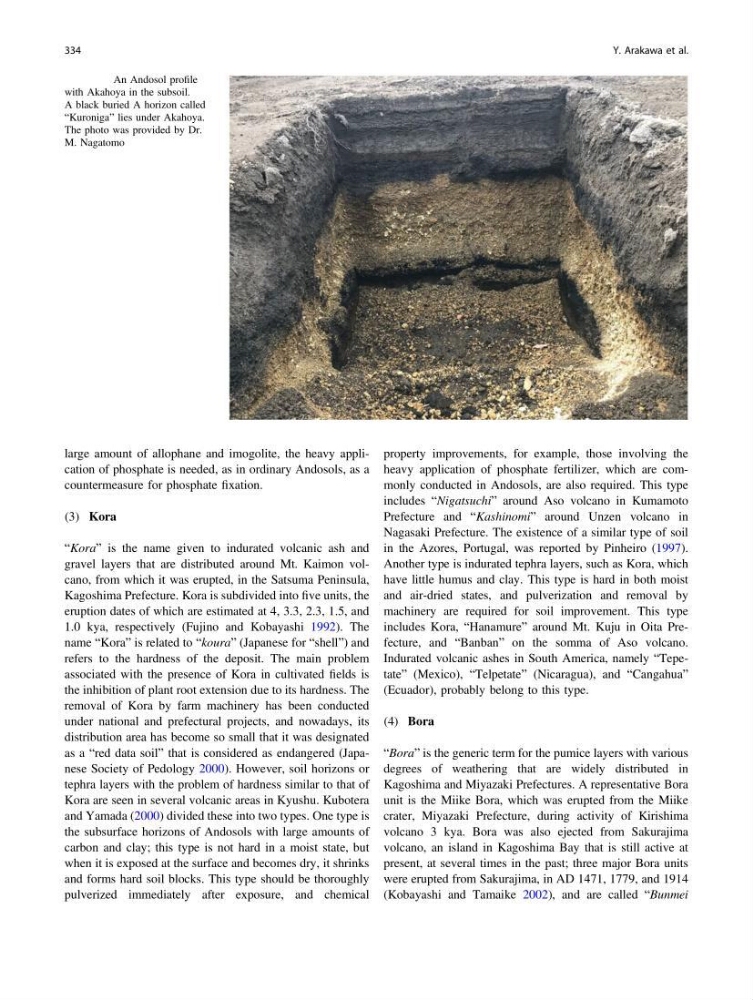
Fig. 10.4 An Andosol profile
with Akahoya in the subsoil.
A black buried A horizon called
“Kuroniga” lies under Akahoya.
The photo was provided by Dr.
M. Nagatomo
334
Y. Arakawa et al.
countermeasure for phosphate fixation.
(3) Kora
“Kora” is the name given to indurated volcanic ash and
gravel layers that are distributed around Mt. Kaimon volcano, from which it was erupted, in the Satsuma Peninsula,
Kagoshima Prefecture. Kora is subdivided into five units, the
eruption dates of which are estimated at 4, 3.3, 2.3, 1.5, and
1.0 kya, respectively (Fujino and Kobayashi 1992). The
name “Kora” is related to “koura” (Japanese for “shell”) and
refers to the hardness of the deposit. The main problem
associated with the presence of Kora in cultivated fields is
the inhibition of plant root extension due to its hardness. The
removal of Kora by farm machinery has been conducted
under national and prefectural projects, and nowadays, its
distribution area has become so small that it was designated
as a “red data soil” that is considered as endangered (Japanese Society of Pedology 2000). However, soil horizons or
tephra layers with the problem of hardness similar to that of
Kora are seen in several volcanic areas in Kyushu. Kubotera
and Yamada (2000) divided these into two types. One type is
the subsurface horizons of Andosols with large amounts of
carbon and clay; this type is not hard in a moist state, but
when it is exposed at the surface and becomes dry, it shrinks
and forms hard soil blocks. This type should be thoroughly
pulverized immediately after exposure, and chemical
property improvements, for example, those involving the
heavy application of phosphate fertilizer, which are commonly conducted in Andosols, are also required. This type
includes “Nigatsuchi” around Aso volcano in Kumamoto
Prefecture and “Kashinomi” around Unzen volcano in
Nagasaki Prefecture. The existence of a similar type of soil
in the Azores, Portugal, was reported by Pinheiro (1997).
Another type is indurated tephra layers, such as Kora, which
have little humus and clay. This type is hard in both moist
and air-dried states, and pulverization and removal by
machinery are required for soil improvement. This type
includes Kora, “Hanamure” around Mt. Kuju in Oita Prefecture, and “Banban” on the somma of Aso volcano.
Indurated volcanic ashes in South America, namely “Tepetate” (Mexico), “Telpetate” (Nicaragua), and “Cangahua”
(Ecuador), probably belong to this type.
(4) Bora
“Bora” is the generic term for the pumice layers with various
degrees of weathering that are widely distributed in
Kagoshima and Miyazaki Prefectures. A representative Bora
unit is the Miike Bora, which was erupted from the Miike
crater, Miyazaki Prefecture, during activity of Kirishima
volcano 3 kya. Bora was also ejected from Sakurajima
volcano, an island in Kagoshima Bay that is still active at
present, at several times in the past; three major Bora units
were erupted from Sakurajima, in AD 1471, 1779, and 1914
(Kobayashi and Tamaike 2002), and are called “Bunmei
Fig. 10.4 An Andosol profile
with Akahoya in the subsoil.
A black buried A horizon called
“Kuroniga” lies under Akahoya.
The photo was provided by Dr.
M. Nagatomo
334
Y. Arakawa et al.