

and marine landforms around the world. However, since the
mid-1950s, the oxygen isotope ratios of microfossils in
marine sediments and of glacial ice have proved to be
effective as indicators of global climate change in the past
(Emiliani 1955; Dansgarrd 1964). In particular, the variation
of the oxygen isotope ratio (d
18 O) of benthic foraminiferal
shells in marine sediment is related to changes in the volume
of the continental ice sheet, corresponding to increases and
decreases in the amount of seawater. Since benthic foraminiferal d
18 O values show almost the same variation
pattern anywhere on Earth, it became clear that the climate
change that caused the change of the volume of the continental ice sheet occurred on a global scale (Schackleton
1969; Lisiecki and Raymo 2005; Railsback et al. 2015;
Fig. 2.7).
As described in Sect. 2.2, in the plains of the Japanese
Islands the oldest marine terraces were formed in marine
isotope stage (MIS) 13 (about 500,000 years ago) and the
oldest fluvial terraces were probably formed in MIS 16–17
(about 690,000–630,000 years ago) (Machida and Chinzei
2001). Therefore, the landforms and soils of the Japanese
plains are considered to have formed sometime after this time.
(2) Climate change after the last interglacial period in
the Japanese Islands
The regional paleoclimate has been reconstructed primarily
from plant fossils (pollen, seeds, fruit, wood, phytolith,
diatoms, etc.), fossil periglacial phenomena and minerals in
the various terrestrial and marine sediments and landforms.
These records have been compared with the timing and
magnitude of global climate change (Fig. 2.8). The period
from MIS 5e (the last interglacial period) to MIS 4–2 (the
last glacial period) is the era for which detailed past global
climatic records have been obtained, even in the Pleistocene.
Therefore, paleoenvironmental reconstruction after the last
interglacial period is also important in order to estimate the
paleoenvironment of older glacial and interglacial periods.
However, it is not easy to quantitatively reconstruct the
specific temperature and precipitation for this period.
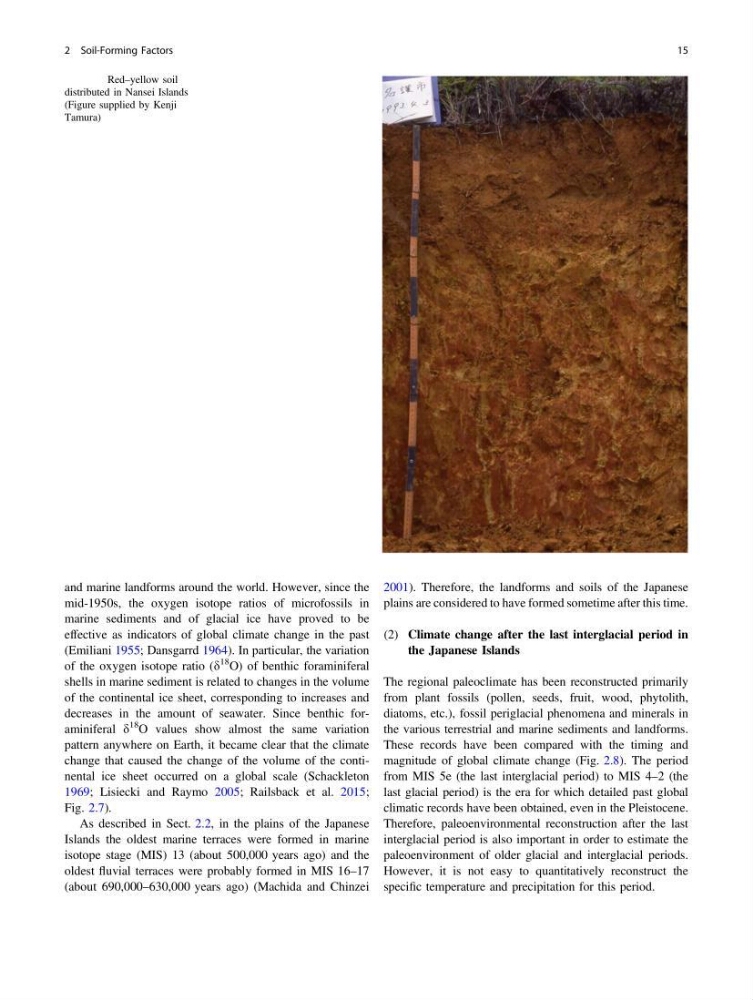
Fig. 2.2 Red–yellow soil
distributed in Nansei Islands
(Figure supplied by Kenji
Tamura)
2 Soil-Forming Factors
15
mid-1950s, the oxygen isotope ratios of microfossils in
marine sediments and of glacial ice have proved to be
effective as indicators of global climate change in the past
(Emiliani 1955; Dansgarrd 1964). In particular, the variation
of the oxygen isotope ratio (d
18 O) of benthic foraminiferal
shells in marine sediment is related to changes in the volume
of the continental ice sheet, corresponding to increases and
decreases in the amount of seawater. Since benthic foraminiferal d
18 O values show almost the same variation
pattern anywhere on Earth, it became clear that the climate
change that caused the change of the volume of the continental ice sheet occurred on a global scale (Schackleton
1969; Lisiecki and Raymo 2005; Railsback et al. 2015;
Fig. 2.7).
As described in Sect. 2.2, in the plains of the Japanese
Islands the oldest marine terraces were formed in marine
isotope stage (MIS) 13 (about 500,000 years ago) and the
oldest fluvial terraces were probably formed in MIS 16–17
(about 690,000–630,000 years ago) (Machida and Chinzei
2001). Therefore, the landforms and soils of the Japanese
plains are considered to have formed sometime after this time.
(2) Climate change after the last interglacial period in
the Japanese Islands
The regional paleoclimate has been reconstructed primarily
from plant fossils (pollen, seeds, fruit, wood, phytolith,
diatoms, etc.), fossil periglacial phenomena and minerals in
the various terrestrial and marine sediments and landforms.
These records have been compared with the timing and
magnitude of global climate change (Fig. 2.8). The period
from MIS 5e (the last interglacial period) to MIS 4–2 (the
last glacial period) is the era for which detailed past global
climatic records have been obtained, even in the Pleistocene.
Therefore, paleoenvironmental reconstruction after the last
interglacial period is also important in order to estimate the
paleoenvironment of older glacial and interglacial periods.
However, it is not easy to quantitatively reconstruct the
specific temperature and precipitation for this period.
Fig. 2.2 Red–yellow soil
distributed in Nansei Islands
(Figure supplied by Kenji
Tamura)
2 Soil-Forming Factors
15