

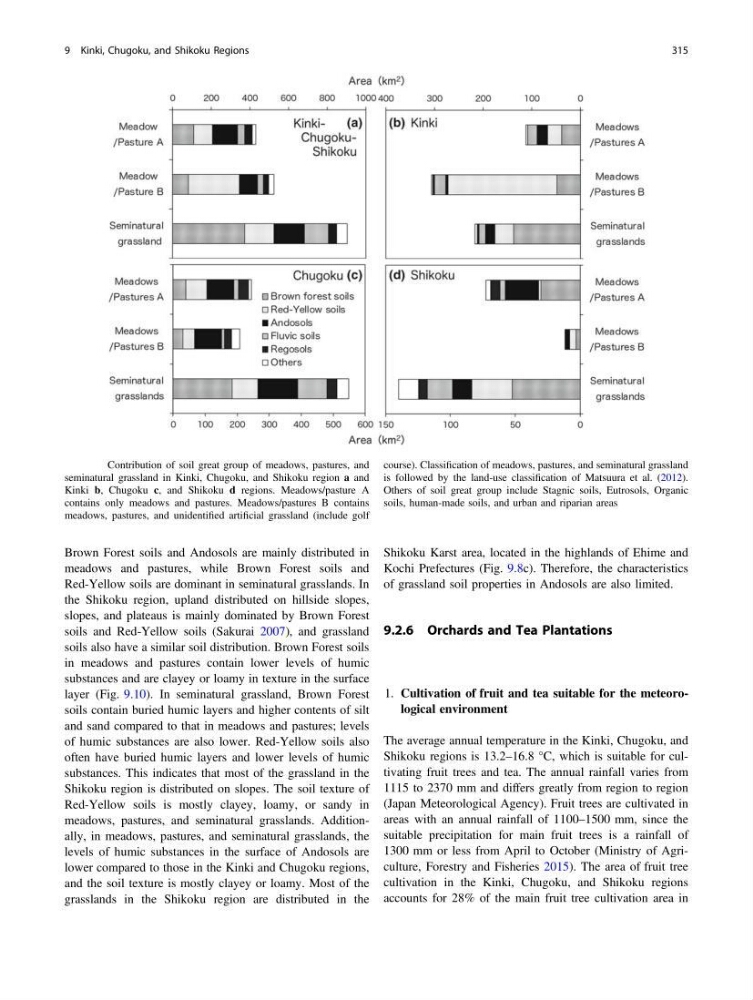
Brown Forest soils and Andosols are mainly distributed in
meadows and pastures, while Brown Forest soils and
Red-Yellow soils are dominant in seminatural grasslands. In
the Shikoku region, upland distributed on hillside slopes,
slopes, and plateaus is mainly dominated by Brown Forest
soils and Red-Yellow soils (Sakurai 2007), and grassland
soils also have a similar soil distribution. Brown Forest soils
in meadows and pastures contain lower levels of humic
substances and are clayey or loamy in texture in the surface
layer (Fig. 9.10). In seminatural grassland, Brown Forest
soils contain buried humic layers and higher contents of silt
and sand compared to that in meadows and pastures; levels
of humic substances are also lower. Red-Yellow soils also
often have buried humic layers and lower levels of humic
substances. This indicates that most of the grassland in the
Shikoku region is distributed on slopes. The soil texture of
Red-Yellow soils is mostly clayey, loamy, or sandy in
meadows, pastures, and seminatural grasslands. Additionally, in meadows, pastures, and seminatural grasslands, the
levels of humic substances in the surface of Andosols are
lower compared to those in the Kinki and Chugoku regions,
and the soil texture is mostly clayey or loamy. Most of the
grasslands in the Shikoku region are distributed in the
Shikoku Karst area, located in the highlands of Ehime and
Kochi Prefectures (Fig. 9.8c). Therefore, the characteristics
of grassland soil properties in Andosols are also limited.
9.2.6 Orchards and Tea Plantations
1. Cultivation of fruit and tea suitable for the meteorological environment
The average annual temperature in the Kinki, Chugoku, and
Shikoku regions is 13.2–16.8 °C, which is suitable for cultivating fruit trees and tea. The annual rainfall varies from
1115 to 2370 mm and differs greatly from region to region
(Japan Meteorological Agency). Fruit trees are cultivated in
areas with an annual rainfall of 1100–1500 mm, since the
suitable precipitation for main fruit trees is a rainfall of
1300 mm or less from April to October (Ministry of Agriculture, Forestry and Fisheries 2015). The area of fruit tree
cultivation in the Kinki, Chugoku, and Shikoku regions
accounts for 28% of the main fruit tree cultivation area in
Fig. 9.9 Contribution of soil great group of meadows, pastures, and
seminatural grassland in Kinki, Chugoku, and Shikoku region a and
Kinki b, Chugoku c, and Shikoku d regions. Meadows/pasture A
contains only meadows and pastures. Meadows/pastures B contains
meadows, pastures, and unidentified artificial grassland (include golf
course). Classification of meadows, pastures, and seminatural grassland
is followed by the land-use classification of Matsuura et al. (2012).
Others of soil great group include Stagnic soils, Eutrosols, Organic
soils, human-made soils, and urban and riparian areas
9 Kinki, Chugoku, and Shikoku Regions
315
meadows and pastures, while Brown Forest soils and
Red-Yellow soils are dominant in seminatural grasslands. In
the Shikoku region, upland distributed on hillside slopes,
slopes, and plateaus is mainly dominated by Brown Forest
soils and Red-Yellow soils (Sakurai 2007), and grassland
soils also have a similar soil distribution. Brown Forest soils
in meadows and pastures contain lower levels of humic
substances and are clayey or loamy in texture in the surface
layer (Fig. 9.10). In seminatural grassland, Brown Forest
soils contain buried humic layers and higher contents of silt
and sand compared to that in meadows and pastures; levels
of humic substances are also lower. Red-Yellow soils also
often have buried humic layers and lower levels of humic
substances. This indicates that most of the grassland in the
Shikoku region is distributed on slopes. The soil texture of
Red-Yellow soils is mostly clayey, loamy, or sandy in
meadows, pastures, and seminatural grasslands. Additionally, in meadows, pastures, and seminatural grasslands, the
levels of humic substances in the surface of Andosols are
lower compared to those in the Kinki and Chugoku regions,
and the soil texture is mostly clayey or loamy. Most of the
grasslands in the Shikoku region are distributed in the
Shikoku Karst area, located in the highlands of Ehime and
Kochi Prefectures (Fig. 9.8c). Therefore, the characteristics
of grassland soil properties in Andosols are also limited.
9.2.6 Orchards and Tea Plantations
1. Cultivation of fruit and tea suitable for the meteorological environment
The average annual temperature in the Kinki, Chugoku, and
Shikoku regions is 13.2–16.8 °C, which is suitable for cultivating fruit trees and tea. The annual rainfall varies from
1115 to 2370 mm and differs greatly from region to region
(Japan Meteorological Agency). Fruit trees are cultivated in
areas with an annual rainfall of 1100–1500 mm, since the
suitable precipitation for main fruit trees is a rainfall of
1300 mm or less from April to October (Ministry of Agriculture, Forestry and Fisheries 2015). The area of fruit tree
cultivation in the Kinki, Chugoku, and Shikoku regions
accounts for 28% of the main fruit tree cultivation area in
Fig. 9.9 Contribution of soil great group of meadows, pastures, and
seminatural grassland in Kinki, Chugoku, and Shikoku region a and
Kinki b, Chugoku c, and Shikoku d regions. Meadows/pasture A
contains only meadows and pastures. Meadows/pastures B contains
meadows, pastures, and unidentified artificial grassland (include golf
course). Classification of meadows, pastures, and seminatural grassland
is followed by the land-use classification of Matsuura et al. (2012).
Others of soil great group include Stagnic soils, Eutrosols, Organic
soils, human-made soils, and urban and riparian areas
9 Kinki, Chugoku, and Shikoku Regions
315