

grasslands (Fig. 9.9b). Brown Forest soils in meadows,
pastures, and seminatural grasslands have a low content of
humic substances, and soil texture varies from heavy clay to
sandy (Fig. 9.10). While Red-Yellow soils have a low
content of humic substances, soils with a high clay content
are often observed. Andosols are not widely distributed in
grassland, accounting for approximately 7%. The content of
humic substances in the surface soil of Andosols in seminatural grasslands is more than 10%, higher than that of
meadows and pastures, as those of meadows and pastures
range from 5 to 10%. The soil texture of Andosols is often
heavy clay or clayey in meadows and pastures, while that in
seminatural grasslands is clayey or loamy.
2. Chugoku region
The Chugoku region has the largest area of meadows,
pastures, and seminatural grassland among the Kinki, Chugoku, and Shikoku regions, accounting for 54% (1002 km
2 ).
In meadows and pastures, the prevalence of Andosols varied
from 34 to 40%, while Brown Forest soils and Andosols
together account for approximately 56% of seminatural
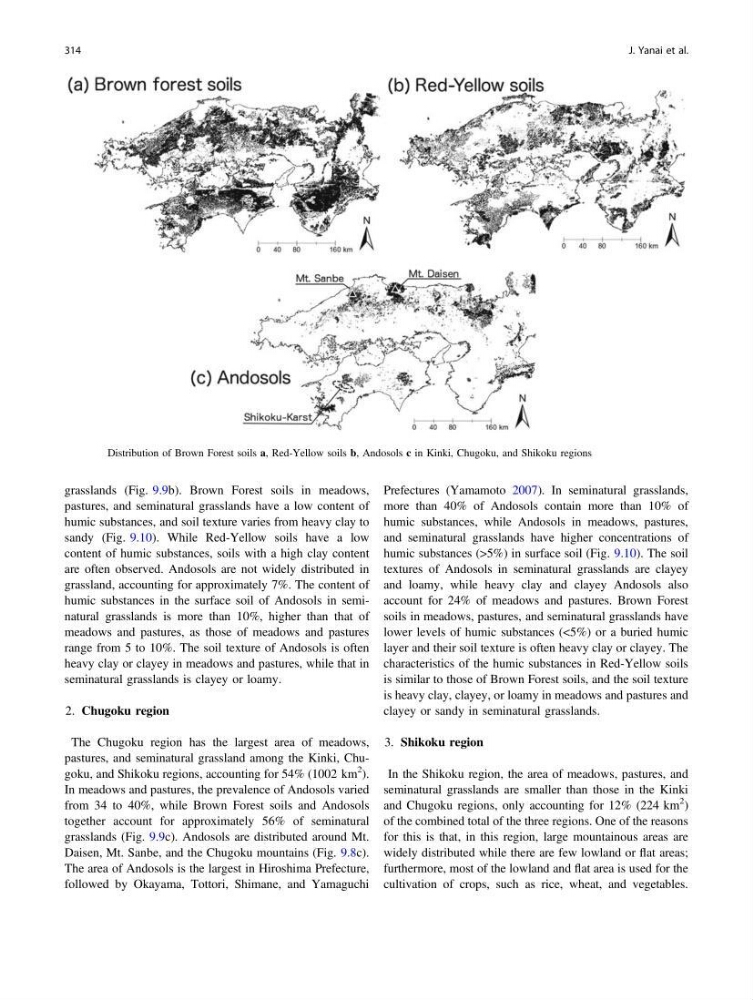
grasslands (Fig. 9.9c). Andosols are distributed around Mt.
Daisen, Mt. Sanbe, and the Chugoku mountains (Fig. 9.8c).
The area of Andosols is the largest in Hiroshima Prefecture,
followed by Okayama, Tottori, Shimane, and Yamaguchi
Prefectures (Yamamoto 2007). In seminatural grasslands,
more than 40% of Andosols contain more than 10% of
humic substances, while Andosols in meadows, pastures,
and seminatural grasslands have higher concentrations of
humic substances (>5%) in surface soil (Fig. 9.10). The soil
textures of Andosols in seminatural grasslands are clayey
and loamy, while heavy clay and clayey Andosols also
account for 24% of meadows and pastures. Brown Forest
soils in meadows, pastures, and seminatural grasslands have
lower levels of humic substances (<5%) or a buried humic
layer and their soil texture is often heavy clay or clayey. The
characteristics of the humic substances in Red-Yellow soils
is similar to those of Brown Forest soils, and the soil texture
is heavy clay, clayey, or loamy in meadows and pastures and
clayey or sandy in seminatural grasslands.
3. Shikoku region
In the Shikoku region, the area of meadows, pastures, and
seminatural grasslands are smaller than those in the Kinki
and Chugoku regions, only accounting for 12% (224 km
2 )
of the combined total of the three regions. One of the reasons
for this is that, in this region, large mountainous areas are
widely distributed while there are few lowland or flat areas;
furthermore, most of the lowland and flat area is used for the
cultivation of crops, such as rice, wheat, and vegetables.
Fig. 9.8 Distribution of Brown Forest soils a, Red-Yellow soils b, Andosols c in Kinki, Chugoku, and Shikoku regions
314
J. Yanai et al.
pastures, and seminatural grasslands have a low content of
humic substances, and soil texture varies from heavy clay to
sandy (Fig. 9.10). While Red-Yellow soils have a low
content of humic substances, soils with a high clay content
are often observed. Andosols are not widely distributed in
grassland, accounting for approximately 7%. The content of
humic substances in the surface soil of Andosols in seminatural grasslands is more than 10%, higher than that of
meadows and pastures, as those of meadows and pastures
range from 5 to 10%. The soil texture of Andosols is often
heavy clay or clayey in meadows and pastures, while that in
seminatural grasslands is clayey or loamy.
2. Chugoku region
The Chugoku region has the largest area of meadows,
pastures, and seminatural grassland among the Kinki, Chugoku, and Shikoku regions, accounting for 54% (1002 km
2 ).
In meadows and pastures, the prevalence of Andosols varied
from 34 to 40%, while Brown Forest soils and Andosols
together account for approximately 56% of seminatural
grasslands (Fig. 9.9c). Andosols are distributed around Mt.
Daisen, Mt. Sanbe, and the Chugoku mountains (Fig. 9.8c).
The area of Andosols is the largest in Hiroshima Prefecture,
followed by Okayama, Tottori, Shimane, and Yamaguchi
Prefectures (Yamamoto 2007). In seminatural grasslands,
more than 40% of Andosols contain more than 10% of
humic substances, while Andosols in meadows, pastures,
and seminatural grasslands have higher concentrations of
humic substances (>5%) in surface soil (Fig. 9.10). The soil
textures of Andosols in seminatural grasslands are clayey
and loamy, while heavy clay and clayey Andosols also
account for 24% of meadows and pastures. Brown Forest
soils in meadows, pastures, and seminatural grasslands have
lower levels of humic substances (<5%) or a buried humic
layer and their soil texture is often heavy clay or clayey. The
characteristics of the humic substances in Red-Yellow soils
is similar to those of Brown Forest soils, and the soil texture
is heavy clay, clayey, or loamy in meadows and pastures and
clayey or sandy in seminatural grasslands.
3. Shikoku region
In the Shikoku region, the area of meadows, pastures, and
seminatural grasslands are smaller than those in the Kinki
and Chugoku regions, only accounting for 12% (224 km
2 )
of the combined total of the three regions. One of the reasons
for this is that, in this region, large mountainous areas are
widely distributed while there are few lowland or flat areas;
furthermore, most of the lowland and flat area is used for the
cultivation of crops, such as rice, wheat, and vegetables.
Fig. 9.8 Distribution of Brown Forest soils a, Red-Yellow soils b, Andosols c in Kinki, Chugoku, and Shikoku regions
314
J. Yanai et al.