

(Fig. 9.6). These sloping upland fields comprise Brown
Forest soils, which contain large amounts of gravel such as
crystalline schist, which are prone to flaking. Originating
from basic rocks rich in colored minerals, this soil abounds
in nutrients (Japanese Society of Pedology 2007). Today,
this area is designated as a globally important agricultural
heritage system for its “Nishiawa slope farming system.”
9.2.4 Vegetable Fields
In the Kansai region (Kinki, Chugoku, and Shikoku
regions), the planting areas of the main vegetables (Japanese
radish [Raphanus sativus], carrot [Daucus carota], potato
[Solanum tuberosum], taro [Colocasia esculenta], Chinese
cabbage [Brassica Pekinensis], cabbage [Brassica oleracea],
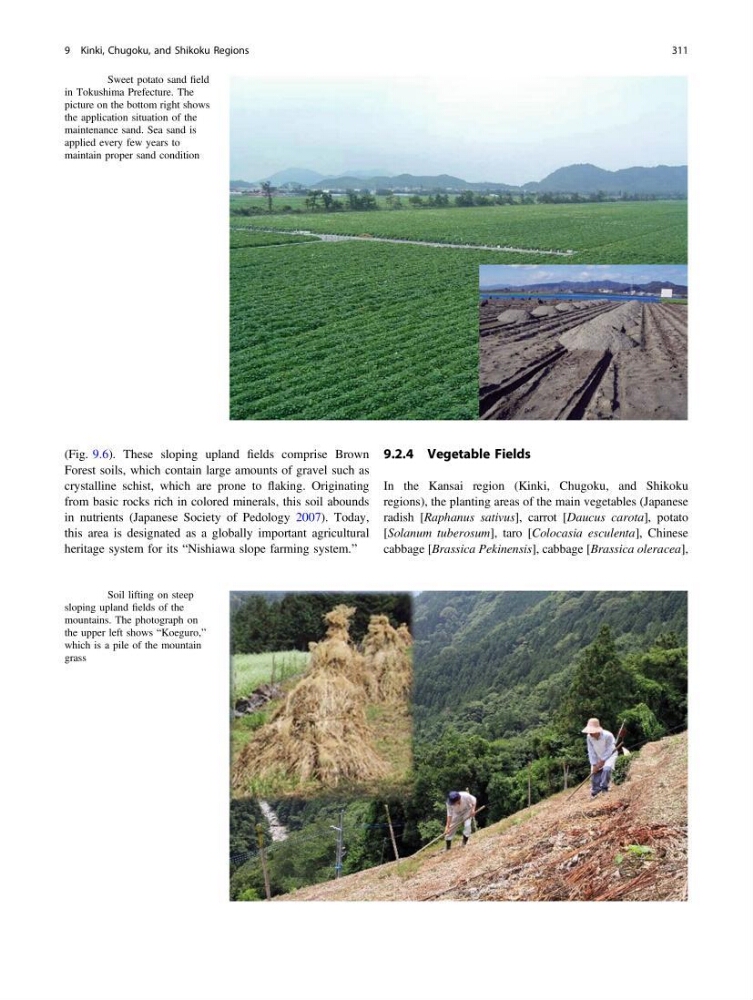
Fig. 9.5 Sweet potato sand field
in Tokushima Prefecture. The
picture on the bottom right shows
the application situation of the
maintenance sand. Sea sand is
applied every few years to
maintain proper sand condition
Fig. 9.6 Soil lifting on steep
sloping upland fields of the
mountains. The photograph on
the upper left shows “Koeguro,”
which is a pile of the mountain
grass
9 Kinki, Chugoku, and Shikoku Regions
311
Forest soils, which contain large amounts of gravel such as
crystalline schist, which are prone to flaking. Originating
from basic rocks rich in colored minerals, this soil abounds
in nutrients (Japanese Society of Pedology 2007). Today,
this area is designated as a globally important agricultural
heritage system for its “Nishiawa slope farming system.”
9.2.4 Vegetable Fields
In the Kansai region (Kinki, Chugoku, and Shikoku
regions), the planting areas of the main vegetables (Japanese
radish [Raphanus sativus], carrot [Daucus carota], potato
[Solanum tuberosum], taro [Colocasia esculenta], Chinese
cabbage [Brassica Pekinensis], cabbage [Brassica oleracea],
Fig. 9.5 Sweet potato sand field
in Tokushima Prefecture. The
picture on the bottom right shows
the application situation of the
maintenance sand. Sea sand is
applied every few years to
maintain proper sand condition
Fig. 9.6 Soil lifting on steep
sloping upland fields of the
mountains. The photograph on
the upper left shows “Koeguro,”
which is a pile of the mountain
grass
9 Kinki, Chugoku, and Shikoku Regions
311