

spinach [Spinacia oleracea], lettuce [Lectuca sativa], onion
[Allium cepa], green onion [A. cepa var. Aggregatum],
cucumber [Cucumis sativus], eggplant [Solanum melongena], tomato [Solanum lycopersicum], and green pepper
[Capsicum annuum]) occupy between 3.5% and 23.0% of
the respective agricultural land of Japan (Statistics Department of Minister’s Secretariat, Ministry of Agriculture,
Forestry and Fisheries 2017). The areas are not larger than
those in other regions, as the total area of the Kansai region
accounts for approximately 20.6% of the area of Japan.
A major cause would be the difficulty of agricultural
mechanization due to the lack of flat land and the utilization
of most of the limited flat land for paddy farming. However,
a wide variety of vegetables, including traditional vegetables, is produced based on appropriate soil management.
1. Cultivated soils for major vegetables
Many of the major vegetables produced in the Kansai region
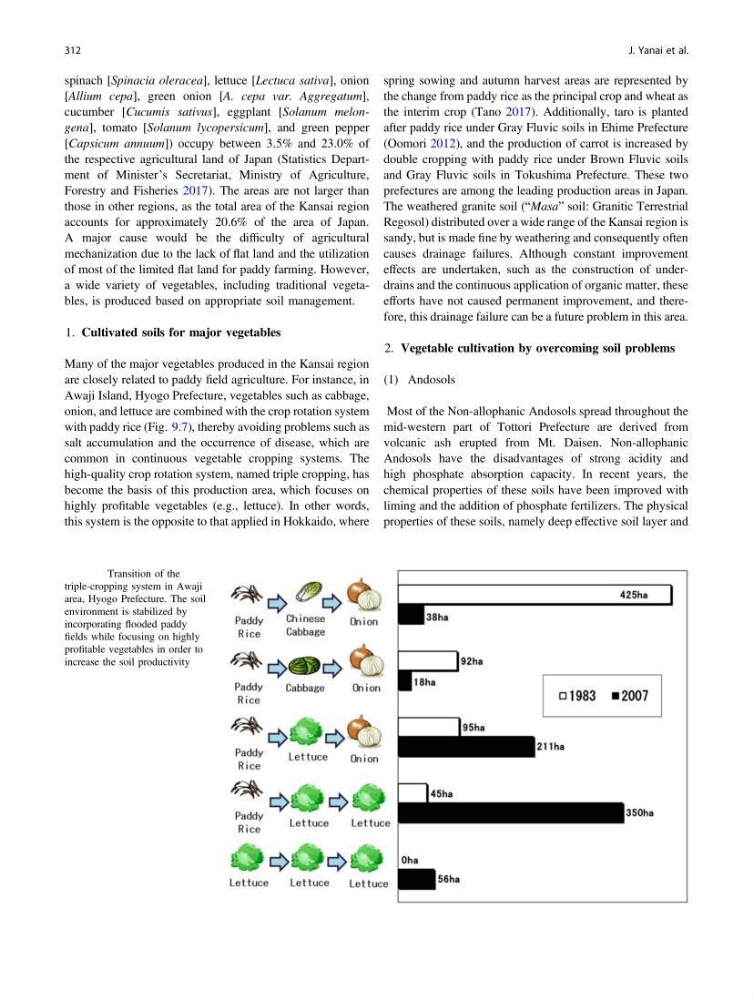
are closely related to paddy field agriculture. For instance, in
Awaji Island, Hyogo Prefecture, vegetables such as cabbage,
onion, and lettuce are combined with the crop rotation system
with paddy rice (Fig. 9.7), thereby avoiding problems such as
salt accumulation and the occurrence of disease, which are
common in continuous vegetable cropping systems. The
high-quality crop rotation system, named triple cropping, has
become the basis of this production area, which focuses on
highly profitable vegetables (e.g., lettuce). In other words,
this system is the opposite to that applied in Hokkaido, where
spring sowing and autumn harvest areas are represented by
the change from paddy rice as the principal crop and wheat as
the interim crop (Tano 2017). Additionally, taro is planted
after paddy rice under Gray Fluvic soils in Ehime Prefecture
(Oomori 2012), and the production of carrot is increased by
double cropping with paddy rice under Brown Fluvic soils
and Gray Fluvic soils in Tokushima Prefecture. These two
prefectures are among the leading production areas in Japan.
The weathered granite soil (“Masa” soil: Granitic Terrestrial
Regosol) distributed over a wide range of the Kansai region is
sandy, but is made fine by weathering and consequently often
causes drainage failures. Although constant improvement
effects are undertaken, such as the construction of underdrains and the continuous application of organic matter, these
efforts have not caused permanent improvement, and therefore, this drainage failure can be a future problem in this area.
2. Vegetable cultivation by overcoming soil problems
(1) Andosols
Most of the Non-allophanic Andosols spread throughout the
mid-western part of Tottori Prefecture are derived from
volcanic ash erupted from Mt. Daisen. Non-allophanic
Andosols have the disadvantages of strong acidity and
high phosphate absorption capacity. In recent years, the
chemical properties of these soils have been improved with
liming and the addition of phosphate fertilizers. The physical
properties of these soils, namely deep effective soil layer and
Fig. 9.7 Transition of the
triple-cropping system in Awaji
area, Hyogo Prefecture. The soil
environment is stabilized by
incorporating flooded paddy
fields while focusing on highly
profitable vegetables in order to
increase the soil productivity
312
J. Yanai et al.
[Allium cepa], green onion [A. cepa var. Aggregatum],
cucumber [Cucumis sativus], eggplant [Solanum melongena], tomato [Solanum lycopersicum], and green pepper
[Capsicum annuum]) occupy between 3.5% and 23.0% of
the respective agricultural land of Japan (Statistics Department of Minister’s Secretariat, Ministry of Agriculture,
Forestry and Fisheries 2017). The areas are not larger than
those in other regions, as the total area of the Kansai region
accounts for approximately 20.6% of the area of Japan.
A major cause would be the difficulty of agricultural
mechanization due to the lack of flat land and the utilization
of most of the limited flat land for paddy farming. However,
a wide variety of vegetables, including traditional vegetables, is produced based on appropriate soil management.
1. Cultivated soils for major vegetables
Many of the major vegetables produced in the Kansai region
are closely related to paddy field agriculture. For instance, in
Awaji Island, Hyogo Prefecture, vegetables such as cabbage,
onion, and lettuce are combined with the crop rotation system
with paddy rice (Fig. 9.7), thereby avoiding problems such as
salt accumulation and the occurrence of disease, which are
common in continuous vegetable cropping systems. The
high-quality crop rotation system, named triple cropping, has
become the basis of this production area, which focuses on
highly profitable vegetables (e.g., lettuce). In other words,
this system is the opposite to that applied in Hokkaido, where
spring sowing and autumn harvest areas are represented by
the change from paddy rice as the principal crop and wheat as
the interim crop (Tano 2017). Additionally, taro is planted
after paddy rice under Gray Fluvic soils in Ehime Prefecture
(Oomori 2012), and the production of carrot is increased by
double cropping with paddy rice under Brown Fluvic soils
and Gray Fluvic soils in Tokushima Prefecture. These two
prefectures are among the leading production areas in Japan.
The weathered granite soil (“Masa” soil: Granitic Terrestrial
Regosol) distributed over a wide range of the Kansai region is
sandy, but is made fine by weathering and consequently often
causes drainage failures. Although constant improvement
effects are undertaken, such as the construction of underdrains and the continuous application of organic matter, these
efforts have not caused permanent improvement, and therefore, this drainage failure can be a future problem in this area.
2. Vegetable cultivation by overcoming soil problems
(1) Andosols
Most of the Non-allophanic Andosols spread throughout the
mid-western part of Tottori Prefecture are derived from
volcanic ash erupted from Mt. Daisen. Non-allophanic
Andosols have the disadvantages of strong acidity and
high phosphate absorption capacity. In recent years, the
chemical properties of these soils have been improved with
liming and the addition of phosphate fertilizers. The physical
properties of these soils, namely deep effective soil layer and
Fig. 9.7 Transition of the
triple-cropping system in Awaji
area, Hyogo Prefecture. The soil
environment is stabilized by
incorporating flooded paddy
fields while focusing on highly
profitable vegetables in order to
increase the soil productivity
312
J. Yanai et al.