

decreased harvest in paddy–upland rotation fields that have
produced black soybean for many years. In order to maintain
yield and soil nitrogen fertility, it seems reasonable to set the
frequency of black soybean cultivation to 40% or less
(Moritsugu and Washio 2016).
(3) Naked barley production (Ehime Prefecture,
Kagawa Prefecture: Gray Fluvic soils)
Ehime and Kagawa Prefectures, which are located on the
coast of the Seto Inland Sea, where the climate is warm and
precipitation is relatively low, have been producing naked
barley (Hordeum volgare var. nudum) since ancient times.
A total of 52% of the cultivated farmland area for this crop in
Japan is located in these two prefectures. With a wide distribution of soil derived from granite and Izumi sandstone,
both Ehime and Kagawa Prefectures have an abundance of
moderately coarse-grained Gray Fluvic soils with excellent
drainage. Being more susceptible to damage by cold temperature, snow, and humidity than wheat, naked barley is
suited to the climatic and soil conditions in this region. For
this reason, the double cropping of rice and naked barley is
widely practiced (Oomori 2012; Tanabe 2012).
2. Sweet potato production in large-scale soil dressing
farmland (Tokushima Prefecture: Sandy Regosols)
The “Naruto Kintoki” is a kind of sweet potato that is a local
agricultural specialty in Tokushima Prefecture. This cultivar
is characterized by its soft and crumby texture, sweet taste,
and vivid violet skin. It is produced on approximately
1100 ha of farmland comprising immature Sandy Regosols
(referred to as “Sunajibata”) stretching across the northern
coast of the prefecture (Fig. 9.5). These sandy fields were
once paddy fields. However, the Nankai earthquakes in 1946
caused the ground to sink by more than 30 cm, leaving
infertile single-crop fields with high salinity. Later, these
fields were subjected to soil dressing as sand in the former
Yoshino river was pumped in. A total of 90% of these sandy
fields were created through soil dressing in which riverbed or
seabed sand was accumulated to a thickness of 60–100 cm
after the 1960s (Tateishi 2007).
The sand used for soil dressing was derived primarily
from crystalline schist containing greenschist (bluestone)
distributed in the Sambagawa belt of the Yoshino river basin
that cuts through Tokushima Prefecture. The soil management for these sandy fields is characterized by the absence of
organic matter application and regular soil dressing with sea
sand (referred to as “Teirezuna”) in order to maintain
excellent ventilation and water retention properties.
3. Traditional crop farming on slopes (Tokushima Prefecture: Brown Forest soils)
In the west of Tokushima Prefecture, farmers have traditionally produced wheat, upland rice, tubers, maize (Zea
mays), soba, millet, konjac (Amorphophallus konjac), and
other crops in the sloping upland fields of mountains.
However, due to the recent depopulation of the area, both the
variety of produce and the area of farmland have been in
decline. In this area, wild grass such as Miscanthus sinensis
is cut, stored, and applied to the fields to prevent soil loss.
Furthermore, furrows are made along contour lines, and
runoff soil is pushed back in an effort to continue production
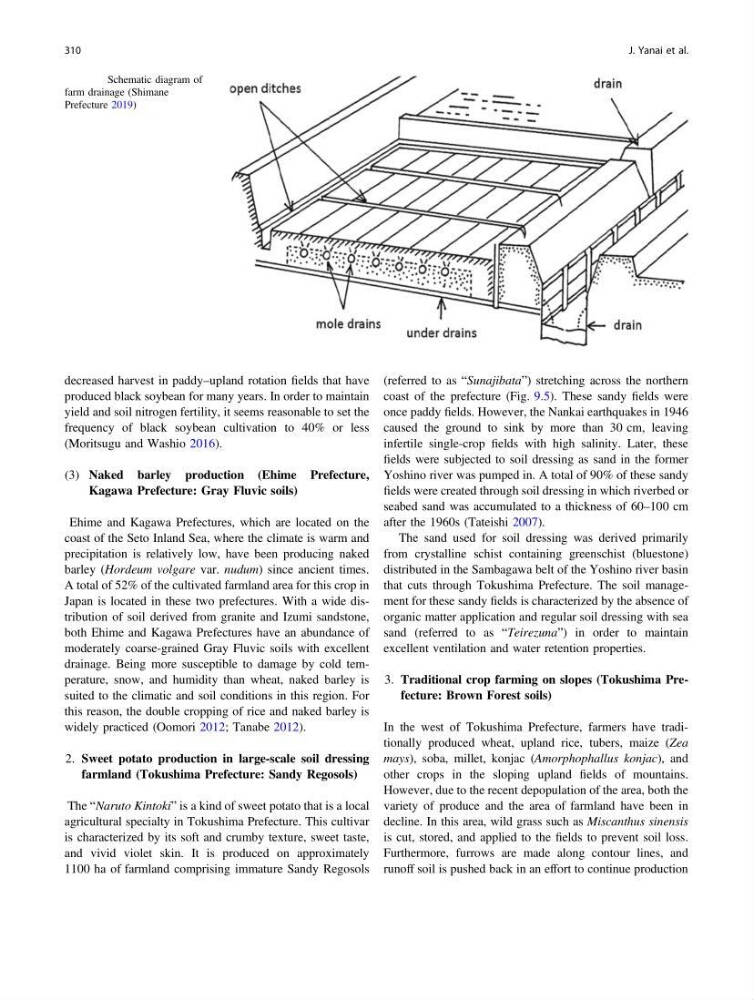
Fig. 9.4 Schematic diagram of
farm drainage (Shimane
Prefecture 2019)
310
J. Yanai et al.
produced black soybean for many years. In order to maintain
yield and soil nitrogen fertility, it seems reasonable to set the
frequency of black soybean cultivation to 40% or less
(Moritsugu and Washio 2016).
(3) Naked barley production (Ehime Prefecture,
Kagawa Prefecture: Gray Fluvic soils)
Ehime and Kagawa Prefectures, which are located on the
coast of the Seto Inland Sea, where the climate is warm and
precipitation is relatively low, have been producing naked
barley (Hordeum volgare var. nudum) since ancient times.
A total of 52% of the cultivated farmland area for this crop in
Japan is located in these two prefectures. With a wide distribution of soil derived from granite and Izumi sandstone,
both Ehime and Kagawa Prefectures have an abundance of
moderately coarse-grained Gray Fluvic soils with excellent
drainage. Being more susceptible to damage by cold temperature, snow, and humidity than wheat, naked barley is
suited to the climatic and soil conditions in this region. For
this reason, the double cropping of rice and naked barley is
widely practiced (Oomori 2012; Tanabe 2012).
2. Sweet potato production in large-scale soil dressing
farmland (Tokushima Prefecture: Sandy Regosols)
The “Naruto Kintoki” is a kind of sweet potato that is a local
agricultural specialty in Tokushima Prefecture. This cultivar
is characterized by its soft and crumby texture, sweet taste,
and vivid violet skin. It is produced on approximately
1100 ha of farmland comprising immature Sandy Regosols
(referred to as “Sunajibata”) stretching across the northern
coast of the prefecture (Fig. 9.5). These sandy fields were
once paddy fields. However, the Nankai earthquakes in 1946
caused the ground to sink by more than 30 cm, leaving
infertile single-crop fields with high salinity. Later, these
fields were subjected to soil dressing as sand in the former
Yoshino river was pumped in. A total of 90% of these sandy
fields were created through soil dressing in which riverbed or
seabed sand was accumulated to a thickness of 60–100 cm
after the 1960s (Tateishi 2007).
The sand used for soil dressing was derived primarily
from crystalline schist containing greenschist (bluestone)
distributed in the Sambagawa belt of the Yoshino river basin
that cuts through Tokushima Prefecture. The soil management for these sandy fields is characterized by the absence of
organic matter application and regular soil dressing with sea
sand (referred to as “Teirezuna”) in order to maintain
excellent ventilation and water retention properties.
3. Traditional crop farming on slopes (Tokushima Prefecture: Brown Forest soils)
In the west of Tokushima Prefecture, farmers have traditionally produced wheat, upland rice, tubers, maize (Zea
mays), soba, millet, konjac (Amorphophallus konjac), and
other crops in the sloping upland fields of mountains.
However, due to the recent depopulation of the area, both the
variety of produce and the area of farmland have been in
decline. In this area, wild grass such as Miscanthus sinensis
is cut, stored, and applied to the fields to prevent soil loss.
Furthermore, furrows are made along contour lines, and
runoff soil is pushed back in an effort to continue production
Fig. 9.4 Schematic diagram of
farm drainage (Shimane
Prefecture 2019)
310
J. Yanai et al.