

compost can be regarded as available to crops, as is those in
chemical fertilizer; (2) the K content is higher in cattle manure compost than in pig manure compost, and vice versa for
P content; and (3) K is leached from soil, while P is accumulated in soil. Because of these characteristics, from the
fourth year onward, cabbage, the first crop grown after
compost application, grew well without chemical fertilizer,
but K and P fertilizers were needed for maize, the second
crop. According to the experimental results, it was concluded that the application of a full amount of P (100 kg
P 2 O 5 ha
−1 ) with a half amount of K (125 kg K 2 O ha
−1 )
relative to the amounts for the no-compost plot is appropriate
in the cattle manure compost plot, and that the application of
K fertilizer at the same amount as in the no-compost plot
(250 kg K 2 O ha
−1 ) without P fertilizer application is
appropriate to the pig manure compost plot.
As such, it is possible to reduce the cost of fertilization
and the load of nutrients on water areas without reducing
productivity by estimating appropriate rates of chemical
fertilizer application while taking the nutrient supply from
livestock manure compost into consideration.
(3) Recycling of surplus N using green manure
In the Red-Yellow soil region of the Atsumi Peninsula, green
manure is widely used as well as livestock manure compost.
Since the autumn/winter production of crops, such as cabbage and broccoli, is popular in this region, many upland
fields are left as bare land during the hot and wet summer
season. The resulting decrease in soil fertility caused by the
active decomposition of soil organic matter and subsequent
nitrate N leaching during the summer season is concerning.
To prevent nutrients in soil from being leached and to use
them as fertilizer for autumn/winter crops, an off-crop season
green manure crop cultivation technique was established in a
6-year field experiment. This technique was expected to
suppress the decrease in soil fertility and maintain or increase
vegetable productivity. Sorghum (Sorghum bicolor L.
Moench) was grown as the green manure crop and plowed
into the soil before cabbage was grown every year. In the first
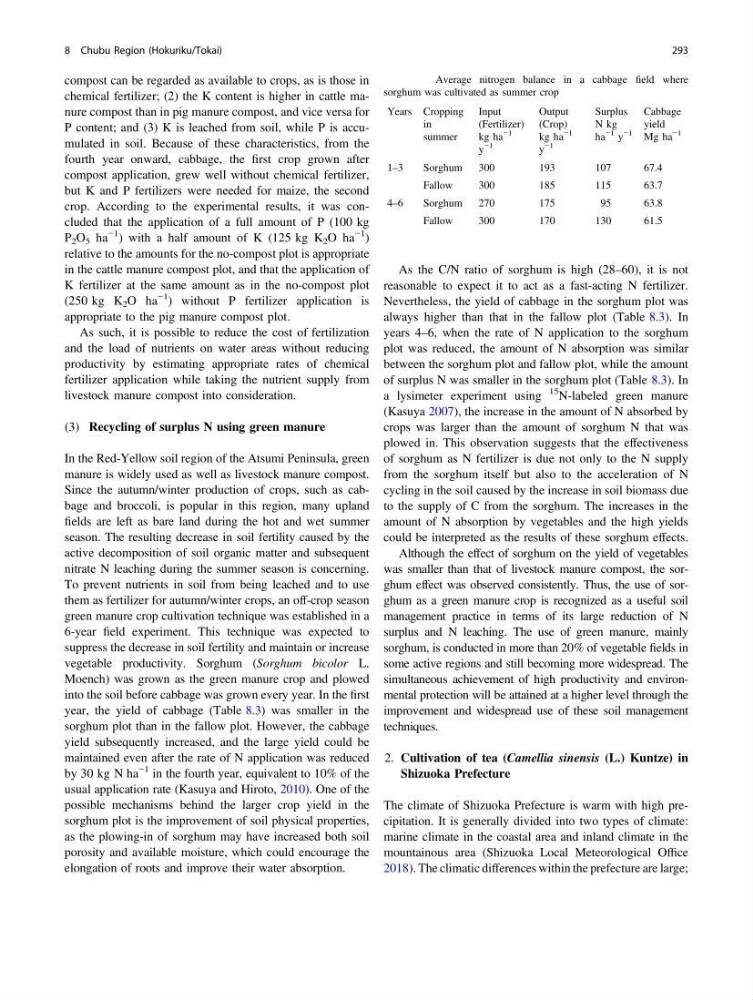
year, the yield of cabbage (Table 8.3) was smaller in the
sorghum plot than in the fallow plot. However, the cabbage
yield subsequently increased, and the large yield could be
maintained even after the rate of N application was reduced
by 30 kg N ha
−1 in the fourth year, equivalent to 10% of the
usual application rate (Kasuya and Hiroto, 2010). One of the
possible mechanisms behind the larger crop yield in the
sorghum plot is the improvement of soil physical properties,
as the plowing-in of sorghum may have increased both soil
porosity and available moisture, which could encourage the
elongation of roots and improve their water absorption.
As the C/N ratio of sorghum is high (28–60), it is not
reasonable to expect it to act as a fast-acting N fertilizer.
Nevertheless, the yield of cabbage in the sorghum plot was
always higher than that in the fallow plot (Table 8.3). In
years 4–6, when the rate of N application to the sorghum
plot was reduced, the amount of N absorption was similar
between the sorghum plot and fallow plot, while the amount
of surplus N was smaller in the sorghum plot (Table 8.3). In
a lysimeter experiment using
15 N-labeled green manure
(Kasuya 2007), the increase in the amount of N absorbed by
crops was larger than the amount of sorghum N that was
plowed in. This observation suggests that the effectiveness
of sorghum as N fertilizer is due not only to the N supply
from the sorghum itself but also to the acceleration of N
cycling in the soil caused by the increase in soil biomass due
to the supply of C from the sorghum. The increases in the
amount of N absorption by vegetables and the high yields
could be interpreted as the results of these sorghum effects.
Although the effect of sorghum on the yield of vegetables
was smaller than that of livestock manure compost, the sorghum effect was observed consistently. Thus, the use of sorghum as a green manure crop is recognized as a useful soil
management practice in terms of its large reduction of N
surplus and N leaching. The use of green manure, mainly
sorghum, is conducted in more than 20% of vegetable fields in
some active regions and still becoming more widespread. The
simultaneous achievement of high productivity and environmental protection will be attained at a higher level through the
improvement and widespread use of these soil management
techniques.
2. Cultivation of tea (Camellia sinensis (L.) Kuntze) in
Shizuoka Prefecture
The climate of Shizuoka Prefecture is warm with high precipitation. It is generally divided into two types of climate:
marine climate in the coastal area and inland climate in the
mountainous area (Shizuoka Local Meteorological Office
2018). The climatic differences within the prefecture are large;
Table 8.3 Average nitrogen balance in a cabbage field where
sorghum was cultivated as summer crop
Years Cropping
in
summer
Input
(Fertilizer)
kg ha
−1
y
−1
Output
(Crop)
kg ha
−1
y
−1
Surplus
N kg
ha
−1 y
−1
Cabbage
yield
Mg ha
−1
1–3
Sorghum
300
193
107
67.4
Fallow
300
185
115
63.7
4–6
Sorghum
270
175
95
63.8
Fallow
300
170
130
61.5
8 Chubu Region (Hokuriku/Tokai)
293
chemical fertilizer; (2) the K content is higher in cattle manure compost than in pig manure compost, and vice versa for
P content; and (3) K is leached from soil, while P is accumulated in soil. Because of these characteristics, from the
fourth year onward, cabbage, the first crop grown after
compost application, grew well without chemical fertilizer,
but K and P fertilizers were needed for maize, the second
crop. According to the experimental results, it was concluded that the application of a full amount of P (100 kg
P 2 O 5 ha
−1 ) with a half amount of K (125 kg K 2 O ha
−1 )
relative to the amounts for the no-compost plot is appropriate
in the cattle manure compost plot, and that the application of
K fertilizer at the same amount as in the no-compost plot
(250 kg K 2 O ha
−1 ) without P fertilizer application is
appropriate to the pig manure compost plot.
As such, it is possible to reduce the cost of fertilization
and the load of nutrients on water areas without reducing
productivity by estimating appropriate rates of chemical
fertilizer application while taking the nutrient supply from
livestock manure compost into consideration.
(3) Recycling of surplus N using green manure
In the Red-Yellow soil region of the Atsumi Peninsula, green
manure is widely used as well as livestock manure compost.
Since the autumn/winter production of crops, such as cabbage and broccoli, is popular in this region, many upland
fields are left as bare land during the hot and wet summer
season. The resulting decrease in soil fertility caused by the
active decomposition of soil organic matter and subsequent
nitrate N leaching during the summer season is concerning.
To prevent nutrients in soil from being leached and to use
them as fertilizer for autumn/winter crops, an off-crop season
green manure crop cultivation technique was established in a
6-year field experiment. This technique was expected to
suppress the decrease in soil fertility and maintain or increase
vegetable productivity. Sorghum (Sorghum bicolor L.
Moench) was grown as the green manure crop and plowed
into the soil before cabbage was grown every year. In the first
year, the yield of cabbage (Table 8.3) was smaller in the
sorghum plot than in the fallow plot. However, the cabbage
yield subsequently increased, and the large yield could be
maintained even after the rate of N application was reduced
by 30 kg N ha
−1 in the fourth year, equivalent to 10% of the
usual application rate (Kasuya and Hiroto, 2010). One of the
possible mechanisms behind the larger crop yield in the
sorghum plot is the improvement of soil physical properties,
as the plowing-in of sorghum may have increased both soil
porosity and available moisture, which could encourage the
elongation of roots and improve their water absorption.
As the C/N ratio of sorghum is high (28–60), it is not
reasonable to expect it to act as a fast-acting N fertilizer.
Nevertheless, the yield of cabbage in the sorghum plot was
always higher than that in the fallow plot (Table 8.3). In
years 4–6, when the rate of N application to the sorghum
plot was reduced, the amount of N absorption was similar
between the sorghum plot and fallow plot, while the amount
of surplus N was smaller in the sorghum plot (Table 8.3). In
a lysimeter experiment using
15 N-labeled green manure
(Kasuya 2007), the increase in the amount of N absorbed by
crops was larger than the amount of sorghum N that was
plowed in. This observation suggests that the effectiveness
of sorghum as N fertilizer is due not only to the N supply
from the sorghum itself but also to the acceleration of N
cycling in the soil caused by the increase in soil biomass due
to the supply of C from the sorghum. The increases in the
amount of N absorption by vegetables and the high yields
could be interpreted as the results of these sorghum effects.
Although the effect of sorghum on the yield of vegetables
was smaller than that of livestock manure compost, the sorghum effect was observed consistently. Thus, the use of sorghum as a green manure crop is recognized as a useful soil
management practice in terms of its large reduction of N
surplus and N leaching. The use of green manure, mainly
sorghum, is conducted in more than 20% of vegetable fields in
some active regions and still becoming more widespread. The
simultaneous achievement of high productivity and environmental protection will be attained at a higher level through the
improvement and widespread use of these soil management
techniques.
2. Cultivation of tea (Camellia sinensis (L.) Kuntze) in
Shizuoka Prefecture
The climate of Shizuoka Prefecture is warm with high precipitation. It is generally divided into two types of climate:
marine climate in the coastal area and inland climate in the
mountainous area (Shizuoka Local Meteorological Office
2018). The climatic differences within the prefecture are large;
Table 8.3 Average nitrogen balance in a cabbage field where
sorghum was cultivated as summer crop
Years Cropping
in
summer
Input
(Fertilizer)
kg ha
−1
y
−1
Output
(Crop)
kg ha
−1
y
−1
Surplus
N kg
ha
−1 y
−1
Cabbage
yield
Mg ha
−1
1–3
Sorghum
300
193
107
67.4
Fallow
300
185
115
63.7
4–6
Sorghum
270
175
95
63.8
Fallow
300
170
130
61.5
8 Chubu Region (Hokuriku/Tokai)
293