

the climate is relatively mild in the coastal area, with an annual
average temperature of 15–16°C and average annual precipitation of less than 2000 mm yr
−1 , while in the mountainous
area, the annual average temperature is 11–12°C, and the
average annual precipitation is 2500–3000 mm yr
−1
.
The total land area of Shizuoka Prefecture is 777,743 ha.
Of this, farmland accounts for 8.6% (67,100 ha). Because
the prefecture has a varied climate and topography, various
crops are cultivated. The information on soil and agricultural
land use in Shizuoka Prefecture has been introduced in detail
by Matsumoto (2005).
In Shizuoka Prefecture, tea, citrus, wasabi, and flowers
(gerbera, rose, and orchid) have a high market share
nationwide. Among these, tea is the representative crop in
Shizuoka Prefecture due to its large cultivation area
(17,400 ha, 26% of the total farmland area in the prefecture)
and the high economic value of its agricultural production
(30.6 billion yen, 14% of the total value of agricultural
production in Shizuoka Prefecture). Soil management in tea
gardens and measures for reducing the environmental load
induced by nitrogen fertilizer application are shown below.
(1) Soil management in tea gardens
The recommended fertilizer application rates for tea cultivation are set by each prefecture. The recommended level of
nitrogen application is about 500 kg N ha
−1 yr
−1 , and that of
phosphorus (P 2 O 5 ) and potassium (K 2 O) is between one
third and one half of the nitrogen application rates. For tea
crops, the new shoots of the plants are harvested, and since
new shoots with high contents of amino acids tend to be high
quality, more nitrogen is applied as fertilizer compared with
other crops. Nitrogen uptake by tea plants mostly occurs
during the period from April to November. Tea plants prefer
ammonium–nitrogen (NH 4
+
-N) to nitrate–nitrogen (NO 3
− -
N). The growth and nitrogen content of new shoots increases
with the application of NH 4
+
-N. The application rates of
organic fertilizers in tea gardens are higher than those in
other crop lands. In particular, during tea cultivation, organic
fertilizers are applied in large amounts in spring and autumn,
while fast-acting chemical fertilizers are applied in summer.
Tea plants prefer acidic soils; the optimal soil pH (H 2 O)
is 4–5. When soil pH exceeds 6, the growth of roots
becomes worse, which negatively affects the growth of tea
plants. Meanwhile, in significantly lower pH conditions,
problems arise including the suppression of root growth,
decreases in CEC, leaching of bases, and delays in decomposition of organic matter.
Fertilizer is generally applied in the soil between rows of
tea plants, which accounts for only one sixth to one fourth of
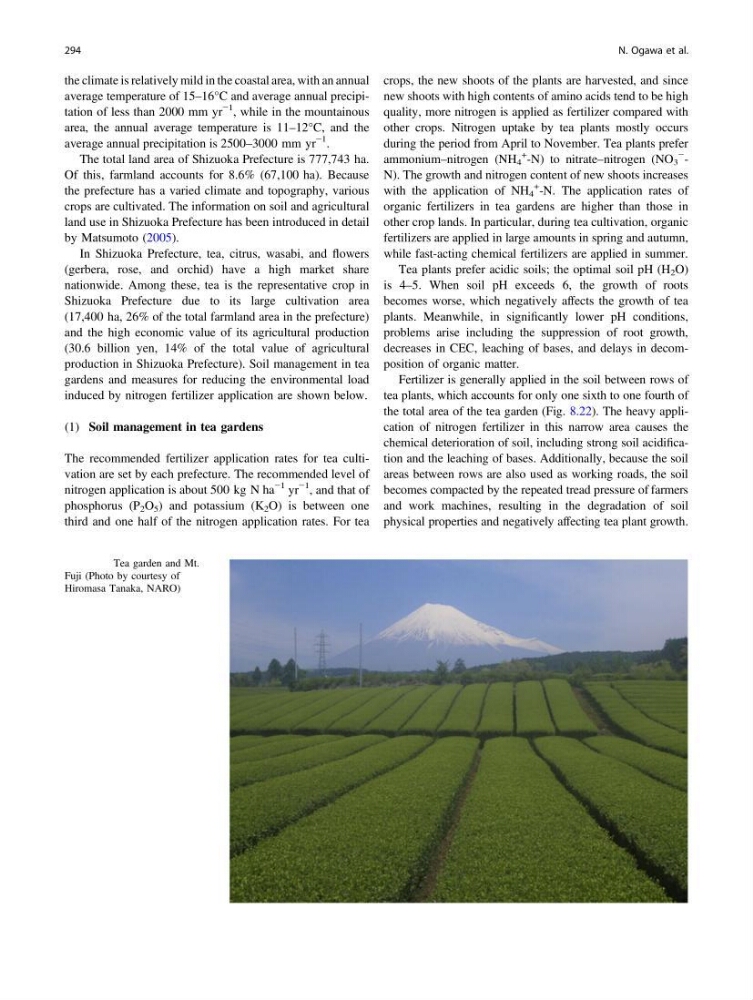
the total area of the tea garden (Fig. 8.22). The heavy application of nitrogen fertilizer in this narrow area causes the
chemical deterioration of soil, including strong soil acidification and the leaching of bases. Additionally, because the soil
areas between rows are also used as working roads, the soil
becomes compacted by the repeated tread pressure of farmers
and work machines, resulting in the degradation of soil
physical properties and negatively affecting tea plant growth.
Fig. 8.22 Tea garden and Mt.
Fuji (Photo by courtesy of
Hiromasa Tanaka, NARO)
294
N. Ogawa et al.
average temperature of 15–16°C and average annual precipitation of less than 2000 mm yr
−1 , while in the mountainous
area, the annual average temperature is 11–12°C, and the
average annual precipitation is 2500–3000 mm yr
−1
.
The total land area of Shizuoka Prefecture is 777,743 ha.
Of this, farmland accounts for 8.6% (67,100 ha). Because
the prefecture has a varied climate and topography, various
crops are cultivated. The information on soil and agricultural
land use in Shizuoka Prefecture has been introduced in detail
by Matsumoto (2005).
In Shizuoka Prefecture, tea, citrus, wasabi, and flowers
(gerbera, rose, and orchid) have a high market share
nationwide. Among these, tea is the representative crop in
Shizuoka Prefecture due to its large cultivation area
(17,400 ha, 26% of the total farmland area in the prefecture)
and the high economic value of its agricultural production
(30.6 billion yen, 14% of the total value of agricultural
production in Shizuoka Prefecture). Soil management in tea
gardens and measures for reducing the environmental load
induced by nitrogen fertilizer application are shown below.
(1) Soil management in tea gardens
The recommended fertilizer application rates for tea cultivation are set by each prefecture. The recommended level of
nitrogen application is about 500 kg N ha
−1 yr
−1 , and that of
phosphorus (P 2 O 5 ) and potassium (K 2 O) is between one
third and one half of the nitrogen application rates. For tea
crops, the new shoots of the plants are harvested, and since
new shoots with high contents of amino acids tend to be high
quality, more nitrogen is applied as fertilizer compared with
other crops. Nitrogen uptake by tea plants mostly occurs
during the period from April to November. Tea plants prefer
ammonium–nitrogen (NH 4
+
-N) to nitrate–nitrogen (NO 3
− -
N). The growth and nitrogen content of new shoots increases
with the application of NH 4
+
-N. The application rates of
organic fertilizers in tea gardens are higher than those in
other crop lands. In particular, during tea cultivation, organic
fertilizers are applied in large amounts in spring and autumn,
while fast-acting chemical fertilizers are applied in summer.
Tea plants prefer acidic soils; the optimal soil pH (H 2 O)
is 4–5. When soil pH exceeds 6, the growth of roots
becomes worse, which negatively affects the growth of tea
plants. Meanwhile, in significantly lower pH conditions,
problems arise including the suppression of root growth,
decreases in CEC, leaching of bases, and delays in decomposition of organic matter.
Fertilizer is generally applied in the soil between rows of
tea plants, which accounts for only one sixth to one fourth of
the total area of the tea garden (Fig. 8.22). The heavy application of nitrogen fertilizer in this narrow area causes the
chemical deterioration of soil, including strong soil acidification and the leaching of bases. Additionally, because the soil
areas between rows are also used as working roads, the soil
becomes compacted by the repeated tread pressure of farmers
and work machines, resulting in the degradation of soil
physical properties and negatively affecting tea plant growth.
Fig. 8.22 Tea garden and Mt.
Fuji (Photo by courtesy of
Hiromasa Tanaka, NARO)
294
N. Ogawa et al.