

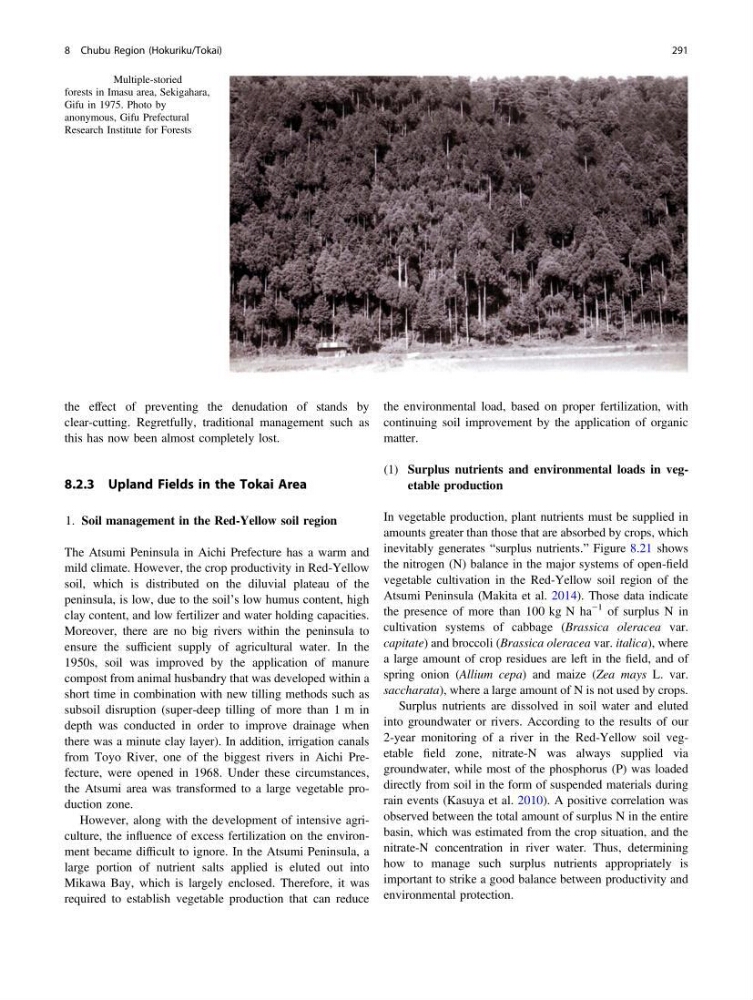
the effect of preventing the denudation of stands by
clear-cutting. Regretfully, traditional management such as
this has now been almost completely lost.
8.2.3 Upland Fields in the Tokai Area
1. Soil management in the Red-Yellow soil region
The Atsumi Peninsula in Aichi Prefecture has a warm and
mild climate. However, the crop productivity in Red-Yellow
soil, which is distributed on the diluvial plateau of the
peninsula, is low, due to the soil’s low humus content, high
clay content, and low fertilizer and water holding capacities.
Moreover, there are no big rivers within the peninsula to
ensure the sufficient supply of agricultural water. In the
1950s, soil was improved by the application of manure
compost from animal husbandry that was developed within a
short time in combination with new tilling methods such as
subsoil disruption (super-deep tilling of more than 1 m in
depth was conducted in order to improve drainage when
there was a minute clay layer). In addition, irrigation canals
from Toyo River, one of the biggest rivers in Aichi Prefecture, were opened in 1968. Under these circumstances,
the Atsumi area was transformed to a large vegetable production zone.
However, along with the development of intensive agriculture, the influence of excess fertilization on the environment became difficult to ignore. In the Atsumi Peninsula, a
large portion of nutrient salts applied is eluted out into
Mikawa Bay, which is largely enclosed. Therefore, it was
required to establish vegetable production that can reduce
the environmental load, based on proper fertilization, with
continuing soil improvement by the application of organic
matter.
(1) Surplus nutrients and environmental loads in vegetable production
In vegetable production, plant nutrients must be supplied in
amounts greater than those that are absorbed by crops, which
inevitably generates “surplus nutrients.” Figure 8.21 shows
the nitrogen (N) balance in the major systems of open-field
vegetable cultivation in the Red-Yellow soil region of the
Atsumi Peninsula (Makita et al. 2014). Those data indicate
the presence of more than 100 kg N ha
−1 of surplus N in
cultivation systems of cabbage (Brassica oleracea var.
capitate) and broccoli (Brassica oleracea var. italica), where
a large amount of crop residues are left in the field, and of
spring onion (Allium cepa) and maize (Zea mays L. var.
saccharata), where a large amount of N is not used by crops.
Surplus nutrients are dissolved in soil water and eluted
into groundwater or rivers. According to the results of our
2-year monitoring of a river in the Red-Yellow soil vegetable field zone, nitrate-N was always supplied via
groundwater, while most of the phosphorus (P) was loaded
directly from soil in the form of suspended materials during
rain events (Kasuya et al. 2010). A positive correlation was
observed between the total amount of surplus N in the entire
basin, which was estimated from the crop situation, and the
nitrate-N concentration in river water. Thus, determining
how to manage such surplus nutrients appropriately is
important to strike a good balance between productivity and
environmental protection.
Fig. 8.20 Multiple-storied
forests in Imasu area, Sekigahara,
Gifu in 1975. Photo by
anonymous, Gifu Prefectural
Research Institute for Forests
8 Chubu Region (Hokuriku/Tokai)
291
clear-cutting. Regretfully, traditional management such as
this has now been almost completely lost.
8.2.3 Upland Fields in the Tokai Area
1. Soil management in the Red-Yellow soil region
The Atsumi Peninsula in Aichi Prefecture has a warm and
mild climate. However, the crop productivity in Red-Yellow
soil, which is distributed on the diluvial plateau of the
peninsula, is low, due to the soil’s low humus content, high
clay content, and low fertilizer and water holding capacities.
Moreover, there are no big rivers within the peninsula to
ensure the sufficient supply of agricultural water. In the
1950s, soil was improved by the application of manure
compost from animal husbandry that was developed within a
short time in combination with new tilling methods such as
subsoil disruption (super-deep tilling of more than 1 m in
depth was conducted in order to improve drainage when
there was a minute clay layer). In addition, irrigation canals
from Toyo River, one of the biggest rivers in Aichi Prefecture, were opened in 1968. Under these circumstances,
the Atsumi area was transformed to a large vegetable production zone.
However, along with the development of intensive agriculture, the influence of excess fertilization on the environment became difficult to ignore. In the Atsumi Peninsula, a
large portion of nutrient salts applied is eluted out into
Mikawa Bay, which is largely enclosed. Therefore, it was
required to establish vegetable production that can reduce
the environmental load, based on proper fertilization, with
continuing soil improvement by the application of organic
matter.
(1) Surplus nutrients and environmental loads in vegetable production
In vegetable production, plant nutrients must be supplied in
amounts greater than those that are absorbed by crops, which
inevitably generates “surplus nutrients.” Figure 8.21 shows
the nitrogen (N) balance in the major systems of open-field
vegetable cultivation in the Red-Yellow soil region of the
Atsumi Peninsula (Makita et al. 2014). Those data indicate
the presence of more than 100 kg N ha
−1 of surplus N in
cultivation systems of cabbage (Brassica oleracea var.
capitate) and broccoli (Brassica oleracea var. italica), where
a large amount of crop residues are left in the field, and of
spring onion (Allium cepa) and maize (Zea mays L. var.
saccharata), where a large amount of N is not used by crops.
Surplus nutrients are dissolved in soil water and eluted
into groundwater or rivers. According to the results of our
2-year monitoring of a river in the Red-Yellow soil vegetable field zone, nitrate-N was always supplied via
groundwater, while most of the phosphorus (P) was loaded
directly from soil in the form of suspended materials during
rain events (Kasuya et al. 2010). A positive correlation was
observed between the total amount of surplus N in the entire
basin, which was estimated from the crop situation, and the
nitrate-N concentration in river water. Thus, determining
how to manage such surplus nutrients appropriately is
important to strike a good balance between productivity and
environmental protection.
Fig. 8.20 Multiple-storied
forests in Imasu area, Sekigahara,
Gifu in 1975. Photo by
anonymous, Gifu Prefectural
Research Institute for Forests
8 Chubu Region (Hokuriku/Tokai)
291