

undergrowth, especially in unthinned cypress forests
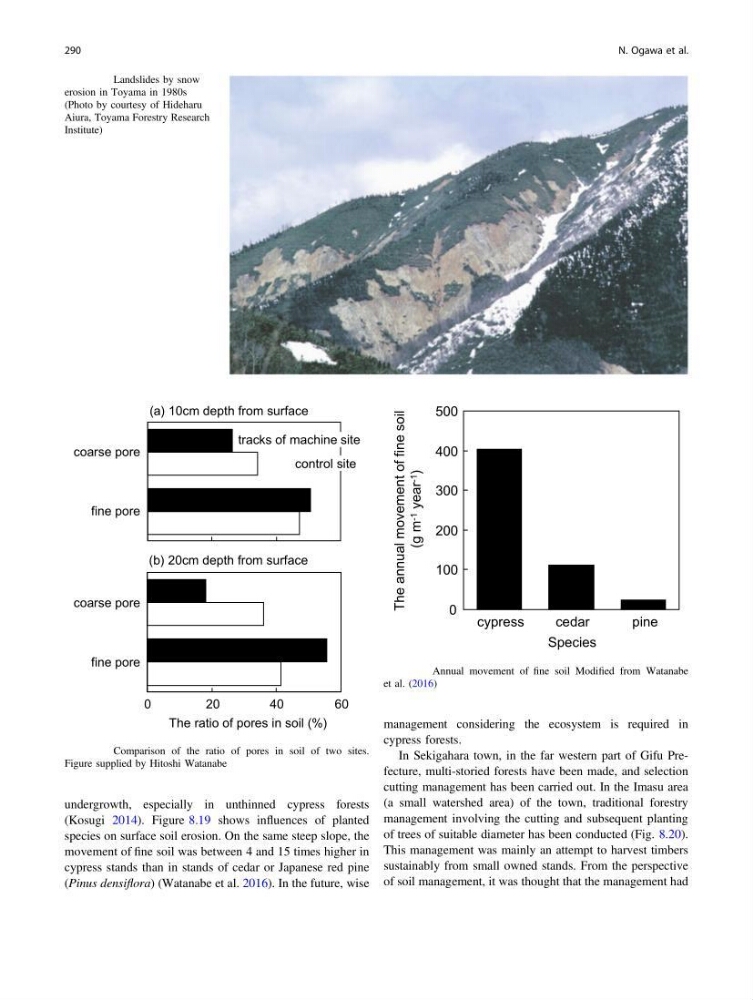
(Kosugi 2014). Figure 8.19 shows influences of planted
species on surface soil erosion. On the same steep slope, the
movement of fine soil was between 4 and 15 times higher in
cypress stands than in stands of cedar or Japanese red pine
(Pinus densiflora) (Watanabe et al. 2016). In the future, wise
management considering the ecosystem is required in
cypress forests.
In Sekigahara town, in the far western part of Gifu Prefecture, multi-storied forests have been made, and selection
cutting management has been carried out. In the Imasu area
(a small watershed area) of the town, traditional forestry
management involving the cutting and subsequent planting
of trees of suitable diameter has been conducted (Fig. 8.20).
This management was mainly an attempt to harvest timbers
sustainably from small owned stands. From the perspective
of soil management, it was thought that the management had
Fig. 8.17 Landslides by snow
erosion in Toyama in 1980s
(Photo by courtesy of Hideharu
Aiura, Toyama Forestry Research
Institute)
fine pore
coarse pore
0
2 0
4 0
6 0
fine pore
coarse pore
tracks of machine site
control site
(a) 10cm depth from surface
(b) 20cm depth from surface
The ratio of pores in soil (%)
Fig. 8.18 Comparison of the ratio of pores in soil of two sites.
Figure supplied by Hitoshi Watanabe
0
100
200
300
400
500
cypress
cedar
pine
The annual movement of fine soil
(g m -1
year -1
)
Species
Fig. 8.19 Annual movement of fine soil Modified from Watanabe
et al. (2016)
290
N. Ogawa et al.
(Kosugi 2014). Figure 8.19 shows influences of planted
species on surface soil erosion. On the same steep slope, the
movement of fine soil was between 4 and 15 times higher in
cypress stands than in stands of cedar or Japanese red pine
(Pinus densiflora) (Watanabe et al. 2016). In the future, wise
management considering the ecosystem is required in
cypress forests.
In Sekigahara town, in the far western part of Gifu Prefecture, multi-storied forests have been made, and selection
cutting management has been carried out. In the Imasu area
(a small watershed area) of the town, traditional forestry
management involving the cutting and subsequent planting
of trees of suitable diameter has been conducted (Fig. 8.20).
This management was mainly an attempt to harvest timbers
sustainably from small owned stands. From the perspective
of soil management, it was thought that the management had
Fig. 8.17 Landslides by snow
erosion in Toyama in 1980s
(Photo by courtesy of Hideharu
Aiura, Toyama Forestry Research
Institute)
fine pore
coarse pore
0
2 0
4 0
6 0
fine pore
coarse pore
tracks of machine site
control site
(a) 10cm depth from surface
(b) 20cm depth from surface
The ratio of pores in soil (%)
Fig. 8.18 Comparison of the ratio of pores in soil of two sites.
Figure supplied by Hitoshi Watanabe
0
100
200
300
400
500
cypress
cedar
pine
The annual movement of fine soil
(g m -1
year -1
)
Species
Fig. 8.19 Annual movement of fine soil Modified from Watanabe
et al. (2016)
290
N. Ogawa et al.