

decrease production excess (Fig. 8.10). As a result, the
reformation of fields to a wide block of over 3000 m
2 has
been completed in more than 90% of the paddy fields in
Fukui Prefecture (compared with 64% for the whole of
Japan) (Ministry of Agriculture, Forestry and Fisheries).
Additionally, underdrains have been constructed, and irrigation and drainage water flows have been separated in
many paddy fields in the prefecture.
(1) Change in soil properties in the paddy fields of
Fukui Prefecture
The soil of paddy fields in Fukui Prefecture is mainly alluvial, and most of the soils are wet and clayey. After the
implementation of the field improvement program, the
drainage of soil was improved. More than 60% of the paddy
fields in the prefecture were wet before paddy–upland
rotational managements were started in the 1970s, the proportion of wet paddy fields decreased to about 33% in 2000.
Furthermore, the depth of the plow layer was reduced by the
formation of plow pan that resulted from the use of large
machinery in the wide block of paddy fields. Around 1970,
66% of the paddy fields in Fukui Prefecture achieved the
target value of plow layer depth (deeper than 150 mm,
according to the Soil Fertility Enhancement Act); however,
only 36% of paddy fields achieved that target value about
30 years later (Imori et al. 2002).
The soil drying effect, in which soil organic matter
decomposition is enhanced by the rewetting of soil after
dryness, is exhibited when upland field is reconverted to
paddy field. The soil drying effect has become smaller as
paddy–upland rotations have been repeated. Additionally,
the application rate of nitrogen (N) fertilizer had been
decreased to 80% of the standard amount for rice cultivation
after barley cultivation. However, the decreased N application rate has not been needed in recent years.
Although phosphate and potassium fertilizers and silicate
materials were applied to paddy fields extensively until the
1980s, the application rate has been decreasing since the
mid-1990s due to the falling price of rice and the worldwide
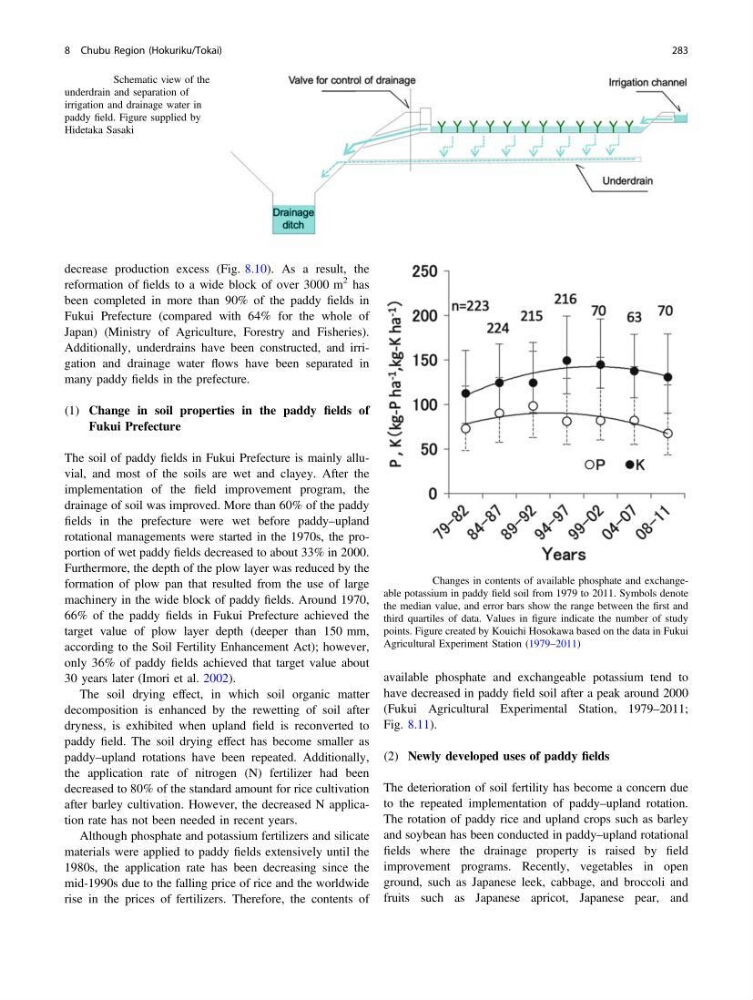
rise in the prices of fertilizers. Therefore, the contents of
available phosphate and exchangeable potassium tend to
have decreased in paddy field soil after a peak around 2000
(Fukui Agricultural Experimental Station, 1979–2011;
Fig. 8.11).
(2) Newly developed uses of paddy fields
The deterioration of soil fertility has become a concern due
to the repeated implementation of paddy–upland rotation.
The rotation of paddy rice and upland crops such as barley
and soybean has been conducted in paddy–upland rotational
fields where the drainage property is raised by field
improvement programs. Recently, vegetables in open
ground, such as Japanese leek, cabbage, and broccoli and
fruits such as Japanese apricot, Japanese pear, and
Fig. 8.10 Schematic view of the
underdrain and separation of
irrigation and drainage water in
paddy field. Figure supplied by
Hidetaka Sasaki
Fig. 8.11 Changes in contents of available phosphate and exchangeable potassium in paddy field soil from 1979 to 2011. Symbols denote
the median value, and error bars show the range between the first and
third quartiles of data. Values in figure indicate the number of study
points. Figure created by Kouichi Hosokawa based on the data in Fukui
Agricultural Experiment Station (1979–2011)
8 Chubu Region (Hokuriku/Tokai)
283
reformation of fields to a wide block of over 3000 m
2 has
been completed in more than 90% of the paddy fields in
Fukui Prefecture (compared with 64% for the whole of
Japan) (Ministry of Agriculture, Forestry and Fisheries).
Additionally, underdrains have been constructed, and irrigation and drainage water flows have been separated in
many paddy fields in the prefecture.
(1) Change in soil properties in the paddy fields of
Fukui Prefecture
The soil of paddy fields in Fukui Prefecture is mainly alluvial, and most of the soils are wet and clayey. After the
implementation of the field improvement program, the
drainage of soil was improved. More than 60% of the paddy
fields in the prefecture were wet before paddy–upland
rotational managements were started in the 1970s, the proportion of wet paddy fields decreased to about 33% in 2000.
Furthermore, the depth of the plow layer was reduced by the
formation of plow pan that resulted from the use of large
machinery in the wide block of paddy fields. Around 1970,
66% of the paddy fields in Fukui Prefecture achieved the
target value of plow layer depth (deeper than 150 mm,
according to the Soil Fertility Enhancement Act); however,
only 36% of paddy fields achieved that target value about
30 years later (Imori et al. 2002).
The soil drying effect, in which soil organic matter
decomposition is enhanced by the rewetting of soil after
dryness, is exhibited when upland field is reconverted to
paddy field. The soil drying effect has become smaller as
paddy–upland rotations have been repeated. Additionally,
the application rate of nitrogen (N) fertilizer had been
decreased to 80% of the standard amount for rice cultivation
after barley cultivation. However, the decreased N application rate has not been needed in recent years.
Although phosphate and potassium fertilizers and silicate
materials were applied to paddy fields extensively until the
1980s, the application rate has been decreasing since the
mid-1990s due to the falling price of rice and the worldwide
rise in the prices of fertilizers. Therefore, the contents of
available phosphate and exchangeable potassium tend to
have decreased in paddy field soil after a peak around 2000
(Fukui Agricultural Experimental Station, 1979–2011;
Fig. 8.11).
(2) Newly developed uses of paddy fields
The deterioration of soil fertility has become a concern due
to the repeated implementation of paddy–upland rotation.
The rotation of paddy rice and upland crops such as barley
and soybean has been conducted in paddy–upland rotational
fields where the drainage property is raised by field
improvement programs. Recently, vegetables in open
ground, such as Japanese leek, cabbage, and broccoli and
fruits such as Japanese apricot, Japanese pear, and
Fig. 8.10 Schematic view of the
underdrain and separation of
irrigation and drainage water in
paddy field. Figure supplied by
Hidetaka Sasaki
Fig. 8.11 Changes in contents of available phosphate and exchangeable potassium in paddy field soil from 1979 to 2011. Symbols denote
the median value, and error bars show the range between the first and
third quartiles of data. Values in figure indicate the number of study
points. Figure created by Kouichi Hosokawa based on the data in Fukui
Agricultural Experiment Station (1979–2011)
8 Chubu Region (Hokuriku/Tokai)
283