

persimmon have also been cultivated in upland fields converted from paddy fields in order to earn high income.
Japanese apricot is a major fruit crop in Fukui Prefecture,
and about 30% of Japanese apricot fields in the prefecture
were converted from paddy fields. Although converted fields
have been dried by field improvement programs, the
groundwater level is still sometimes high, which leads to the
presence of standing water on the soil surface. Under these
conditions, the roots of the Japanese apricot are difficult to
extend due to a high oxygen requirement, and the growth of
trees is therefore suppressed (Kanda 2015). In order to
improve the draining property in converted fields, drainage
ditches have been constructed, and/or the plow pan has been
broken with a subsoiler before cultivation.
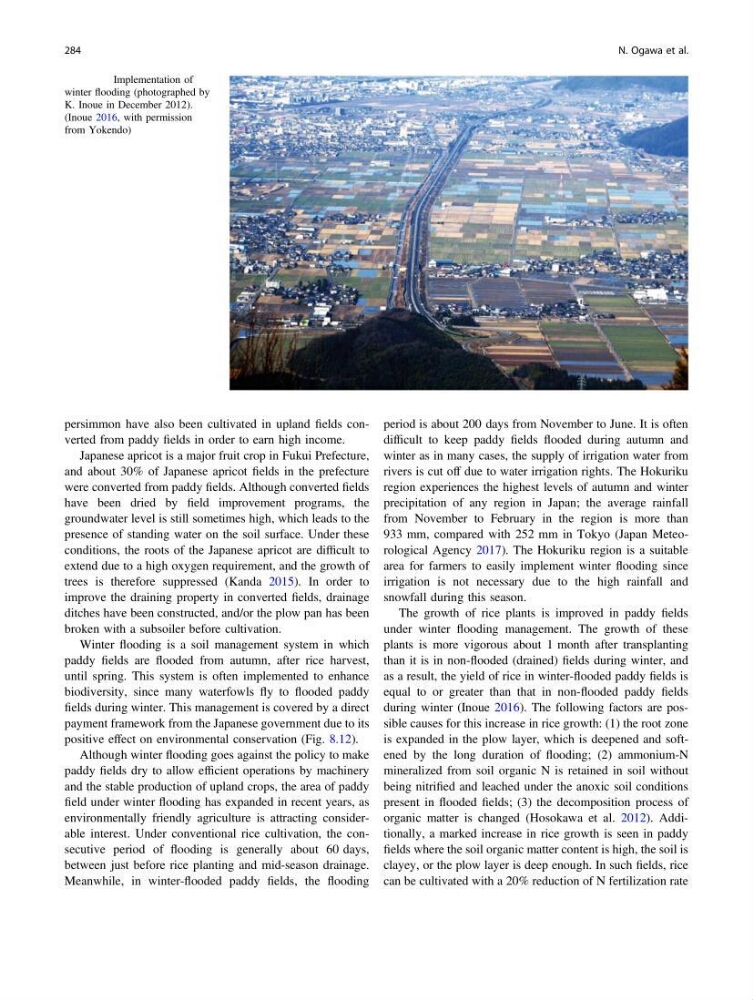
Winter flooding is a soil management system in which
paddy fields are flooded from autumn, after rice harvest,
until spring. This system is often implemented to enhance
biodiversity, since many waterfowls fly to flooded paddy
fields during winter. This management is covered by a direct
payment framework from the Japanese government due to its
positive effect on environmental conservation (Fig. 8.12).
Although winter flooding goes against the policy to make
paddy fields dry to allow efficient operations by machinery
and the stable production of upland crops, the area of paddy
field under winter flooding has expanded in recent years, as
environmentally friendly agriculture is attracting considerable interest. Under conventional rice cultivation, the consecutive period of flooding is generally about 60 days,
between just before rice planting and mid-season drainage.
Meanwhile, in winter-flooded paddy fields, the flooding
period is about 200 days from November to June. It is often
difficult to keep paddy fields flooded during autumn and
winter as in many cases, the supply of irrigation water from
rivers is cut off due to water irrigation rights. The Hokuriku
region experiences the highest levels of autumn and winter
precipitation of any region in Japan; the average rainfall
from November to February in the region is more than
933 mm, compared with 252 mm in Tokyo (Japan Meteorological Agency 2017). The Hokuriku region is a suitable
area for farmers to easily implement winter flooding since
irrigation is not necessary due to the high rainfall and
snowfall during this season.
The growth of rice plants is improved in paddy fields
under winter flooding management. The growth of these
plants is more vigorous about 1 month after transplanting
than it is in non-flooded (drained) fields during winter, and
as a result, the yield of rice in winter-flooded paddy fields is
equal to or greater than that in non-flooded paddy fields
during winter (Inoue 2016). The following factors are possible causes for this increase in rice growth: (1) the root zone
is expanded in the plow layer, which is deepened and softened by the long duration of flooding; (2) ammonium-N
mineralized from soil organic N is retained in soil without
being nitrified and leached under the anoxic soil conditions
present in flooded fields; (3) the decomposition process of
organic matter is changed (Hosokawa et al. 2012). Additionally, a marked increase in rice growth is seen in paddy
fields where the soil organic matter content is high, the soil is
clayey, or the plow layer is deep enough. In such fields, rice
can be cultivated with a 20% reduction of N fertilization rate
Fig. 8.12 Implementation of
winter flooding (photographed by
K. Inoue in December 2012).
(Inoue 2016, with permission
from Yokendo)
284
N. Ogawa et al.
Japanese apricot is a major fruit crop in Fukui Prefecture,
and about 30% of Japanese apricot fields in the prefecture
were converted from paddy fields. Although converted fields
have been dried by field improvement programs, the
groundwater level is still sometimes high, which leads to the
presence of standing water on the soil surface. Under these
conditions, the roots of the Japanese apricot are difficult to
extend due to a high oxygen requirement, and the growth of
trees is therefore suppressed (Kanda 2015). In order to
improve the draining property in converted fields, drainage
ditches have been constructed, and/or the plow pan has been
broken with a subsoiler before cultivation.
Winter flooding is a soil management system in which
paddy fields are flooded from autumn, after rice harvest,
until spring. This system is often implemented to enhance
biodiversity, since many waterfowls fly to flooded paddy
fields during winter. This management is covered by a direct
payment framework from the Japanese government due to its
positive effect on environmental conservation (Fig. 8.12).
Although winter flooding goes against the policy to make
paddy fields dry to allow efficient operations by machinery
and the stable production of upland crops, the area of paddy
field under winter flooding has expanded in recent years, as
environmentally friendly agriculture is attracting considerable interest. Under conventional rice cultivation, the consecutive period of flooding is generally about 60 days,
between just before rice planting and mid-season drainage.
Meanwhile, in winter-flooded paddy fields, the flooding
period is about 200 days from November to June. It is often
difficult to keep paddy fields flooded during autumn and
winter as in many cases, the supply of irrigation water from
rivers is cut off due to water irrigation rights. The Hokuriku
region experiences the highest levels of autumn and winter
precipitation of any region in Japan; the average rainfall
from November to February in the region is more than
933 mm, compared with 252 mm in Tokyo (Japan Meteorological Agency 2017). The Hokuriku region is a suitable
area for farmers to easily implement winter flooding since
irrigation is not necessary due to the high rainfall and
snowfall during this season.
The growth of rice plants is improved in paddy fields
under winter flooding management. The growth of these
plants is more vigorous about 1 month after transplanting
than it is in non-flooded (drained) fields during winter, and
as a result, the yield of rice in winter-flooded paddy fields is
equal to or greater than that in non-flooded paddy fields
during winter (Inoue 2016). The following factors are possible causes for this increase in rice growth: (1) the root zone
is expanded in the plow layer, which is deepened and softened by the long duration of flooding; (2) ammonium-N
mineralized from soil organic N is retained in soil without
being nitrified and leached under the anoxic soil conditions
present in flooded fields; (3) the decomposition process of
organic matter is changed (Hosokawa et al. 2012). Additionally, a marked increase in rice growth is seen in paddy
fields where the soil organic matter content is high, the soil is
clayey, or the plow layer is deep enough. In such fields, rice
can be cultivated with a 20% reduction of N fertilization rate
Fig. 8.12 Implementation of
winter flooding (photographed by
K. Inoue in December 2012).
(Inoue 2016, with permission
from Yokendo)
284
N. Ogawa et al.