

reported by Yamamoto et al. (1973), dieldrin contamination occurs in root vegetables such as carrot and
radish.
(2) Application of low-dieldrin-uptake rootstock into
cucumber cultivation
Otani and Seike (2007) proposed that selecting
low-dieldrin-uptake rootstock is a promising practical
technique to significantly reduce dieldrin concentration
in cucumber fruits grown in contaminated fields.
(3) Application of carbonaceous adsorbents
Organic pollutants, including POPs, is strongly adsorbed to carbonaceous materials such as activated carbon
and biochar. Saito et al. (2011) demonstrated that the
application of activated carbon to dieldrin-contaminated
soil is an effective and practical technique for reducing
dieldrin concentration in cucumber fruits.
7.5.4 Recycling of Organic Resources
The application of organic matter is an essential practice in
local agricultural production. Cattle manure compost is the
most commonly used type of organic matter, but organic
waste garbage from cities and vegetable waste from fields is
produced in massive quantities. This organic waste is a
valuable resource. However, it is not used effectively
because it comes in many forms and compositions and
because of its high water content. If it could be used as
fertilizer for agricultural production instead of being disposed of as waste, partnerships could be formed between
cities and the farming industry.
Although methane fermentation technology and technologies for converting organic waste into livestock feed and
fertilizer have been established to facilitate the effective use
of organic waste with high moisture content, most agricultural waste is deposited in landfills and urban waste is disposed of by incineration. The ingredients of animal feed
must be fresh. Methane fermentation poses the problem of
the need to process residual liquid. Converting organic waste
to fertilizer and compost offers the advantage of being able
to process such waste completely on farmland. However,
converting organic waste to compost requires expansive
facilities and lengthy processing; it also poses environmental
problems such as foul odors and is not suitable for urban
areas. Efforts are therefore being made to develop a way to
produce liquid fertilizer by thermal decomposition to convert
organic waste with high moisture content to fertilizer in
narrow spaces in a short period of time.
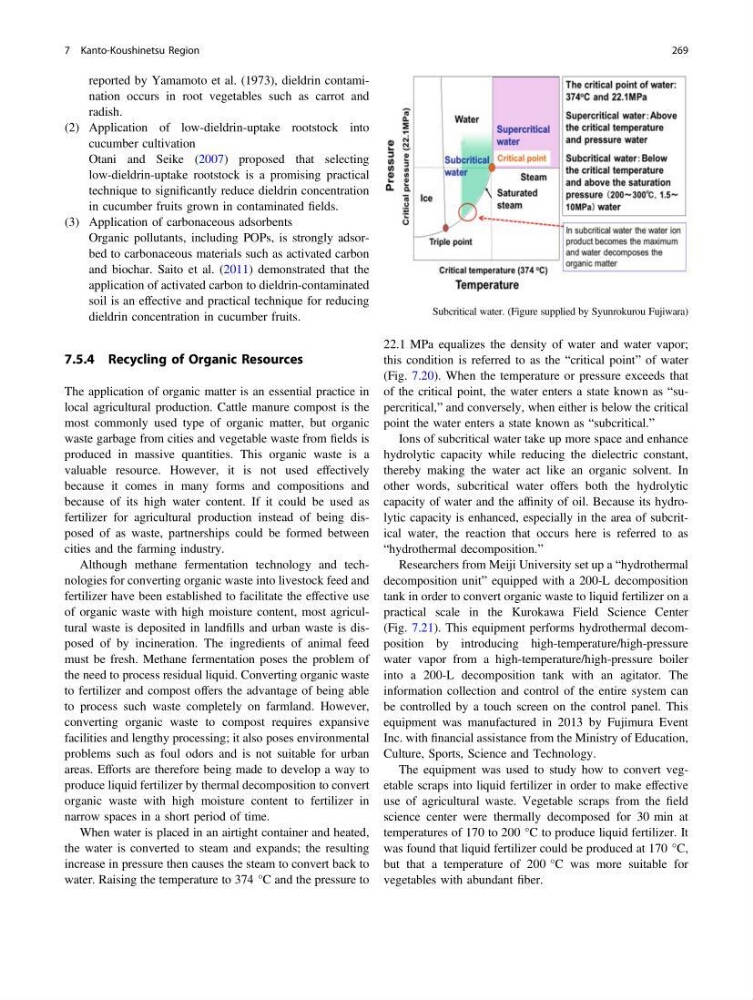
When water is placed in an airtight container and heated,
the water is converted to steam and expands; the resulting
increase in pressure then causes the steam to convert back to
water. Raising the temperature to 374 °C and the pressure to
22.1 MPa equalizes the density of water and water vapor;
this condition is referred to as the “critical point” of water
(Fig. 7.20). When the temperature or pressure exceeds that
of the critical point, the water enters a state known as “supercritical,” and conversely, when either is below the critical
point the water enters a state known as “subcritical.”
Ions of subcritical water take up more space and enhance
hydrolytic capacity while reducing the dielectric constant,
thereby making the water act like an organic solvent. In
other words, subcritical water offers both the hydrolytic
capacity of water and the affinity of oil. Because its hydrolytic capacity is enhanced, especially in the area of subcritical water, the reaction that occurs here is referred to as
“hydrothermal decomposition.”
Researchers from Meiji University set up a “hydrothermal
decomposition unit” equipped with a 200-L decomposition
tank in order to convert organic waste to liquid fertilizer on a
practical scale in the Kurokawa Field Science Center
(Fig. 7.21). This equipment performs hydrothermal decomposition by introducing high-temperature/high-pressure
water vapor from a high-temperature/high-pressure boiler
into a 200-L decomposition tank with an agitator. The
information collection and control of the entire system can
be controlled by a touch screen on the control panel. This
equipment was manufactured in 2013 by Fujimura Event
Inc. with financial assistance from the Ministry of Education,
Culture, Sports, Science and Technology.
The equipment was used to study how to convert vegetable scraps into liquid fertilizer in order to make effective
use of agricultural waste. Vegetable scraps from the field
science center were thermally decomposed for 30 min at
temperatures of 170 to 200 °C to produce liquid fertilizer. It
was found that liquid fertilizer could be produced at 170 °C,
but that a temperature of 200 °C was more suitable for
vegetables with abundant fiber.
Fig. 7.20 Subcritical water. (Figure supplied by Syunrokurou Fujiwara)
7 Kanto-Koushinetsu Region
269
radish.
(2) Application of low-dieldrin-uptake rootstock into
cucumber cultivation
Otani and Seike (2007) proposed that selecting
low-dieldrin-uptake rootstock is a promising practical
technique to significantly reduce dieldrin concentration
in cucumber fruits grown in contaminated fields.
(3) Application of carbonaceous adsorbents
Organic pollutants, including POPs, is strongly adsorbed to carbonaceous materials such as activated carbon
and biochar. Saito et al. (2011) demonstrated that the
application of activated carbon to dieldrin-contaminated
soil is an effective and practical technique for reducing
dieldrin concentration in cucumber fruits.
7.5.4 Recycling of Organic Resources
The application of organic matter is an essential practice in
local agricultural production. Cattle manure compost is the
most commonly used type of organic matter, but organic
waste garbage from cities and vegetable waste from fields is
produced in massive quantities. This organic waste is a
valuable resource. However, it is not used effectively
because it comes in many forms and compositions and
because of its high water content. If it could be used as
fertilizer for agricultural production instead of being disposed of as waste, partnerships could be formed between
cities and the farming industry.
Although methane fermentation technology and technologies for converting organic waste into livestock feed and
fertilizer have been established to facilitate the effective use
of organic waste with high moisture content, most agricultural waste is deposited in landfills and urban waste is disposed of by incineration. The ingredients of animal feed
must be fresh. Methane fermentation poses the problem of
the need to process residual liquid. Converting organic waste
to fertilizer and compost offers the advantage of being able
to process such waste completely on farmland. However,
converting organic waste to compost requires expansive
facilities and lengthy processing; it also poses environmental
problems such as foul odors and is not suitable for urban
areas. Efforts are therefore being made to develop a way to
produce liquid fertilizer by thermal decomposition to convert
organic waste with high moisture content to fertilizer in
narrow spaces in a short period of time.
When water is placed in an airtight container and heated,
the water is converted to steam and expands; the resulting
increase in pressure then causes the steam to convert back to
water. Raising the temperature to 374 °C and the pressure to
22.1 MPa equalizes the density of water and water vapor;
this condition is referred to as the “critical point” of water
(Fig. 7.20). When the temperature or pressure exceeds that
of the critical point, the water enters a state known as “supercritical,” and conversely, when either is below the critical
point the water enters a state known as “subcritical.”
Ions of subcritical water take up more space and enhance
hydrolytic capacity while reducing the dielectric constant,
thereby making the water act like an organic solvent. In
other words, subcritical water offers both the hydrolytic
capacity of water and the affinity of oil. Because its hydrolytic capacity is enhanced, especially in the area of subcritical water, the reaction that occurs here is referred to as
“hydrothermal decomposition.”
Researchers from Meiji University set up a “hydrothermal
decomposition unit” equipped with a 200-L decomposition
tank in order to convert organic waste to liquid fertilizer on a
practical scale in the Kurokawa Field Science Center
(Fig. 7.21). This equipment performs hydrothermal decomposition by introducing high-temperature/high-pressure
water vapor from a high-temperature/high-pressure boiler
into a 200-L decomposition tank with an agitator. The
information collection and control of the entire system can
be controlled by a touch screen on the control panel. This
equipment was manufactured in 2013 by Fujimura Event
Inc. with financial assistance from the Ministry of Education,
Culture, Sports, Science and Technology.
The equipment was used to study how to convert vegetable scraps into liquid fertilizer in order to make effective
use of agricultural waste. Vegetable scraps from the field
science center were thermally decomposed for 30 min at
temperatures of 170 to 200 °C to produce liquid fertilizer. It
was found that liquid fertilizer could be produced at 170 °C,
but that a temperature of 200 °C was more suitable for
vegetables with abundant fiber.
Fig. 7.20 Subcritical water. (Figure supplied by Syunrokurou Fujiwara)
7 Kanto-Koushinetsu Region
269