

By repeating the vegetable cultivation test using thermal
decomposition liquid fertilizer various times with various
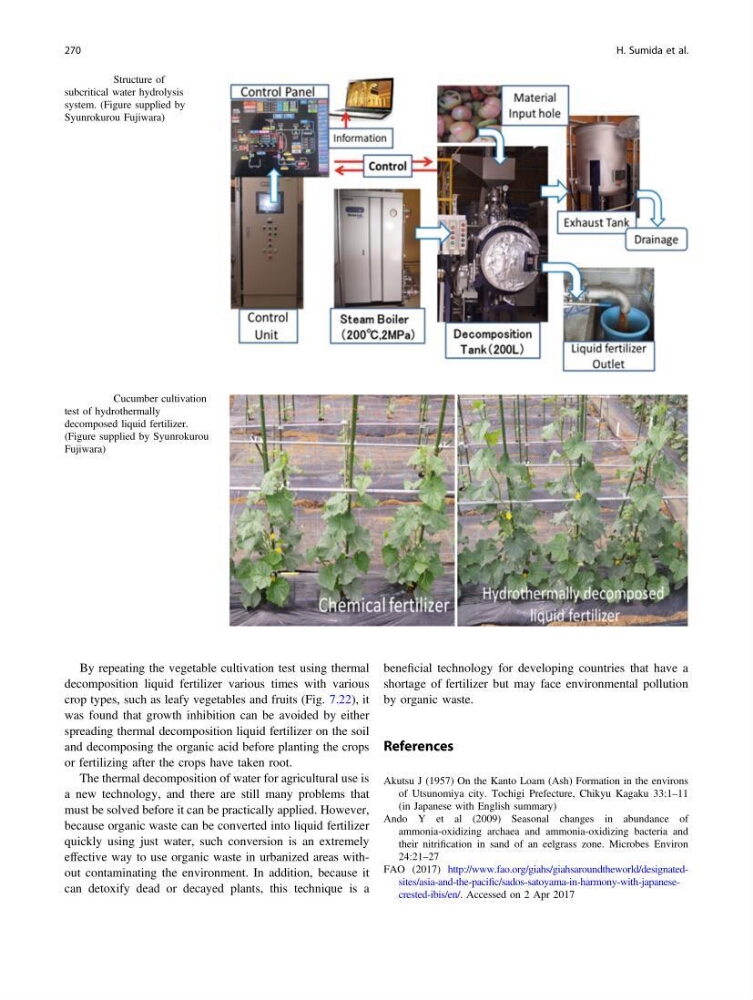
crop types, such as leafy vegetables and fruits (Fig. 7.22), it
was found that growth inhibition can be avoided by either
spreading thermal decomposition liquid fertilizer on the soil
and decomposing the organic acid before planting the crops
or fertilizing after the crops have taken root.
The thermal decomposition of water for agricultural use is
a new technology, and there are still many problems that
must be solved before it can be practically applied. However,
because organic waste can be converted into liquid fertilizer
quickly using just water, such conversion is an extremely
effective way to use organic waste in urbanized areas without contaminating the environment. In addition, because it
can detoxify dead or decayed plants, this technique is a
beneficial technology for developing countries that have a
shortage of fertilizer but may face environmental pollution
by organic waste.
References
Akutsu J (1957) On the Kanto Loam (Ash) Formation in the environs
of Utsunomiya city. Tochigi Prefecture, Chikyu Kagaku 33:1–11
(in Japanese with English summary)
Ando Y et al (2009) Seasonal changes in abundance of
ammonia-oxidizing archaea and ammonia-oxidizing bacteria and
their nitrification in sand of an eelgrass zone. Microbes Environ
24:21–27
sites/asia-and-the-pacific/sados-satoyama-in-harmony-with-japanesecrested-ibis/en/. Accessed on 2 Apr 2017
Fig. 7.21 Structure of
subcritical water hydrolysis
system. (Figure supplied by
Syunrokurou Fujiwara)
Fig. 7.22 Cucumber cultivation
test of hydrothermally
decomposed liquid fertilizer.
(Figure supplied by Syunrokurou
Fujiwara)
270
H. Sumida et al.
decomposition liquid fertilizer various times with various
crop types, such as leafy vegetables and fruits (Fig. 7.22), it
was found that growth inhibition can be avoided by either
spreading thermal decomposition liquid fertilizer on the soil
and decomposing the organic acid before planting the crops
or fertilizing after the crops have taken root.
The thermal decomposition of water for agricultural use is
a new technology, and there are still many problems that
must be solved before it can be practically applied. However,
because organic waste can be converted into liquid fertilizer
quickly using just water, such conversion is an extremely
effective way to use organic waste in urbanized areas without contaminating the environment. In addition, because it
can detoxify dead or decayed plants, this technique is a
beneficial technology for developing countries that have a
shortage of fertilizer but may face environmental pollution
by organic waste.
References
Akutsu J (1957) On the Kanto Loam (Ash) Formation in the environs
of Utsunomiya city. Tochigi Prefecture, Chikyu Kagaku 33:1–11
(in Japanese with English summary)
Ando Y et al (2009) Seasonal changes in abundance of
ammonia-oxidizing archaea and ammonia-oxidizing bacteria and
their nitrification in sand of an eelgrass zone. Microbes Environ
24:21–27
sites/asia-and-the-pacific/sados-satoyama-in-harmony-with-japanesecrested-ibis/en/. Accessed on 2 Apr 2017
Fig. 7.21 Structure of
subcritical water hydrolysis
system. (Figure supplied by
Syunrokurou Fujiwara)
Fig. 7.22 Cucumber cultivation
test of hydrothermally
decomposed liquid fertilizer.
(Figure supplied by Syunrokurou
Fujiwara)
270
H. Sumida et al.