

community. The authors showed that the enriched culture of
Nitrotoga could adapt to low temperature and also to relatively high concentrations of ammonia.
7.5.3 Drins in Upland Soils and Agricultural
Crops
Persistent organic pollutants (POPs) are synthetic chemicals
that: (1) pose a risk of causing adverse effects to human
health; (2) persist in the environment; (3) bioaccumulate
through the food web; and (4) can be transported across
international boundaries far from their sources. Currently,
there are 24 POPs that are controlled under the Stockholm
Convention on POPs. POPs can be classified into the following three broad categories:
• Pesticides such as dichloro-diphenyl-trichloroethane and
drins
• Intentionally produced industrial chemicals such as
polychlorinated biphenyls
• Unintentional by-products such as dioxin and furans.
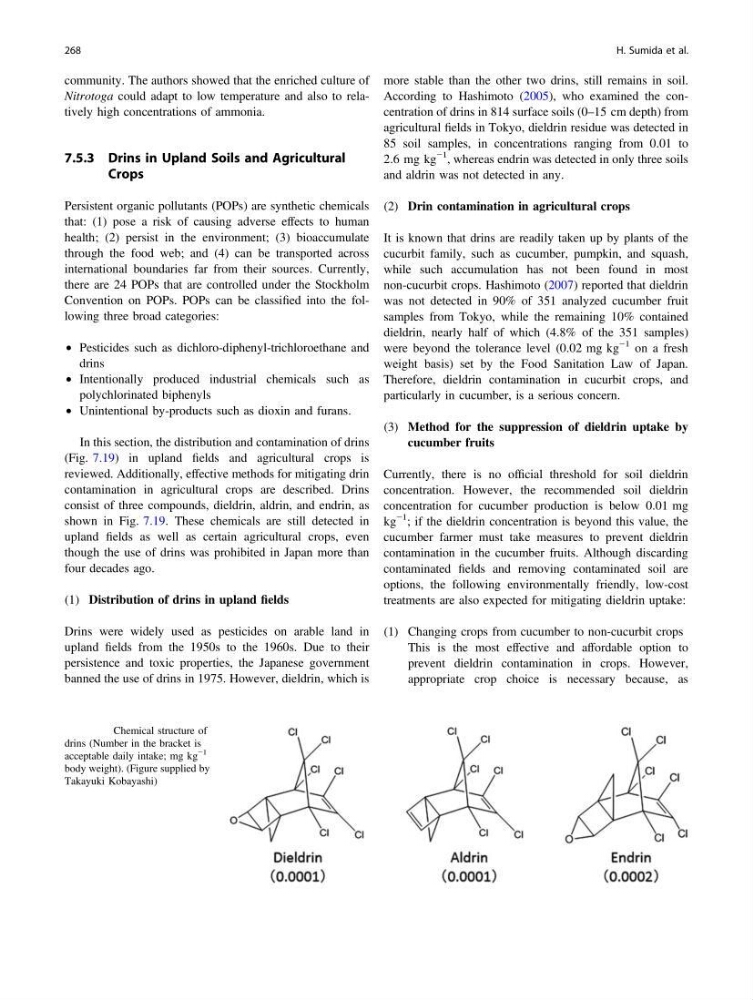
In this section, the distribution and contamination of drins
(Fig. 7.19) in upland fields and agricultural crops is
reviewed. Additionally, effective methods for mitigating drin
contamination in agricultural crops are described. Drins
consist of three compounds, dieldrin, aldrin, and endrin, as
shown in Fig. 7.19. These chemicals are still detected in
upland fields as well as certain agricultural crops, even
though the use of drins was prohibited in Japan more than
four decades ago.
(1) Distribution of drins in upland fields
Drins were widely used as pesticides on arable land in
upland fields from the 1950s to the 1960s. Due to their
persistence and toxic properties, the Japanese government
banned the use of drins in 1975. However, dieldrin, which is
more stable than the other two drins, still remains in soil.
According to Hashimoto (2005), who examined the concentration of drins in 814 surface soils (0–15 cm depth) from
agricultural fields in Tokyo, dieldrin residue was detected in
85 soil samples, in concentrations ranging from 0.01 to
2.6 mg kg
−1 , whereas endrin was detected in only three soils
and aldrin was not detected in any.
(2) Drin contamination in agricultural crops
It is known that drins are readily taken up by plants of the
cucurbit family, such as cucumber, pumpkin, and squash,
while such accumulation has not been found in most
non-cucurbit crops. Hashimoto (2007) reported that dieldrin
was not detected in 90% of 351 analyzed cucumber fruit
samples from Tokyo, while the remaining 10% contained
dieldrin, nearly half of which (4.8% of the 351 samples)
were beyond the tolerance level (0.02 mg kg
−1 on a fresh
weight basis) set by the Food Sanitation Law of Japan.
Therefore, dieldrin contamination in cucurbit crops, and
particularly in cucumber, is a serious concern.
(3) Method for the suppression of dieldrin uptake by
cucumber fruits
Currently, there is no official threshold for soil dieldrin
concentration. However, the recommended soil dieldrin
concentration for cucumber production is below 0.01 mg
kg
−1 ; if the dieldrin concentration is beyond this value, the
cucumber farmer must take measures to prevent dieldrin
contamination in the cucumber fruits. Although discarding
contaminated fields and removing contaminated soil are
options, the following environmentally friendly, low-cost
treatments are also expected for mitigating dieldrin uptake:
(1) Changing crops from cucumber to non-cucurbit crops
This is the most effective and affordable option to
prevent dieldrin contamination in crops. However,
appropriate crop choice is necessary because, as
Fig. 7.19 Chemical structure of
drins (Number in the bracket is
acceptable daily intake; mg kg
−1
body weight). (Figure supplied by
Takayuki Kobayashi)
268
H. Sumida et al.
Nitrotoga could adapt to low temperature and also to relatively high concentrations of ammonia.
7.5.3 Drins in Upland Soils and Agricultural
Crops
Persistent organic pollutants (POPs) are synthetic chemicals
that: (1) pose a risk of causing adverse effects to human
health; (2) persist in the environment; (3) bioaccumulate
through the food web; and (4) can be transported across
international boundaries far from their sources. Currently,
there are 24 POPs that are controlled under the Stockholm
Convention on POPs. POPs can be classified into the following three broad categories:
• Pesticides such as dichloro-diphenyl-trichloroethane and
drins
• Intentionally produced industrial chemicals such as
polychlorinated biphenyls
• Unintentional by-products such as dioxin and furans.
In this section, the distribution and contamination of drins
(Fig. 7.19) in upland fields and agricultural crops is
reviewed. Additionally, effective methods for mitigating drin
contamination in agricultural crops are described. Drins
consist of three compounds, dieldrin, aldrin, and endrin, as
shown in Fig. 7.19. These chemicals are still detected in
upland fields as well as certain agricultural crops, even
though the use of drins was prohibited in Japan more than
four decades ago.
(1) Distribution of drins in upland fields
Drins were widely used as pesticides on arable land in
upland fields from the 1950s to the 1960s. Due to their
persistence and toxic properties, the Japanese government
banned the use of drins in 1975. However, dieldrin, which is
more stable than the other two drins, still remains in soil.
According to Hashimoto (2005), who examined the concentration of drins in 814 surface soils (0–15 cm depth) from
agricultural fields in Tokyo, dieldrin residue was detected in
85 soil samples, in concentrations ranging from 0.01 to
2.6 mg kg
−1 , whereas endrin was detected in only three soils
and aldrin was not detected in any.
(2) Drin contamination in agricultural crops
It is known that drins are readily taken up by plants of the
cucurbit family, such as cucumber, pumpkin, and squash,
while such accumulation has not been found in most
non-cucurbit crops. Hashimoto (2007) reported that dieldrin
was not detected in 90% of 351 analyzed cucumber fruit
samples from Tokyo, while the remaining 10% contained
dieldrin, nearly half of which (4.8% of the 351 samples)
were beyond the tolerance level (0.02 mg kg
−1 on a fresh
weight basis) set by the Food Sanitation Law of Japan.
Therefore, dieldrin contamination in cucurbit crops, and
particularly in cucumber, is a serious concern.
(3) Method for the suppression of dieldrin uptake by
cucumber fruits
Currently, there is no official threshold for soil dieldrin
concentration. However, the recommended soil dieldrin
concentration for cucumber production is below 0.01 mg
kg
−1 ; if the dieldrin concentration is beyond this value, the
cucumber farmer must take measures to prevent dieldrin
contamination in the cucumber fruits. Although discarding
contaminated fields and removing contaminated soil are
options, the following environmentally friendly, low-cost
treatments are also expected for mitigating dieldrin uptake:
(1) Changing crops from cucumber to non-cucurbit crops
This is the most effective and affordable option to
prevent dieldrin contamination in crops. However,
appropriate crop choice is necessary because, as
Fig. 7.19 Chemical structure of
drins (Number in the bracket is
acceptable daily intake; mg kg
−1
body weight). (Figure supplied by
Takayuki Kobayashi)
268
H. Sumida et al.