

started in 2002, and have continued for more than 15 years.
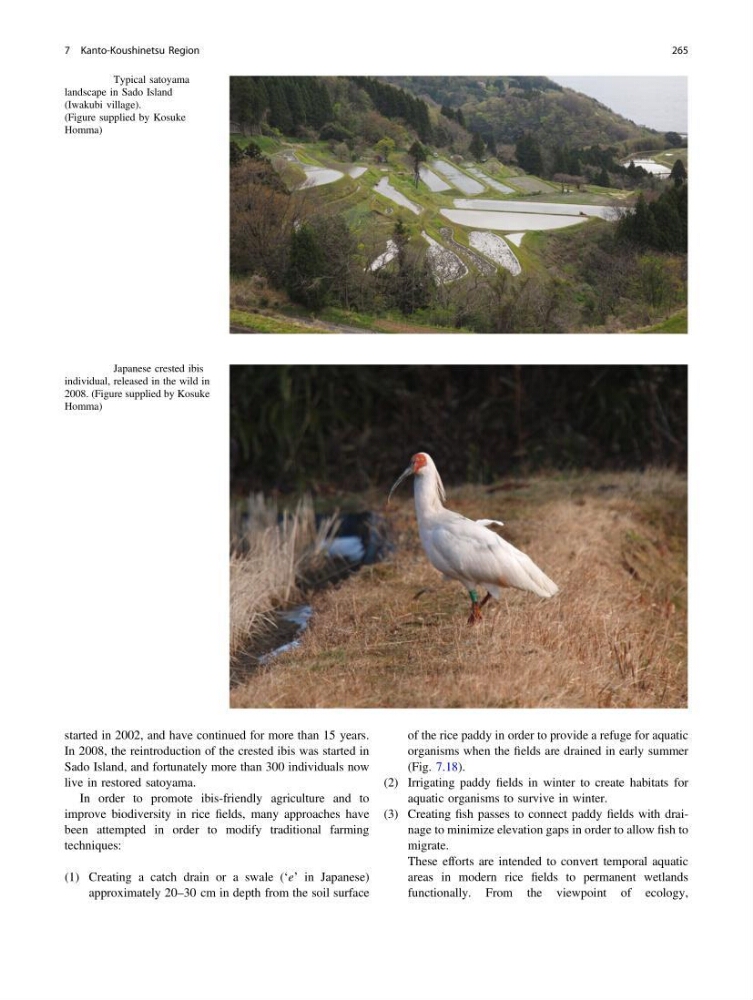
In 2008, the reintroduction of the crested ibis was started in
Sado Island, and fortunately more than 300 individuals now
live in restored satoyama.
In order to promote ibis-friendly agriculture and to
improve biodiversity in rice fields, many approaches have
been attempted in order to modify traditional farming
techniques:
(1) Creating a catch drain or a swale (‘e’ in Japanese)
approximately 20–30 cm in depth from the soil surface
of the rice paddy in order to provide a refuge for aquatic
organisms when the fields are drained in early summer
(Fig. 7.18).
(2) Irrigating paddy fields in winter to create habitats for
aquatic organisms to survive in winter.
(3) Creating fish passes to connect paddy fields with drainage to minimize elevation gaps in order to allow fish to
migrate.
These efforts are intended to convert temporal aquatic
areas in modern rice fields to permanent wetlands
functionally. From the viewpoint of ecology,
Fig. 7.17 Japanese crested ibis
individual, released in the wild in
2008. (Figure supplied by Kosuke
Homma)
Fig. 7.16 Typical satoyama
landscape in Sado Island
(Iwakubi village).
(Figure supplied by Kosuke
Homma)
7 Kanto-Koushinetsu Region
265
In 2008, the reintroduction of the crested ibis was started in
Sado Island, and fortunately more than 300 individuals now
live in restored satoyama.
In order to promote ibis-friendly agriculture and to
improve biodiversity in rice fields, many approaches have
been attempted in order to modify traditional farming
techniques:
(1) Creating a catch drain or a swale (‘e’ in Japanese)
approximately 20–30 cm in depth from the soil surface
of the rice paddy in order to provide a refuge for aquatic
organisms when the fields are drained in early summer
(Fig. 7.18).
(2) Irrigating paddy fields in winter to create habitats for
aquatic organisms to survive in winter.
(3) Creating fish passes to connect paddy fields with drainage to minimize elevation gaps in order to allow fish to
migrate.
These efforts are intended to convert temporal aquatic
areas in modern rice fields to permanent wetlands
functionally. From the viewpoint of ecology,
Fig. 7.17 Japanese crested ibis
individual, released in the wild in
2008. (Figure supplied by Kosuke
Homma)
Fig. 7.16 Typical satoyama
landscape in Sado Island
(Iwakubi village).
(Figure supplied by Kosuke
Homma)
7 Kanto-Koushinetsu Region
265