

close attention to changes in the soil environment due to the
reformation into well-drained paddy soils and to conduct
periodic soil diagnosis to manage plant nutrient practice.
7.4 Globally Important Agricultural Heritage
Systems
7.4.1 The “Satoyama” of Sado Island
In 2011, Sado Island (Sado City, Niigata Prefecture) was
approved to be a Globally Important Agricultural Heritage
System (GIAHS) site by the United Nations Food and
Agriculture Organization (FAO), the first such approval in a
developed country. GIAHS sites tend to be recognized only
as heritage sites with traditional agricultural legacies, as
suggested by the name. However, Sado Island was approved
due to a combination of traditional ecological knowledge
and applications of modern technology (FAO 2017).
The subject of the GIAHS of Sado Island is “satoyama in
harmony with the Japanese crested ibis (Nipponia Nippon).”
A “satoyama,” as defined by the Japanese Ministry of the
Environment, is a landscape complex composed of landscape elements such as villages, rice paddies, agricultural
ponds, coppices, and grasslands, located between wilderness
and the city (Homma 2012) (Fig. 7.16). Satoyama ecosystems have been one of the most important types of ecosystem in East Asian countries, including Japan, because
approximately 50% of endangered species are distributed
there, even though it is secondary nature.
The Japanese crested ibis, the most famous endangered bird
in Japan, is a symbolic species of satoyama (Fig. 7.17). It feeds
on loaches, frogs, aquatic insects, and grasshoppers in rice
paddies, and roosts in coppices or planted coniferous forest that
surround their feeding grounds. The Japanese crested ibis was
widely distributed in the Far East (China, Taiwan, South
Korea, North Korea, Eastern Russia, and Japan) until the
nineteenth century. However, the population of the species
decreased abruptly in each country from the late nineteenth
century to the early twentieth century due to overhunting,
which caused it to become extinct in most distribution areas
except Sado Island, Japan, and Xansi Province, China.
After World War II, the satoyama ecosystems in Japan
were changed drastically by land consolidation, agricultural
mechanization, and the use of herbicide, fungicide, and
pesticide. Satoyamas in mountainous regions was mostly
abandoned, because their production efficiency was not high
enough compared with that of lowland satoyamas and
because fuel wood and charcoal were no longer in demand
as energy sources. Thus, as a result of the environmental
change, the crested ibis had been extinct in the wild in Japan
since 1981. Around the year 2000, an artificial breeding
technique for the crested ibis was established in China and
Japan, and a project for the restoration of satoyama environments and the reintroduction of the crested ibis in the
wild was started in Sado Island in 2002.
Habitat restoration for the reintroduction of the crested
ibis is segmented into two approaches. One is to improve the
environment of modern rice paddies, and another is to
restore abandoned rice paddies and coppices. These projects
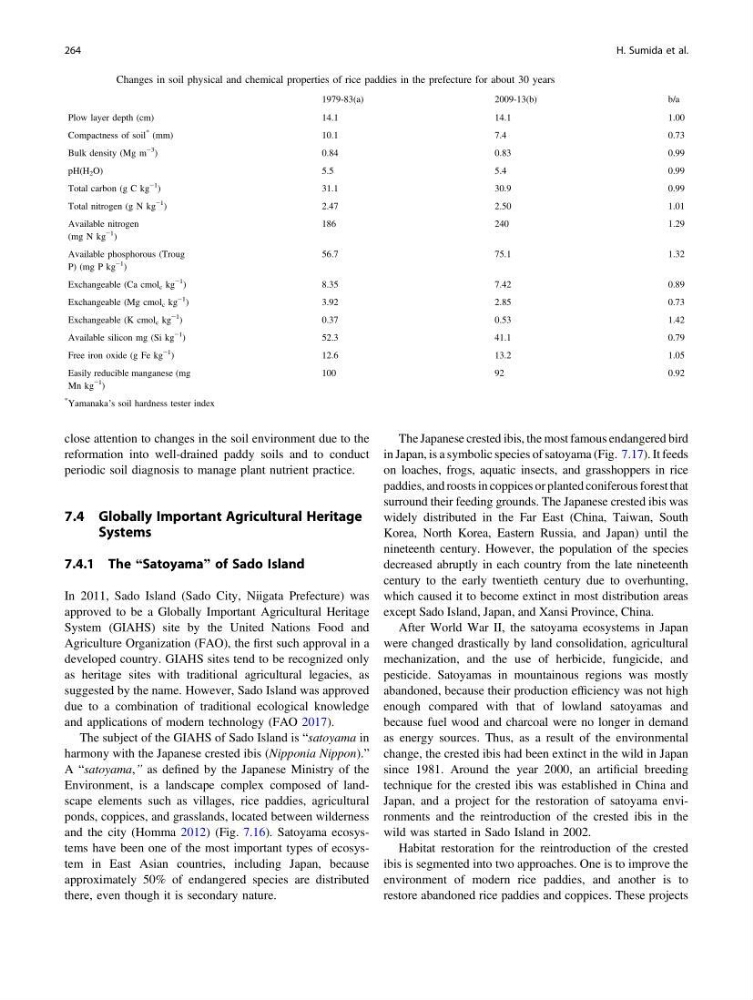
Table 7.2 Changes in soil physical and chemical properties of rice paddies in the prefecture for about 30 years
1979-83(a)
2009-13(b)
b/a
Plow layer depth (cm)
14.1
14.1
1.00
Compactness of soil
* (mm)
10.1
7.4
0.73
Bulk density (Mg m
−3
)
0.84
0.83
0.99
pH(H 2 O)
5.5
5.4
0.99
Total carbon (g C kg
−1
)
31.1
30.9
0.99
Total nitrogen (g N kg
−1
)
2.47
2.50
1.01
Available nitrogen
(mg N kg
−1 )
186
240
1.29
Available phosphorous (Troug
P) (mg P kg
−1
)
56.7
75.1
1.32
Exchangeable (Ca cmol c kg
−1
)
8.35
7.42
0.89
Exchangeable (Mg cmol c kg
−1
)
3.92
2.85
0.73
Exchangeable (K cmol c kg
−1
)
0.37
0.53
1.42
Available silicon mg (Si kg
−1
)
52.3
41.1
0.79
Free iron oxide (g Fe kg
−1
)
12.6
13.2
1.05
Easily reducible manganese (mg
Mn kg
−1
)
100
92
0.92
*
Yamanaka’s soil hardness tester index
264
H. Sumida et al.
reformation into well-drained paddy soils and to conduct
periodic soil diagnosis to manage plant nutrient practice.
7.4 Globally Important Agricultural Heritage
Systems
7.4.1 The “Satoyama” of Sado Island
In 2011, Sado Island (Sado City, Niigata Prefecture) was
approved to be a Globally Important Agricultural Heritage
System (GIAHS) site by the United Nations Food and
Agriculture Organization (FAO), the first such approval in a
developed country. GIAHS sites tend to be recognized only
as heritage sites with traditional agricultural legacies, as
suggested by the name. However, Sado Island was approved
due to a combination of traditional ecological knowledge
and applications of modern technology (FAO 2017).
The subject of the GIAHS of Sado Island is “satoyama in
harmony with the Japanese crested ibis (Nipponia Nippon).”
A “satoyama,” as defined by the Japanese Ministry of the
Environment, is a landscape complex composed of landscape elements such as villages, rice paddies, agricultural
ponds, coppices, and grasslands, located between wilderness
and the city (Homma 2012) (Fig. 7.16). Satoyama ecosystems have been one of the most important types of ecosystem in East Asian countries, including Japan, because
approximately 50% of endangered species are distributed
there, even though it is secondary nature.
The Japanese crested ibis, the most famous endangered bird
in Japan, is a symbolic species of satoyama (Fig. 7.17). It feeds
on loaches, frogs, aquatic insects, and grasshoppers in rice
paddies, and roosts in coppices or planted coniferous forest that
surround their feeding grounds. The Japanese crested ibis was
widely distributed in the Far East (China, Taiwan, South
Korea, North Korea, Eastern Russia, and Japan) until the
nineteenth century. However, the population of the species
decreased abruptly in each country from the late nineteenth
century to the early twentieth century due to overhunting,
which caused it to become extinct in most distribution areas
except Sado Island, Japan, and Xansi Province, China.
After World War II, the satoyama ecosystems in Japan
were changed drastically by land consolidation, agricultural
mechanization, and the use of herbicide, fungicide, and
pesticide. Satoyamas in mountainous regions was mostly
abandoned, because their production efficiency was not high
enough compared with that of lowland satoyamas and
because fuel wood and charcoal were no longer in demand
as energy sources. Thus, as a result of the environmental
change, the crested ibis had been extinct in the wild in Japan
since 1981. Around the year 2000, an artificial breeding
technique for the crested ibis was established in China and
Japan, and a project for the restoration of satoyama environments and the reintroduction of the crested ibis in the
wild was started in Sado Island in 2002.
Habitat restoration for the reintroduction of the crested
ibis is segmented into two approaches. One is to improve the
environment of modern rice paddies, and another is to
restore abandoned rice paddies and coppices. These projects
Table 7.2 Changes in soil physical and chemical properties of rice paddies in the prefecture for about 30 years
1979-83(a)
2009-13(b)
b/a
Plow layer depth (cm)
14.1
14.1
1.00
Compactness of soil
* (mm)
10.1
7.4
0.73
Bulk density (Mg m
−3
)
0.84
0.83
0.99
pH(H 2 O)
5.5
5.4
0.99
Total carbon (g C kg
−1
)
31.1
30.9
0.99
Total nitrogen (g N kg
−1
)
2.47
2.50
1.01
Available nitrogen
(mg N kg
−1 )
186
240
1.29
Available phosphorous (Troug
P) (mg P kg
−1
)
56.7
75.1
1.32
Exchangeable (Ca cmol c kg
−1
)
8.35
7.42
0.89
Exchangeable (Mg cmol c kg
−1
)
3.92
2.85
0.73
Exchangeable (K cmol c kg
−1
)
0.37
0.53
1.42
Available silicon mg (Si kg
−1
)
52.3
41.1
0.79
Free iron oxide (g Fe kg
−1
)
12.6
13.2
1.05
Easily reducible manganese (mg
Mn kg
−1
)
100
92
0.92
*
Yamanaka’s soil hardness tester index
264
H. Sumida et al.