

previous cultivation nor nutrients supplied from soil organic
matter. Decreasing plow layer depth is also a trigger for
nutrient accumulation in the surface layer.
(c) Orchard fields
Concentrations of exchangeable calcium and potassium exceed
the soil diagnostic criterion in 70% to 80% of the orchard fields
in Yamanashi Prefecture. Levels of available phosphoric acid
are also excessive in most of the orchard fields due to the
decrease in the plow depth. The levels of soil humus are
increasing with the spread of herbage cultivation. The soil pH of
tea gardens is lower than the soil diagnostic criterion due to the
excessive application of N fertilizer. Moreover, in the tea gardens, nitrate-nitrogen tends to be lower than in other prefectures.
(2) Nagano Prefecture
The total area of paddy field in Nagano Prefecture is about
70,000 ha. Gray Fluvic soils occupy 21% of the paddy fields
and Brown Fluvic soils account for 19%. In upland fields,
Allophanic Andosol is the most dominant soil group,
accounting for 39% of fields, and the second most dominant
soil group is Brown Forest soils, which account for 17%.
(a) Paddy fields
The fertilizer application rate in paddy fields is at an almost
appropriate level based on the prefectural guidelines. The
amount of available silicon in paddy field soil has tended
to decrease. In order to improve the soil chemical fertility
of paddy fields, the application of integrated amendments, including minor elements, has been recommended.
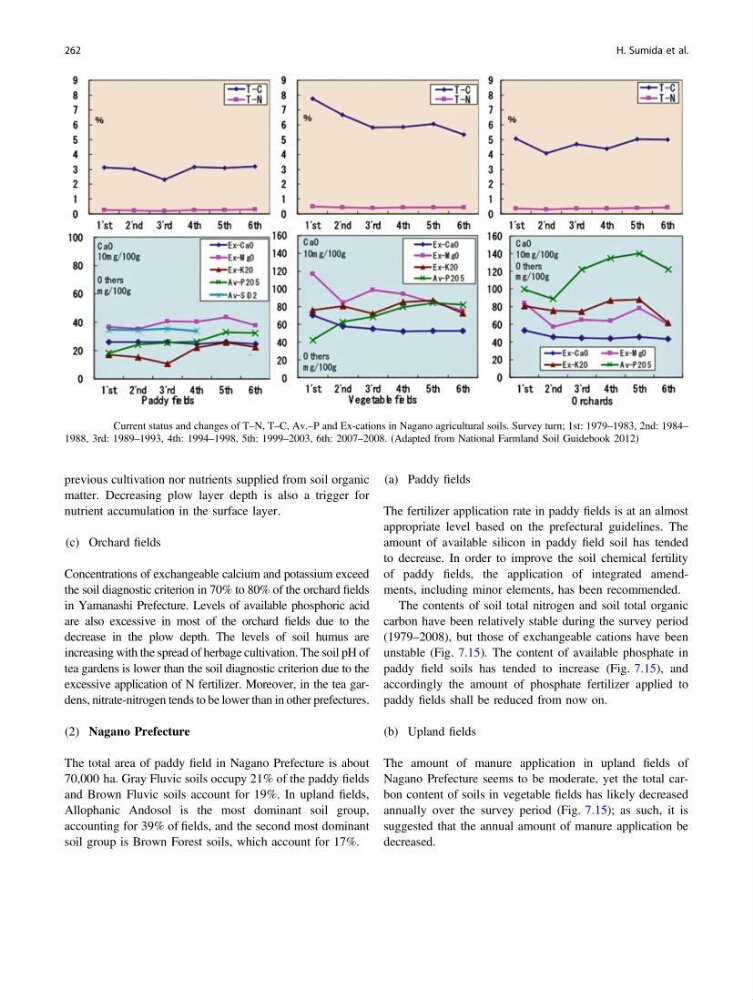
The contents of soil total nitrogen and soil total organic
carbon have been relatively stable during the survey period
(1979–2008), but those of exchangeable cations have been
unstable (Fig. 7.15). The content of available phosphate in
paddy field soils has tended to increase (Fig. 7.15), and
accordingly the amount of phosphate fertilizer applied to
paddy fields shall be reduced from now on.
(b) Upland fields
The amount of manure application in upland fields of
Nagano Prefecture seems to be moderate, yet the total carbon content of soils in vegetable fields has likely decreased
annually over the survey period (Fig. 7.15); as such, it is
suggested that the annual amount of manure application be
decreased.
Fig. 7.15 Current status and changes of T–N, T–C, Av.–P and Ex-cations in Nagano agricultural soils. Survey turn; 1st: 1979–1983, 2nd: 1984–
1988, 3rd: 1989–1993, 4th: 1994–1998, 5th: 1999–2003, 6th: 2007–2008. (Adapted from National Farmland Soil Guidebook 2012)
262
H. Sumida et al.
matter. Decreasing plow layer depth is also a trigger for
nutrient accumulation in the surface layer.
(c) Orchard fields
Concentrations of exchangeable calcium and potassium exceed
the soil diagnostic criterion in 70% to 80% of the orchard fields
in Yamanashi Prefecture. Levels of available phosphoric acid
are also excessive in most of the orchard fields due to the
decrease in the plow depth. The levels of soil humus are
increasing with the spread of herbage cultivation. The soil pH of
tea gardens is lower than the soil diagnostic criterion due to the
excessive application of N fertilizer. Moreover, in the tea gardens, nitrate-nitrogen tends to be lower than in other prefectures.
(2) Nagano Prefecture
The total area of paddy field in Nagano Prefecture is about
70,000 ha. Gray Fluvic soils occupy 21% of the paddy fields
and Brown Fluvic soils account for 19%. In upland fields,
Allophanic Andosol is the most dominant soil group,
accounting for 39% of fields, and the second most dominant
soil group is Brown Forest soils, which account for 17%.
(a) Paddy fields
The fertilizer application rate in paddy fields is at an almost
appropriate level based on the prefectural guidelines. The
amount of available silicon in paddy field soil has tended
to decrease. In order to improve the soil chemical fertility
of paddy fields, the application of integrated amendments, including minor elements, has been recommended.
The contents of soil total nitrogen and soil total organic
carbon have been relatively stable during the survey period
(1979–2008), but those of exchangeable cations have been
unstable (Fig. 7.15). The content of available phosphate in
paddy field soils has tended to increase (Fig. 7.15), and
accordingly the amount of phosphate fertilizer applied to
paddy fields shall be reduced from now on.
(b) Upland fields
The amount of manure application in upland fields of
Nagano Prefecture seems to be moderate, yet the total carbon content of soils in vegetable fields has likely decreased
annually over the survey period (Fig. 7.15); as such, it is
suggested that the annual amount of manure application be
decreased.
Fig. 7.15 Current status and changes of T–N, T–C, Av.–P and Ex-cations in Nagano agricultural soils. Survey turn; 1st: 1979–1983, 2nd: 1984–
1988, 3rd: 1989–1993, 4th: 1994–1998, 5th: 1999–2003, 6th: 2007–2008. (Adapted from National Farmland Soil Guidebook 2012)
262
H. Sumida et al.