

(b) Upland field soil
Soil pH tended to increase in the upland fields (Fig. 7.13),
and 59% of upland fields had soil pH values in excess of pH
6.5. Levels of soil available P 2 O 5 were approximately
appropriate, although levels were excessive in the Brown
Fluvic soils and the Brown Forest soils. Levels of soil
exchangeable K were appropriate in most fields. A total of
41% of fields were deficient in exchangeable Ca, and 41%
had excess levels. There was large difference among the
fields. A total of 48% of fields were deficient in exchangeable Mg. Mg was especially deficient in the Brown Fluvic
soils and the Brown Forest soils. Levels of soil available N
tended to decrease in the upland fields (data not shown).
7.3.2 Koushin Region
(1) Yamanashi Prefecture
The total area of agricultural land in Yamanashi Prefecture is
24,900 ha. Of this, orchard (11,600 ha) is the most dominant
land-use type.
Allophanic Andosols are the most dominant agricultural
soil group in this prefecture, occupying 31% of the total area
of agricultural land, followed by Brown Forest soils (30%),
Regosolic Fluvic soils (12%), and Brown Fluvic soils (11%).
In orchard fields, Brown Forest soil is the most dominant
soil group (43%), followed by Allophanic Andosols (21%)
and Brown Forest soils (19%). These three soil groups are all
characterized by well-drained conditions and are therefore
suitable for fruit cultivation.
(a) Paddy fields
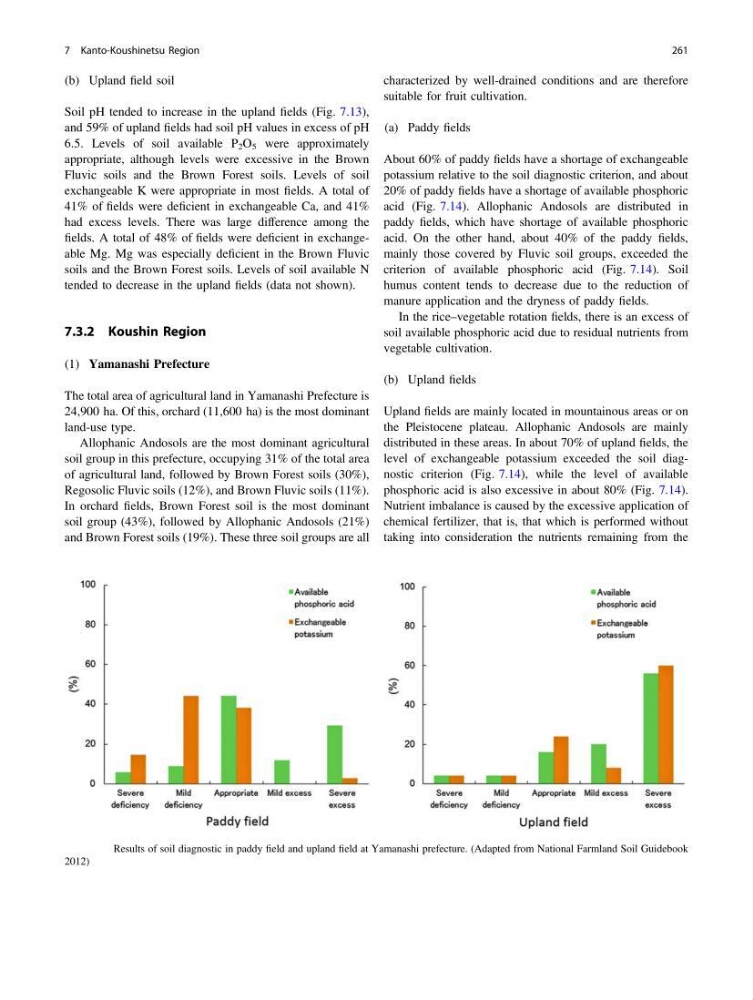
About 60% of paddy fields have a shortage of exchangeable
potassium relative to the soil diagnostic criterion, and about
20% of paddy fields have a shortage of available phosphoric
acid (Fig. 7.14). Allophanic Andosols are distributed in
paddy fields, which have shortage of available phosphoric
acid. On the other hand, about 40% of the paddy fields,
mainly those covered by Fluvic soil groups, exceeded the
criterion of available phosphoric acid (Fig. 7.14). Soil
humus content tends to decrease due to the reduction of
manure application and the dryness of paddy fields.
In the rice–vegetable rotation fields, there is an excess of
soil available phosphoric acid due to residual nutrients from
vegetable cultivation.
(b) Upland fields
Upland fields are mainly located in mountainous areas or on
the Pleistocene plateau. Allophanic Andosols are mainly
distributed in these areas. In about 70% of upland fields, the
level of exchangeable potassium exceeded the soil diagnostic criterion (Fig. 7.14), while the level of available
phosphoric acid is also excessive in about 80% (Fig. 7.14).
Nutrient imbalance is caused by the excessive application of
chemical fertilizer, that is, that which is performed without
taking into consideration the nutrients remaining from the
Fig. 7.14 Results of soil diagnostic in paddy field and upland field at Yamanashi prefecture. (Adapted from National Farmland Soil Guidebook
2012)
7 Kanto-Koushinetsu Region
261
Soil pH tended to increase in the upland fields (Fig. 7.13),
and 59% of upland fields had soil pH values in excess of pH
6.5. Levels of soil available P 2 O 5 were approximately
appropriate, although levels were excessive in the Brown
Fluvic soils and the Brown Forest soils. Levels of soil
exchangeable K were appropriate in most fields. A total of
41% of fields were deficient in exchangeable Ca, and 41%
had excess levels. There was large difference among the
fields. A total of 48% of fields were deficient in exchangeable Mg. Mg was especially deficient in the Brown Fluvic
soils and the Brown Forest soils. Levels of soil available N
tended to decrease in the upland fields (data not shown).
7.3.2 Koushin Region
(1) Yamanashi Prefecture
The total area of agricultural land in Yamanashi Prefecture is
24,900 ha. Of this, orchard (11,600 ha) is the most dominant
land-use type.
Allophanic Andosols are the most dominant agricultural
soil group in this prefecture, occupying 31% of the total area
of agricultural land, followed by Brown Forest soils (30%),
Regosolic Fluvic soils (12%), and Brown Fluvic soils (11%).
In orchard fields, Brown Forest soil is the most dominant
soil group (43%), followed by Allophanic Andosols (21%)
and Brown Forest soils (19%). These three soil groups are all
characterized by well-drained conditions and are therefore
suitable for fruit cultivation.
(a) Paddy fields
About 60% of paddy fields have a shortage of exchangeable
potassium relative to the soil diagnostic criterion, and about
20% of paddy fields have a shortage of available phosphoric
acid (Fig. 7.14). Allophanic Andosols are distributed in
paddy fields, which have shortage of available phosphoric
acid. On the other hand, about 40% of the paddy fields,
mainly those covered by Fluvic soil groups, exceeded the
criterion of available phosphoric acid (Fig. 7.14). Soil
humus content tends to decrease due to the reduction of
manure application and the dryness of paddy fields.
In the rice–vegetable rotation fields, there is an excess of
soil available phosphoric acid due to residual nutrients from
vegetable cultivation.
(b) Upland fields
Upland fields are mainly located in mountainous areas or on
the Pleistocene plateau. Allophanic Andosols are mainly
distributed in these areas. In about 70% of upland fields, the
level of exchangeable potassium exceeded the soil diagnostic criterion (Fig. 7.14), while the level of available
phosphoric acid is also excessive in about 80% (Fig. 7.14).
Nutrient imbalance is caused by the excessive application of
chemical fertilizer, that is, that which is performed without
taking into consideration the nutrients remaining from the
Fig. 7.14 Results of soil diagnostic in paddy field and upland field at Yamanashi prefecture. (Adapted from National Farmland Soil Guidebook
2012)
7 Kanto-Koushinetsu Region
261