

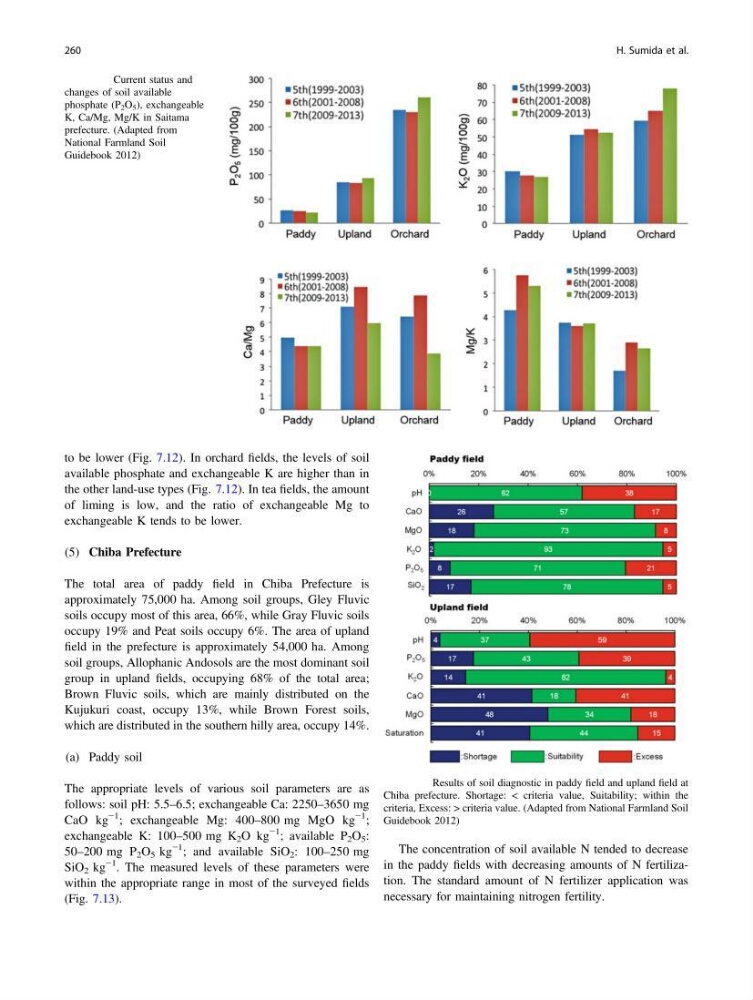
to be lower (Fig. 7.12). In orchard fields, the levels of soil
available phosphate and exchangeable K are higher than in
the other land-use types (Fig. 7.12). In tea fields, the amount
of liming is low, and the ratio of exchangeable Mg to
exchangeable K tends to be lower.
(5) Chiba Prefecture
The total area of paddy field in Chiba Prefecture is
approximately 75,000 ha. Among soil groups, Gley Fluvic
soils occupy most of this area, 66%, while Gray Fluvic soils
occupy 19% and Peat soils occupy 6%. The area of upland
field in the prefecture is approximately 54,000 ha. Among
soil groups, Allophanic Andosols are the most dominant soil
group in upland fields, occupying 68% of the total area;
Brown Fluvic soils, which are mainly distributed on the
Kujukuri coast, occupy 13%, while Brown Forest soils,
which are distributed in the southern hilly area, occupy 14%.
(a) Paddy soil
The appropriate levels of various soil parameters are as
follows: soil pH: 5.5–6.5; exchangeable Ca: 2250–3650 mg
CaO kg
−1 ; exchangeable Mg: 400–800 mg MgO kg
−1 ;
exchangeable K: 100–500 mg K 2 O kg
−1 ; available P 2 O 5 :
50–200 mg P 2 O 5 kg
−1 ; and available SiO 2 : 100–250 mg
SiO 2 kg
−1 . The measured levels of these parameters were
within the appropriate range in most of the surveyed fields
(Fig. 7.13).
The concentration of soil available N tended to decrease
in the paddy fields with decreasing amounts of N fertilization. The standard amount of N fertilizer application was
necessary for maintaining nitrogen fertility.
Fig. 7.12 Current status and
changes of soil available
phosphate (P 2 O 5 ), exchangeable
K, Ca/Mg, Mg/K in Saitama
prefecture. (Adapted from
National Farmland Soil
Guidebook 2012)
Fig. 7.13 Results of soil diagnostic in paddy field and upland field at
Chiba prefecture. Shortage: < criteria value, Suitability; within the
criteria, Excess: > criteria value. (Adapted from National Farmland Soil
Guidebook 2012)
260
H. Sumida et al.
available phosphate and exchangeable K are higher than in
the other land-use types (Fig. 7.12). In tea fields, the amount
of liming is low, and the ratio of exchangeable Mg to
exchangeable K tends to be lower.
(5) Chiba Prefecture
The total area of paddy field in Chiba Prefecture is
approximately 75,000 ha. Among soil groups, Gley Fluvic
soils occupy most of this area, 66%, while Gray Fluvic soils
occupy 19% and Peat soils occupy 6%. The area of upland
field in the prefecture is approximately 54,000 ha. Among
soil groups, Allophanic Andosols are the most dominant soil
group in upland fields, occupying 68% of the total area;
Brown Fluvic soils, which are mainly distributed on the
Kujukuri coast, occupy 13%, while Brown Forest soils,
which are distributed in the southern hilly area, occupy 14%.
(a) Paddy soil
The appropriate levels of various soil parameters are as
follows: soil pH: 5.5–6.5; exchangeable Ca: 2250–3650 mg
CaO kg
−1 ; exchangeable Mg: 400–800 mg MgO kg
−1 ;
exchangeable K: 100–500 mg K 2 O kg
−1 ; available P 2 O 5 :
50–200 mg P 2 O 5 kg
−1 ; and available SiO 2 : 100–250 mg
SiO 2 kg
−1 . The measured levels of these parameters were
within the appropriate range in most of the surveyed fields
(Fig. 7.13).
The concentration of soil available N tended to decrease
in the paddy fields with decreasing amounts of N fertilization. The standard amount of N fertilizer application was
necessary for maintaining nitrogen fertility.
Fig. 7.12 Current status and
changes of soil available
phosphate (P 2 O 5 ), exchangeable
K, Ca/Mg, Mg/K in Saitama
prefecture. (Adapted from
National Farmland Soil
Guidebook 2012)
Fig. 7.13 Results of soil diagnostic in paddy field and upland field at
Chiba prefecture. Shortage: < criteria value, Suitability; within the
criteria, Excess: > criteria value. (Adapted from National Farmland Soil
Guidebook 2012)
260
H. Sumida et al.