

characteristics of tephra for identification, tephra age, source
volcano, volcanic parameters, and tephra chronostratigraphic
position (Machida and Arai 2003).
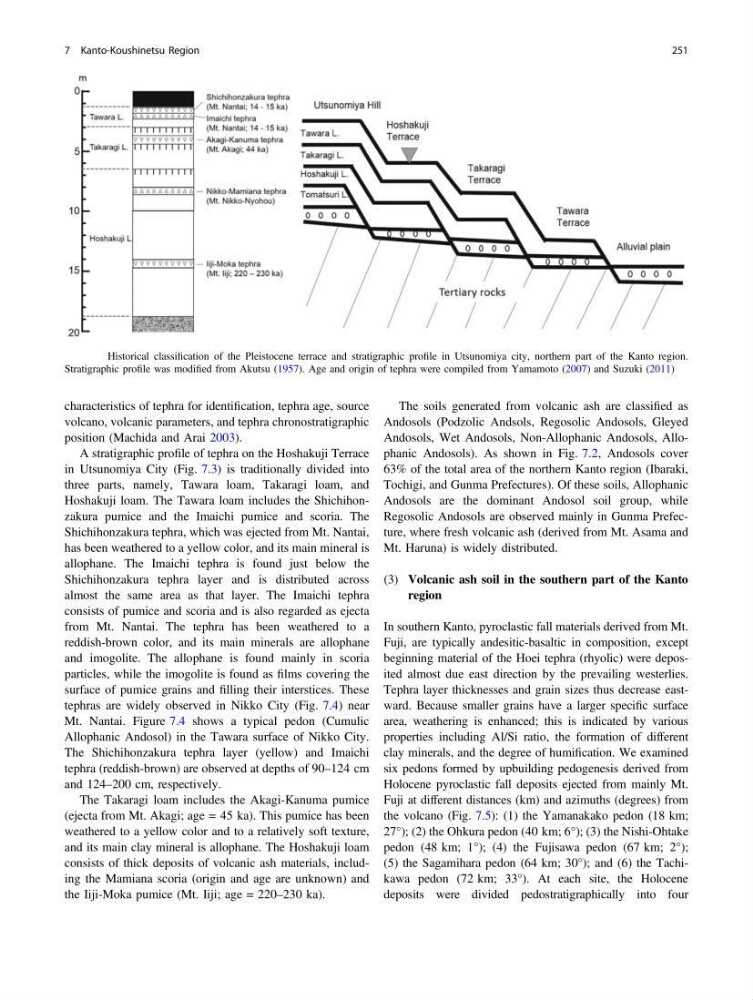
A stratigraphic profile of tephra on the Hoshakuji Terrace
in Utsunomiya City (Fig. 7.3) is traditionally divided into
three parts, namely, Tawara loam, Takaragi loam, and
Hoshakuji loam. The Tawara loam includes the Shichihonzakura pumice and the Imaichi pumice and scoria. The
Shichihonzakura tephra, which was ejected from Mt. Nantai,
has been weathered to a yellow color, and its main mineral is
allophane. The Imaichi tephra is found just below the
Shichihonzakura tephra layer and is distributed across
almost the same area as that layer. The Imaichi tephra
consists of pumice and scoria and is also regarded as ejecta
from Mt. Nantai. The tephra has been weathered to a
reddish-brown color, and its main minerals are allophane
and imogolite. The allophane is found mainly in scoria
particles, while the imogolite is found as films covering the
surface of pumice grains and filling their interstices. These
tephras are widely observed in Nikko City (Fig. 7.4) near
Mt. Nantai. Figure 7.4 shows a typical pedon (Cumulic
Allophanic Andosol) in the Tawara surface of Nikko City.
The Shichihonzakura tephra layer (yellow) and Imaichi
tephra (reddish-brown) are observed at depths of 90–124 cm
and 124–200 cm, respectively.
The Takaragi loam includes the Akagi-Kanuma pumice
(ejecta from Mt. Akagi; age = 45 ka). This pumice has been
weathered to a yellow color and to a relatively soft texture,
and its main clay mineral is allophane. The Hoshakuji loam
consists of thick deposits of volcanic ash materials, including the Mamiana scoria (origin and age are unknown) and
the Iiji-Moka pumice (Mt. Iiji; age = 220–230 ka).
The soils generated from volcanic ash are classified as
Andosols (Podzolic Andsols, Regosolic Andosols, Gleyed
Andosols, Wet Andosols, Non-Allophanic Andosols, Allophanic Andosols). As shown in Fig. 7.2, Andosols cover
63% of the total area of the northern Kanto region (Ibaraki,
Tochigi, and Gunma Prefectures). Of these soils, Allophanic
Andosols are the dominant Andosol soil group, while
Regosolic Andosols are observed mainly in Gunma Prefecture, where fresh volcanic ash (derived from Mt. Asama and
Mt. Haruna) is widely distributed.
(3) Volcanic ash soil in the southern part of the Kanto
region
In southern Kanto, pyroclastic fall materials derived from Mt.
Fuji, are typically andesitic-basaltic in composition, except
beginning material of the Hoei tephra (rhyolic) were deposited almost due east direction by the prevailing westerlies.
Tephra layer thicknesses and grain sizes thus decrease eastward. Because smaller grains have a larger specific surface
area, weathering is enhanced; this is indicated by various
properties including Al/Si ratio, the formation of different
clay minerals, and the degree of humification. We examined
six pedons formed by upbuilding pedogenesis derived from
Holocene pyroclastic fall deposits ejected from mainly Mt.
Fuji at different distances (km) and azimuths (degrees) from
the volcano (Fig. 7.5): (1) the Yamanakako pedon (18 km;
27°); (2) the Ohkura pedon (40 km; 6°); (3) the Nishi-Ohtake
pedon (48 km; 1°); (4) the Fujisawa pedon (67 km; 2°);
(5) the Sagamihara pedon (64 km; 30°); and (6) the Tachikawa pedon (72 km; 33°). At each site, the Holocene
deposits were divided pedostratigraphically into four
Fig. 7.3 Historical classification of the Pleistocene terrace and stratigraphic profile in Utsunomiya city, northern part of the Kanto region.
Stratigraphic profile was modified from Akutsu (1957). Age and origin of tephra were compiled from Yamamoto (2007) and Suzuki (2011)
7 Kanto-Koushinetsu Region
251
volcano, volcanic parameters, and tephra chronostratigraphic
position (Machida and Arai 2003).
A stratigraphic profile of tephra on the Hoshakuji Terrace
in Utsunomiya City (Fig. 7.3) is traditionally divided into
three parts, namely, Tawara loam, Takaragi loam, and
Hoshakuji loam. The Tawara loam includes the Shichihonzakura pumice and the Imaichi pumice and scoria. The
Shichihonzakura tephra, which was ejected from Mt. Nantai,
has been weathered to a yellow color, and its main mineral is
allophane. The Imaichi tephra is found just below the
Shichihonzakura tephra layer and is distributed across
almost the same area as that layer. The Imaichi tephra
consists of pumice and scoria and is also regarded as ejecta
from Mt. Nantai. The tephra has been weathered to a
reddish-brown color, and its main minerals are allophane
and imogolite. The allophane is found mainly in scoria
particles, while the imogolite is found as films covering the
surface of pumice grains and filling their interstices. These
tephras are widely observed in Nikko City (Fig. 7.4) near
Mt. Nantai. Figure 7.4 shows a typical pedon (Cumulic
Allophanic Andosol) in the Tawara surface of Nikko City.
The Shichihonzakura tephra layer (yellow) and Imaichi
tephra (reddish-brown) are observed at depths of 90–124 cm
and 124–200 cm, respectively.
The Takaragi loam includes the Akagi-Kanuma pumice
(ejecta from Mt. Akagi; age = 45 ka). This pumice has been
weathered to a yellow color and to a relatively soft texture,
and its main clay mineral is allophane. The Hoshakuji loam
consists of thick deposits of volcanic ash materials, including the Mamiana scoria (origin and age are unknown) and
the Iiji-Moka pumice (Mt. Iiji; age = 220–230 ka).
The soils generated from volcanic ash are classified as
Andosols (Podzolic Andsols, Regosolic Andosols, Gleyed
Andosols, Wet Andosols, Non-Allophanic Andosols, Allophanic Andosols). As shown in Fig. 7.2, Andosols cover
63% of the total area of the northern Kanto region (Ibaraki,
Tochigi, and Gunma Prefectures). Of these soils, Allophanic
Andosols are the dominant Andosol soil group, while
Regosolic Andosols are observed mainly in Gunma Prefecture, where fresh volcanic ash (derived from Mt. Asama and
Mt. Haruna) is widely distributed.
(3) Volcanic ash soil in the southern part of the Kanto
region
In southern Kanto, pyroclastic fall materials derived from Mt.
Fuji, are typically andesitic-basaltic in composition, except
beginning material of the Hoei tephra (rhyolic) were deposited almost due east direction by the prevailing westerlies.
Tephra layer thicknesses and grain sizes thus decrease eastward. Because smaller grains have a larger specific surface
area, weathering is enhanced; this is indicated by various
properties including Al/Si ratio, the formation of different
clay minerals, and the degree of humification. We examined
six pedons formed by upbuilding pedogenesis derived from
Holocene pyroclastic fall deposits ejected from mainly Mt.
Fuji at different distances (km) and azimuths (degrees) from
the volcano (Fig. 7.5): (1) the Yamanakako pedon (18 km;
27°); (2) the Ohkura pedon (40 km; 6°); (3) the Nishi-Ohtake
pedon (48 km; 1°); (4) the Fujisawa pedon (67 km; 2°);
(5) the Sagamihara pedon (64 km; 30°); and (6) the Tachikawa pedon (72 km; 33°). At each site, the Holocene
deposits were divided pedostratigraphically into four
Fig. 7.3 Historical classification of the Pleistocene terrace and stratigraphic profile in Utsunomiya city, northern part of the Kanto region.
Stratigraphic profile was modified from Akutsu (1957). Age and origin of tephra were compiled from Yamamoto (2007) and Suzuki (2011)
7 Kanto-Koushinetsu Region
251